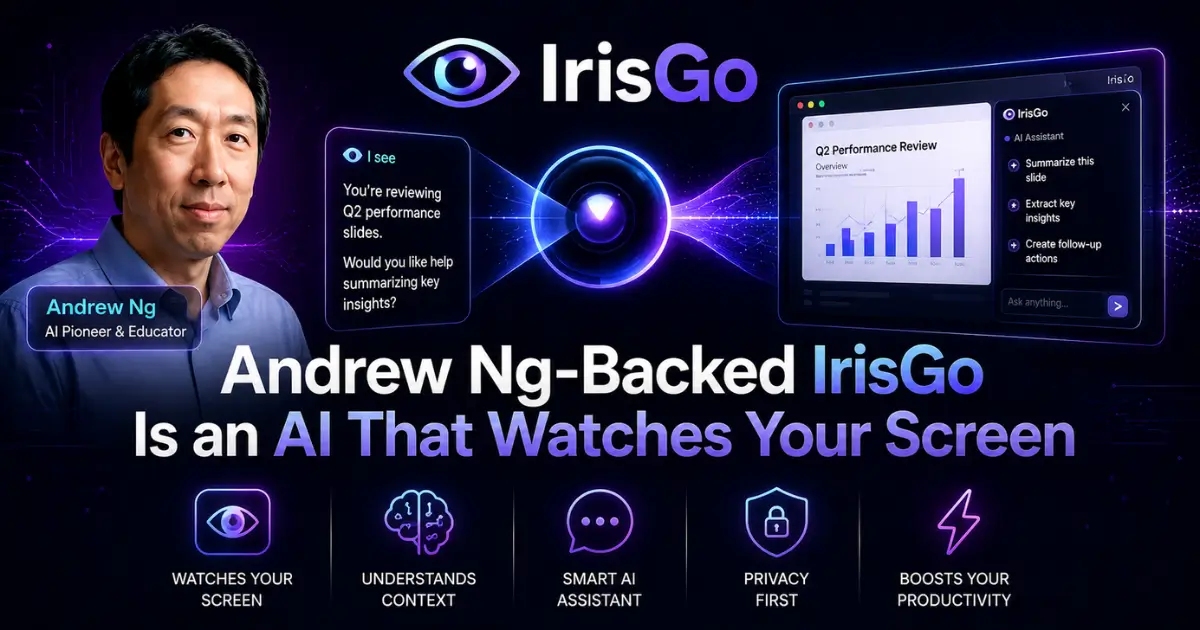
IrisGo, a startup backed by AI luminary Andrew Ng, has launched an AI desktop companion that watches your screen and helps you work. The app sits in the background, understands what you are looking at, and answers questions about your current context — whether that is a spreadsheet, a code editor, a research paper, or a design tool. It is not a chatbot you switch to. It is an assistant that is already watching.
How IrisGo Works
IrisGo runs as a lightweight desktop application on Mac and Windows. Once activated, it continuously processes what is visible on the user's screen. When you need help, you invoke IrisGo with a keyboard shortcut. The assistant already knows what you are looking at. You do not need to copy text, upload screenshots, or describe your context. The AI has been watching the whole time.
Users can ask questions about the content on screen. "What does this error mean?" "Summarize this document." "How do I fix this formula?" "What is the argument in this paper?" The AI responds with context-aware answers that would be impossible without screen understanding.
The app also supports proactive suggestions. If IrisGo detects a coding error, it can flag it before you ask. If a document contains inconsistencies, it can highlight them. The proactive mode is optional — users who prefer reactive-only assistance can disable it.
Why This Approach Is Different
Most AI assistants require explicit context. You open ChatGPT or Claude. You paste your text. You describe your problem. You wait for a response. The process works but interrupts your workflow. Every interaction requires switching windows, formatting input, and translating between what you see and what the AI needs to understand.
IrisGo eliminates that friction. The AI sees what you see. It understands your context without being told. And it responds within the application you are already using rather than forcing you into a separate interface.
The approach connects to what several companies are building. Perplexity Computer controls your Mac autonomously. Microsoft Copilot embeds AI inside Office apps. Google's Gemini Spark monitors Gmail and Calendar proactively. And Anthropic's Cat Wu described a future where Claude anticipates needs before you ask.
IrisGo occupies a middle ground. It does not take control of your computer like Perplexity. It does not limit itself to one app like Copilot. It watches everything and helps with anything — a universal AI layer that works across all applications.
The Andrew Ng Connection
Ng's backing gives IrisGo instant credibility. He is one of the most respected figures in AI — co-founder of Google Brain, former chief scientist at Baidu, and founder of Coursera and DeepLearning.AI. His investment signals that the screen-aware AI assistant category has serious potential.
Ng has been particularly focused on AI tools that augment human capability rather than replace it. IrisGo fits that thesis precisely. It does not do your work for you. It helps you do your work better by understanding what you are doing and providing relevant assistance in real time.
The Privacy Challenge
An AI that watches your screen raises immediate and obvious privacy concerns. The app can see everything — emails, messages, financial data, medical records, passwords, personal photos. For individual users, the tradeoff between convenience and privacy is a personal decision. For enterprise users, it is a security question.
IrisGo says all processing happens locally on the device. Screen content is not uploaded to external servers. The AI runs on-device models for screen understanding and connects to cloud APIs only for complex queries that require frontier model capabilities. Users can configure which applications IrisGo can see and which are excluded.
Whether those protections satisfy enterprise security teams will determine how far IrisGo penetrates the corporate market. The same concerns apply to every screen-aware AI tool — from Perplexity Computer to Apple's rumored AI-enhanced OS features. The companies that solve the privacy-utility tradeoff most convincingly will win this market.
The Desktop AI Race
IrisGo enters a crowded field. Perplexity Computer is free on Mac. Skye is reimagining the phone home screen as an AI surface. Notion just launched a developer platform connecting external AI agents. And every major platform — Google, Microsoft, Apple — is embedding AI deeper into its operating system.
IrisGo's bet is that none of these solutions provides the universal, cross-application screen awareness that users actually need. Copilot works in Office. Gemini works in Google apps. IrisGo works everywhere. Whether that horizontal approach beats the vertical integration of platform-native AI is the central competitive question.
The Bigger Picture
IrisGo represents a vision of AI that is ambient rather than active. You do not open an AI app. You do not type a prompt. The AI is simply present — understanding your work, anticipating your questions, and helping when you need it. That vision is shared by Anthropic, Google, and Microsoft. IrisGo is trying to get there first with a standalone product that works across every platform and every application.
Whether users embrace an AI that watches their screen all day — or find it creepy — will determine whether IrisGo becomes essential desktop software or an interesting experiment that the market was not ready for.