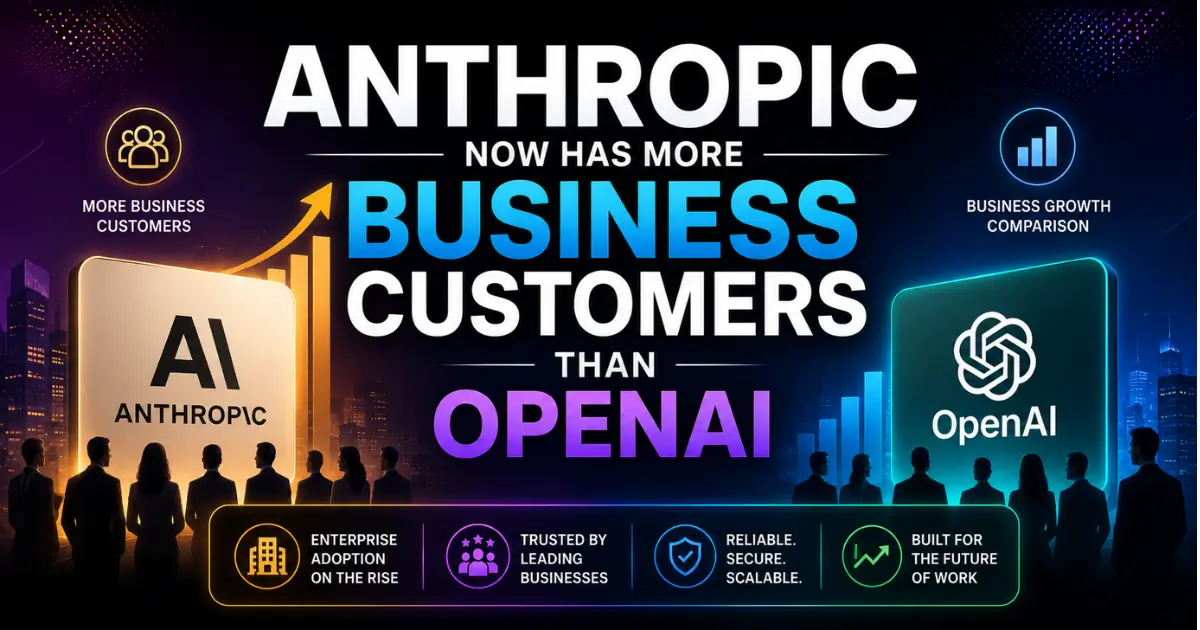
Anthropic has overtaken OpenAI in the number of business customers for the first time. Corporate spending data from Ramp — one of the largest corporate card platforms in the US — shows that more companies are now paying for Anthropic products than for OpenAI. The milestone validates what enterprise revenue data has been suggesting for months: Anthropic is winning the business market.
What the Data Shows
Ramp processes billions of dollars in corporate spending annually. Its data captures what companies actually pay for — not what they say they use in surveys. The platform shows that the number of businesses paying for Anthropic products has surpassed the number paying for OpenAI for the first time.
The shift did not happen overnight. Anthropic's business customer count has been climbing steadily since Claude Code launched. The coding tool became the dominant choice among enterprise developers. Vendor after vendor at the HumanX conference described OpenAI as having gone downhill while praising Claude's reliability and capabilities.
The Ramp data provides independent third-party confirmation of that trend. It is not based on self-reported surveys or company press releases. It is based on actual credit card transactions.
Why Business Customers Matter More Than Users
OpenAI still has far more total users. ChatGPT serves over 400 million people. But the majority are free-tier consumers. Business customers generate higher revenue per account, have lower churn, and produce more predictable income.
Anthropic has said roughly 80 percent of its revenue comes from enterprise customers. OpenAI's revenue is more heavily weighted toward consumer subscriptions. The Ramp data suggests the enterprise gap is widening — with more companies choosing to pay for Claude than for ChatGPT or the OpenAI API.
The distinction matters for valuation. Anthropic is raising $50 billion at up to $900 billion. OpenAI last raised at $852 billion. If Anthropic has both higher enterprise revenue and more business customers, the valuation premium becomes easier to justify.
What Drove the Shift
Several factors explain the crossover. Claude Code's dominance among developers created a pull effect. When engineering teams adopt Claude, the rest of the organization often follows. Anthropic's enterprise joint venture with Blackstone and Goldman Sachs added embedded deployment capabilities. Its Claude for Legal expansion targeted high-value verticals. And its Mythos cybersecurity capabilities attracted security-conscious enterprises.
OpenAI has responded aggressively. GPT-5.5 and GPT-5.5 Instant delivered performance improvements. Codex Labs embedded OpenAI engineers inside enterprise clients through IT partners. The Microsoft renegotiation freed OpenAI to serve customers on any cloud. And a $10 billion enterprise joint venture was launched the same day as Anthropic's.
But the Ramp data suggests those moves have not yet reversed the trend. Business customers are choosing Anthropic at a faster rate than they are choosing OpenAI.
The Copilot Factor
Microsoft Copilot complicates the picture. Many businesses access OpenAI's models through Copilot rather than paying OpenAI directly. Those transactions may not appear in Ramp's data as OpenAI spending. If Copilot's 20 million paid users are counted, OpenAI's effective enterprise footprint is much larger than direct payments suggest.
But the counterargument is that Copilot revenue goes to Microsoft, not OpenAI. And Microsoft now uses multiple models including Claude in Copilot. The lines between OpenAI customers and Microsoft customers are blurring — which may actually benefit Anthropic more than OpenAI in the long run.
What It Means
The Ramp data is a single data point from one corporate spending platform. It does not capture every business customer. But it reflects real spending by real companies. And the signal is clear: Anthropic is no longer the challenger in enterprise AI. It is becoming the default.
For the AI industry, the milestone marks a turning point. OpenAI created the market. Anthropic is winning it. Whether OpenAI can recapture enterprise momentum — or whether the shift becomes permanent — will define the competitive landscape for years to come.