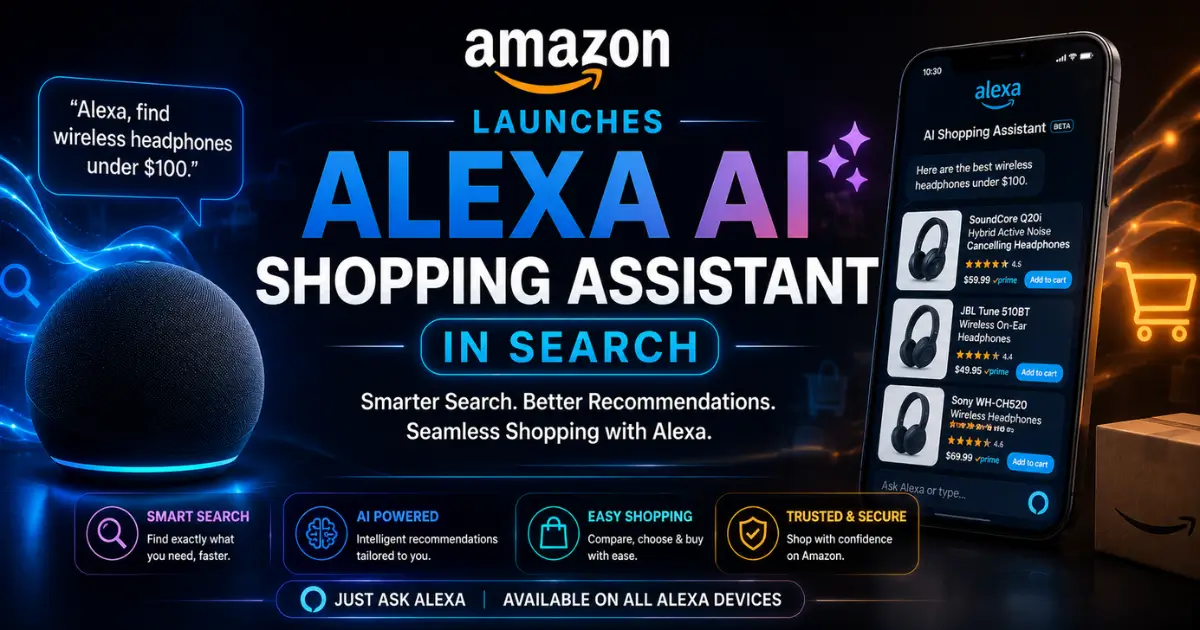
Amazon has embedded an AI shopping assistant directly into its search bar. Powered by Alexa, the feature lets shoppers ask conversational questions instead of typing keywords. Users can describe what they need in natural language — "waterproof hiking boots under $100 for wide feet" — and the AI returns personalized product recommendations with explanations for why each item matches.
How It Works
The new search experience appears at the top of Amazon's app and website. Instead of the traditional keyword search, users see a prompt inviting them to describe what they are looking for. The AI processes the query and returns a curated set of products with brief explanations highlighting why each was selected.
The system factors in the user's purchase history, browsing behavior, reviews, and product specifications. A returning customer who has bought running gear before will get different recommendations than a first-time visitor searching for the same category.
The feature builds on Amazon's earlier AI audio Q&A for product pages. That tool let shoppers ask spoken questions about individual products. The new search assistant operates at the discovery layer — helping users find the right products before they reach a product page.
Why Amazon Needs This
Amazon's search experience has been widely criticized for years. Sponsored listings dominate the first screen of results. Organic rankings are manipulated by sellers using aggressive SEO tactics. And the sheer volume of products — over 350 million — makes finding the right item genuinely difficult.
The AI assistant is designed to cut through that noise. Instead of showing 50 results ranked by a combination of relevance and ad spend, the AI presents a small number of highly relevant recommendations with natural language explanations. The experience is closer to asking a knowledgeable salesperson for advice than scrolling through a warehouse.
The shift mirrors what Google is doing with AI search — replacing link-based results with conversational answers. And it connects to the broader trend of AI agents handling tasks that previously required human judgment or manual browsing.
The Advertising Question
The biggest unresolved question is how advertising works inside AI-powered search. Amazon generates over $50 billion annually from advertising. Most of that comes from sponsored product placements in search results. If the AI assistant returns five curated recommendations instead of 50 search results, the available ad inventory shrinks dramatically.
Amazon has not disclosed how sponsored products will integrate with the AI assistant. But the tension is real. An AI that genuinely recommends the best products for each user may conflict with an advertising model that prioritizes products from sellers who pay the most.
The same tension exists at Google, where AI Overviews are reducing clicks to traditional search results — and the advertising that accompanies them. For Amazon, the stakes are even higher because product search is the company's core commerce experience.
Part of Amazon's AI Commerce Stack
The shopping assistant joins a growing suite of AI tools Amazon is deploying across its platform. AI-generated review summaries. AI-powered size recommendations. AI audio Q&A on product pages. And AI tools for sellers that generate product listings automatically.
Amazon is also investing heavily in AI infrastructure. AWS reported its fastest growth in 15 quarters. Amazon's custom Graviton chips are winning major enterprise customers. And the company's total AI investments — including $13 billion in Anthropic and $50 billion in OpenAI — position it as one of the largest AI spenders in the world.
The shopping assistant is where all that infrastructure meets the consumer. Every Alexa-powered recommendation requires inference compute. Every personalized search result draws on AI models trained on billions of transactions. The technology stack that powers enterprise AI also powers what you see when you search for hiking boots.
The Competition
Amazon is not the only company pursuing AI-powered shopping. Google Shopping has integrated Gemini-powered recommendations. Anthropic's agent marketplace tested AI agents that buy and sell on behalf of users. And startups are building AI shopping assistants that work across multiple retailers.
Amazon's advantage is data. No other company has the purchase history, review corpus, and behavioral data that Amazon has accumulated over three decades. An AI trained on that data can make recommendations that generic shopping assistants cannot match.
The Bigger Picture
Amazon's AI search assistant is a significant step toward a future where shopping is conversational rather than browsable. Instead of scanning pages of results, users describe what they want. The AI finds it. That shift could make shopping faster and more satisfying for consumers. It could also reshape how sellers, advertisers, and the entire e-commerce ecosystem operates.
The search bar just got smarter. Whether it also stays fair is the question Amazon has not yet answered.