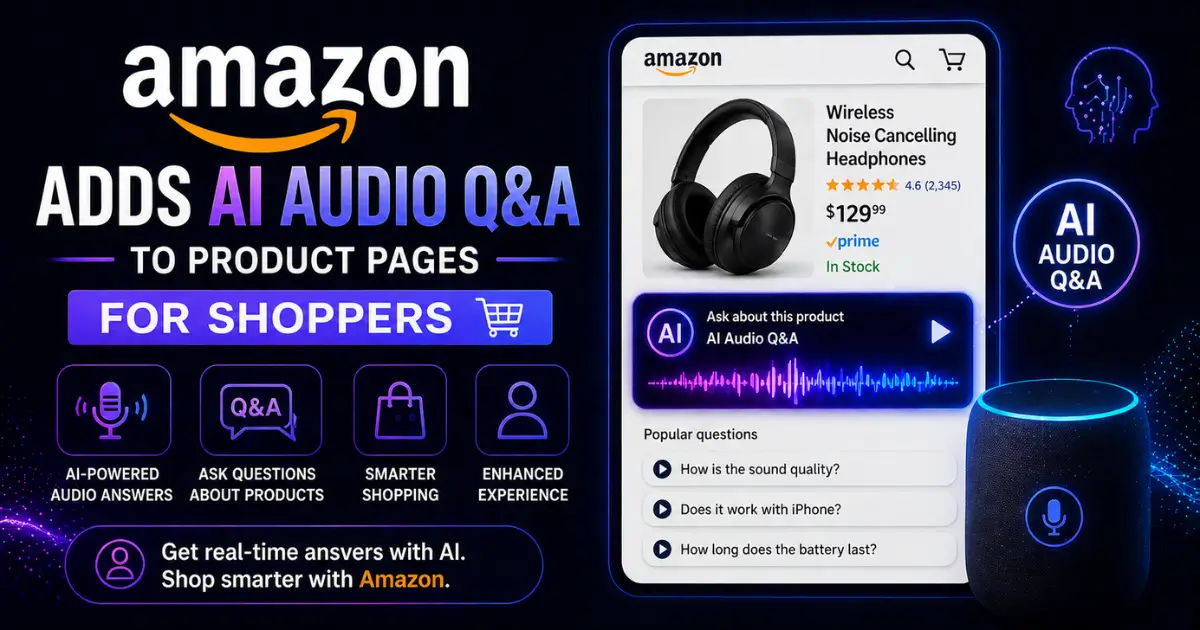
Amazon has launched an AI-powered audio feature on its product pages that lets shoppers ask questions about products and hear AI-generated spoken answers. Instead of scrolling through reviews, specifications, and customer Q&A sections, users can now tap a button and ask what they want to know. The AI responds with a synthesized voice answer drawn from product listings, reviews, and customer feedback.
How It Works
The feature appears as an "Ask" button on product pages in the Amazon app. Users tap it and speak or type a question. The AI processes the query, pulls relevant information from the product listing, verified purchase reviews, and existing Q&A sections, then delivers a spoken response.
The answers are conversational rather than robotic. Amazon's AI synthesizes information from multiple sources into a coherent response. If a user asks whether a backpack fits a 15-inch laptop, the AI might pull from the product specs, three relevant reviews, and a manufacturer response to deliver a single clear answer.
The feature works on both iOS and Android. It is currently rolling out in the US market.
Why Audio Matters
Amazon's product pages have become bloated. A typical listing includes dozens of images, bullet-point specs, hundreds of reviews, a Q&A section, comparison charts, and sponsored recommendations. Finding the specific information you need often requires significant scrolling and reading.
Audio Q&A compresses that process. Instead of spending five minutes reading reviews to figure out whether a pair of running shoes runs narrow, a user can ask and get a direct answer in seconds. The format is especially useful on mobile, where screen size makes long product pages even harder to navigate.
The feature also connects to a broader shift toward voice-based AI interactions. As AI assistants become more conversational, users are increasingly comfortable speaking to their devices rather than typing. Amazon's Alexa has trained hundreds of millions of users to interact with AI through voice. Bringing that interaction model to product pages is a natural extension.
The Trust Question
AI-generated product answers raise immediate questions about reliability. Amazon's review ecosystem is already plagued by fake reviews, incentivized ratings, and manipulated Q&A sections. If the AI generates answers from compromised source material, the spoken responses will sound authoritative while potentially being misleading.
Amazon says the feature uses only verified purchase reviews and official product information. But the distinction between verified and trustworthy is not always clear. A verified purchase review can still be incentivized or biased. The AI has no way to judge the sincerity of a review — only its content.
The trust problem that affects AI chatbots in healthcare and other domains applies equally to commerce. When an AI confidently tells you a product is waterproof based on reviews, and the product turns out not to be, the trust violation feels more personal than reading a misleading review yourself.
Part of Amazon's AI Commerce Push
The audio Q&A feature joins a growing suite of AI tools Amazon is deploying across its commerce platform. The company has already launched AI-generated review summaries, AI-powered size recommendations for clothing, and AI product listing tools for sellers.
Amazon is also pushing aggressively into AI infrastructure. Its Graviton and Trainium chips are winning major customers including Meta and Anthropic. AWS remains the world's largest cloud provider. And Amazon's total AI investment now exceeds $50 billion across OpenAI, Anthropic, and its own internal projects.
The commerce AI features serve a different purpose. They are designed to increase conversion rates — turning browsers into buyers by removing friction from the shopping experience. If audio Q&A helps users make purchase decisions faster, it pays for itself through higher sales.
The Bigger Picture
Amazon's AI audio feature is a small product update with broader implications. It signals that AI is moving beyond chatbot interfaces into embedded experiences that meet users inside the apps they already use. You do not open an AI assistant and ask about a product. You ask the product page directly.
As Google, Apple, and every major tech platform embed AI into their existing products, the standalone AI app may become less important than the AI layer running invisibly inside everything else. Amazon's product page just got a voice. The question is whether shoppers trust what it says.