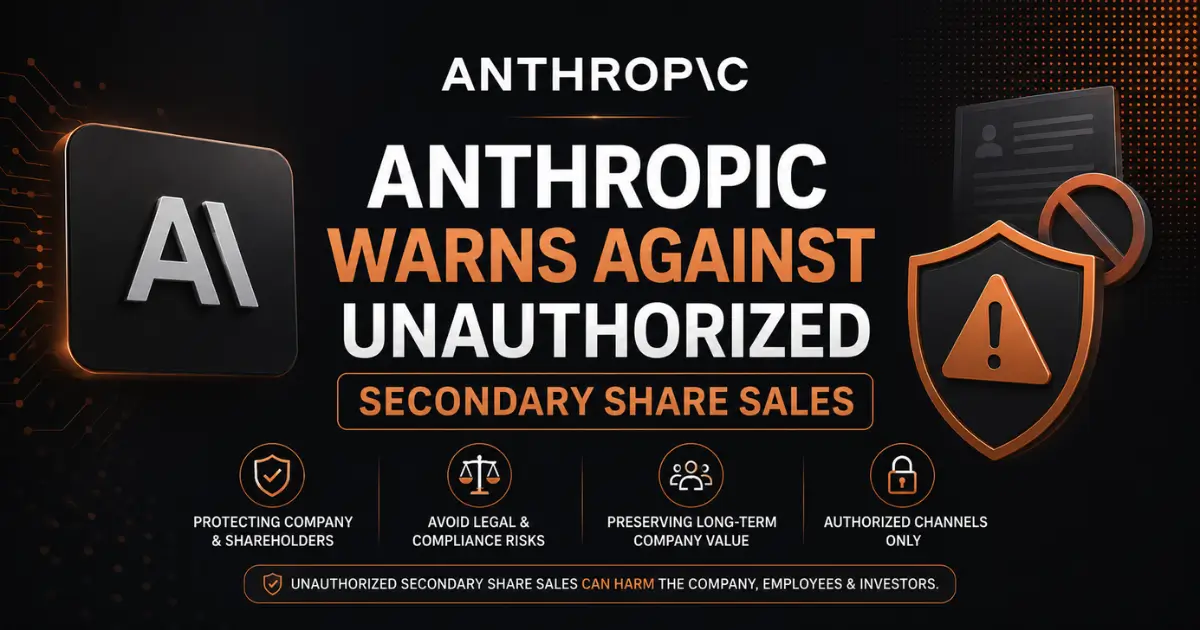
Anthropic has sent a warning to investors: do not buy shares through unauthorized secondary platforms. The company says multiple platforms are offering access to Anthropic equity without the company's approval. Some may be fraudulent. Others may hold legitimate shares but lack the legal standing to transfer them. The warning comes as Anthropic's valuation approaches $900 billion and demand for its shares has reached fever pitch.
What Is Happening
As Anthropic's valuation has skyrocketed, a secondary market has emerged where platforms offer accredited investors access to pre-IPO shares. Some of these platforms aggregate small investor commitments into special purpose vehicles that hold Anthropic stock. Others claim to offer direct share purchases.
Anthropic says many of these platforms are operating without the company's knowledge or consent. The company cannot verify whether the shares being offered are real, whether the legal structures are sound, or whether investors would actually own what they think they are buying.
The problem is not unique to Anthropic. Secondary markets for pre-IPO shares have existed for years. But the scale of demand for Anthropic equity — driven by its revenue growth, Claude Code dominance, and potential IPO — has created an unusually fertile environment for unauthorized offerings.
Why Demand Is So Intense
Anthropic is one of the most sought-after private companies in the world. Its annualized revenue run rate is approaching $40 billion. It has secured over $50 billion from Amazon and Google combined. It recently launched enterprise joint ventures with Blackstone and Goldman Sachs. And its Mythos model just demonstrated transformative cybersecurity capabilities at Mozilla.
An investor who buys at $900 billion and Anthropic IPOs at $1.5 trillion makes a 67 percent return. That potential drives enormous demand — and creates opportunities for platforms that may not have investors' best interests in mind.
The situation mirrors what happened with OpenAI's secondary market. As OpenAI's valuation climbed to $852 billion, unauthorized platforms offered shares with varying degrees of legitimacy. Several investors later discovered their holdings were legally questionable.
The IPO Timeline
Anthropic's warning may also be a signal about its IPO timeline. Companies typically crack down on unauthorized secondary trading as they approach a public offering. Cleaning up the cap table — ensuring every shareholder is properly documented and legally authorized — is a prerequisite for a successful IPO.
Reports have suggested Anthropic could go public as soon as October. A $50 billion fundraise at $900 billion would likely be its final private round. The secondary market warning fits that timeline — the company is putting its house in order.
What Investors Should Know
Anthropic's message to potential investors is straightforward. Only buy shares through channels the company has authorized. Verify the legitimacy of any platform offering pre-IPO access. And understand that unauthorized SPVs may carry legal, tax, and ownership risks that are not immediately apparent.
The company did not name specific platforms in its warning. But the breadth of the statement suggests the problem is widespread enough to warrant a public response.
The Bigger Picture
The unauthorized secondary market for AI company shares is a side effect of the industry's extraordinary growth. When companies reach valuations of $500 billion to $1 trillion while remaining private, the demand for access outstrips the supply of authorized channels. Platforms that promise to bridge that gap — whether legitimately or not — will continue to proliferate.
For the AI industry, the episode highlights a tension that IPOs are designed to resolve. Public markets provide transparent, regulated access to company ownership. Private markets do not. As long as the most valuable AI companies remain private, the gap between investor demand and authorized access will create opportunities for platforms that operate in legal gray areas.
Anthropic's warning will not stop the demand. But it may protect some investors from making purchases they will later regret.