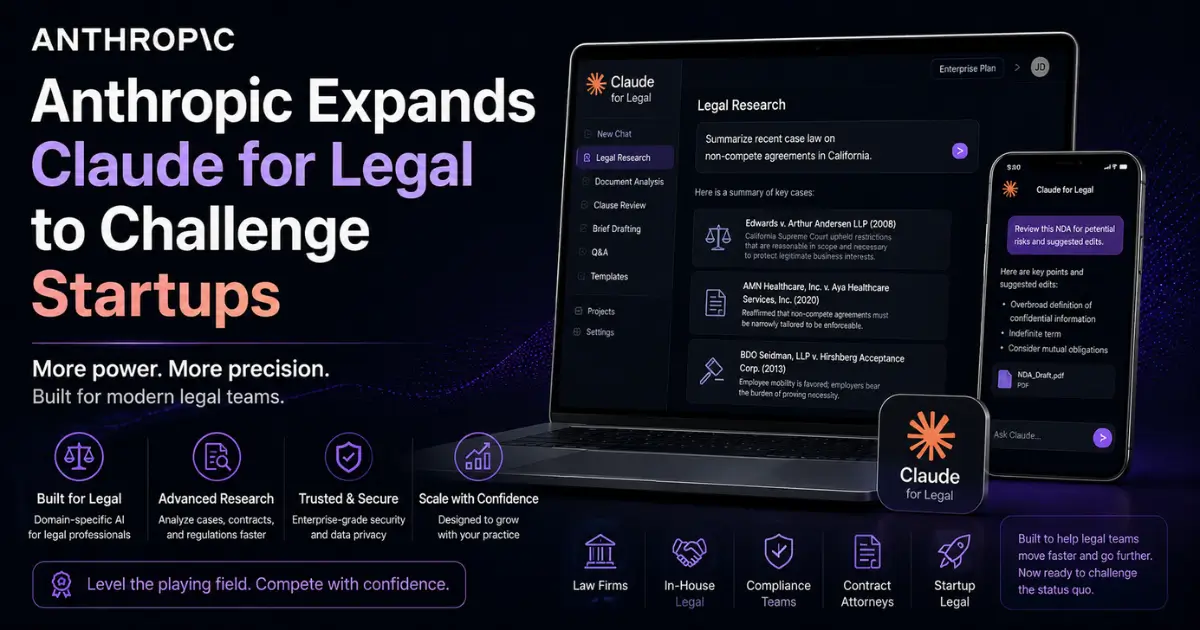
Anthropic is expanding its Claude for Legal offering with new plugins and MCP connectors designed for specific areas of law. The move puts Anthropic in direct competition with legal AI startups Legora and Harvey — and validates the fear those startups have been trying to dismiss: that the platform providers will eventually come for their market.
What Anthropic Launched
The new tools automate specific legal functions including document search and review, case law research, deposition preparation, and document drafting. Anthropic is offering field-specific plugins across commercial law, privacy, corporate, employment, product liability, and AI governance.
The company also launched MCP connectors that integrate Claude directly into software applications law firms already use. DocuSign for signatures. Box for file search. Thomson Reuters for Westlaw legal research. The connectors allow Claude to interact with these systems directly rather than requiring lawyers to copy and paste between tools.
The features are available to all paying Claude customers. They build on the original Claude for Legal plugin that Anthropic launched in February — a release that caused publicly listed legal software stocks to drop immediately.
Why This Threatens Legal AI Startups
The competitive implications are significant. Harvey raised $200 million at an $11 billion valuation. Legora reached $5.6 billion with Nvidia backing. Both companies built their businesses on the premise that legal work requires specialized AI that general-purpose models cannot replicate.
Anthropic's expansion challenges that premise directly. If Claude can handle document review, case research, and deposition prep through native plugins — without requiring a separate legal AI platform — the value proposition of standalone legal AI startups narrows considerably.
Legora CEO Max Junestrand has dismissed the platform risk, arguing that the real value is in how models are applied rather than the models themselves. But Anthropic's new MCP connectors integrate Claude into the exact same tools — Westlaw, DocuSign, Box — that legal AI startups connect to. The differentiation gap is shrinking.
The AI Legal Slop Problem
Anthropic's push into legal AI arrives amid growing chaos in courts caused by AI-generated legal work. Dozens of lawyers have been caught submitting AI-generated documents riddled with errors. California issued the first fine against an attorney who used ChatGPT to draft an appeal containing fabricated quotes. Federal judges have been caught using AI to draft rulings. And AI-generated lawsuits are overwhelming courts with poorly argued legal slop.
The problems echo the health chatbot reliability issues documented earlier this year. General-purpose AI tools produce confident but frequently wrong output. In healthcare, that means bad medical advice. In law, it means fabricated citations and nonsensical legal arguments submitted to real courts.
Anthropic's field-specific plugins are designed to address exactly this problem. By building tools tailored to specific areas of law rather than offering a general-purpose chatbot, Anthropic aims to reduce the hallucination and error rates that have made AI-generated legal work a liability.
The Bigger Battle
Anthropic's legal AI expansion is part of a broader pattern. The company is pushing Claude into vertical markets that legal, healthcare, and financial AI startups have been building in. Its enterprise joint venture with Blackstone and Goldman Sachs embeds Claude engineers directly inside client organizations. Its revenue is approaching $40 billion annualized. And its valuation may soon surpass OpenAI's.
For vertical AI startups, the message is clear. Building on top of Claude is a distribution advantage — until Anthropic decides to offer the same features natively. The legal AI market just learned that lesson. Healthcare and finance may be next.
What It Means
Anthropic's Claude for Legal expansion confirms that frontier AI companies are not content to sell general-purpose models through APIs. They are building vertical solutions that compete directly with the startups that built businesses on their platforms. The legal AI industry — valued at billions across Harvey, Legora, and others — just gained its most formidable competitor.