
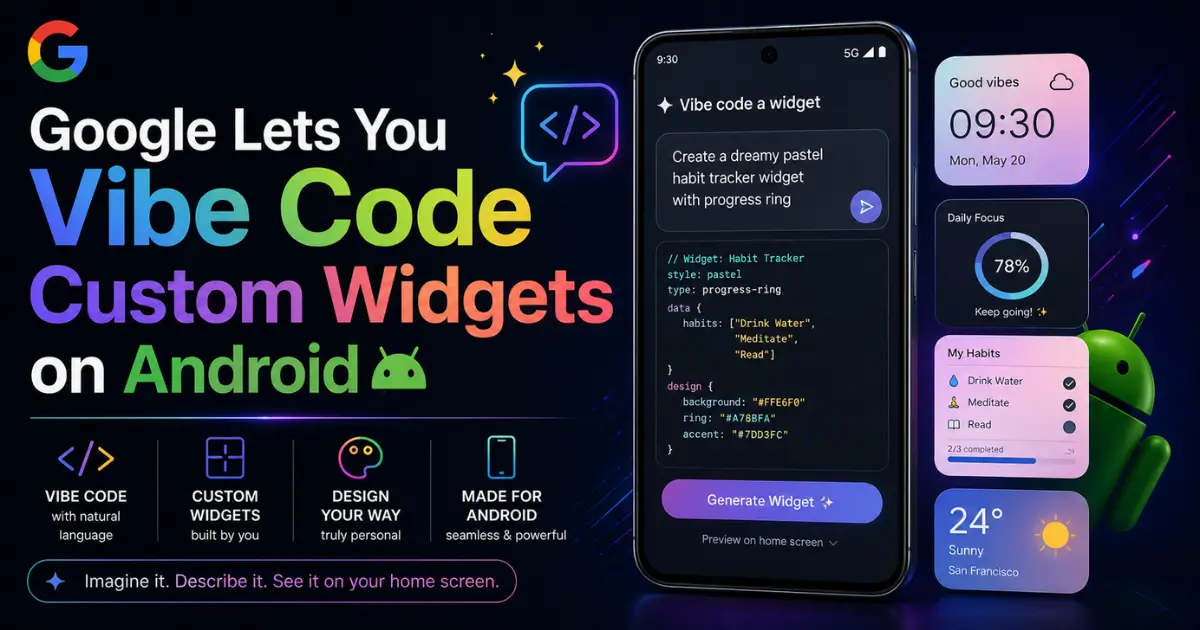
Google is launching a feature called Create My Widget that lets Android users build custom home screen widgets using natural language prompts. Instead of choosing from pre-made widgets, users describe what they want. Gemini AI generates it. The feature brings vibe coding from the developer workstation to the phone home screen — and it turns every Android user into a widget designer.
How It Works
Users open the widget picker on their Pixel phone and tap Create My Widget. They describe what they want in plain language. "Show me today's weather with my calendar events below it." "A countdown to my vacation." "A daily motivational quote with a pastel background." Gemini processes the prompt and generates a functional widget that appears on the home screen.
The widgets are interactive. They update dynamically. And users can refine them by giving Gemini follow-up instructions. "Make it smaller." "Change the color to dark blue." "Add a button that opens my email." Each iteration takes seconds.
The feature launches on Pixel devices first. A broader Android rollout is expected later this year. Google has not confirmed whether third-party Android manufacturers will get access at launch.
Why This Matters
The home screen is the most personal surface on any device. Until now, users could only choose from widgets that developers built. Create My Widget flips that model. Users describe what they want. The AI builds it. The widget is unique to each person.
The concept connects to what Skye is building on iPhone — an AI-powered home screen that surfaces personalized information through widgets. But where Skye is a third-party app working within Apple's constraints, Google is building the capability directly into the operating system. That gives Google a distribution advantage that no startup can match.
It also connects to the broader vibe coding movement. Lovable launched its vibe coding app on iOS and Android. Replit is approaching $1 billion in revenue by letting non-technical users build apps with prompts. And Apple is facing pressure from AI coding tools that let anyone create software. Google's Create My Widget is the most mainstream implementation yet — putting vibe coding in front of billions of Android users.
Part of Gemini Everywhere
The widget feature is another step in Google's strategy of embedding Gemini into every surface of the user experience. In recent weeks, Google has added Gemini to Chrome, Maps, Workspace, YouTube, Google TV, millions of vehicles, Photos, and search. The Android home screen is the last major surface that had not been Gemini-fied.
With Create My Widget, the home screen becomes an AI canvas. The phone is no longer a grid of static icons. It is a dynamically generated, personalized interface that adapts to what each user wants to see.
The Apple Comparison
Apple does not currently offer anything comparable. iOS widgets are pre-built by developers. Users can choose which widgets to display and where. But they cannot create new ones from scratch using natural language.
Apple's incoming CEO John Ternus has signaled a renewed focus on AI-powered hardware and software. But Apple's historically cautious approach to AI features means Google may have a significant head start on AI-generated home screen customization.
For Android users, the feature is a tangible reason to stay on the platform. If your phone can build custom widgets on command while your friend's iPhone cannot, that is a competitive advantage that matters in daily life — not just on spec sheets.
The Bigger Picture
Create My Widget sounds like a small feature. But it represents something larger. It is the moment vibe coding reaches the mainstream. Not developers. Not power users. Everyone with a Pixel phone. Describe what you want. The AI builds it. That is the promise the entire AI industry has been making for years. Google just made it real on the most personal screen people own.