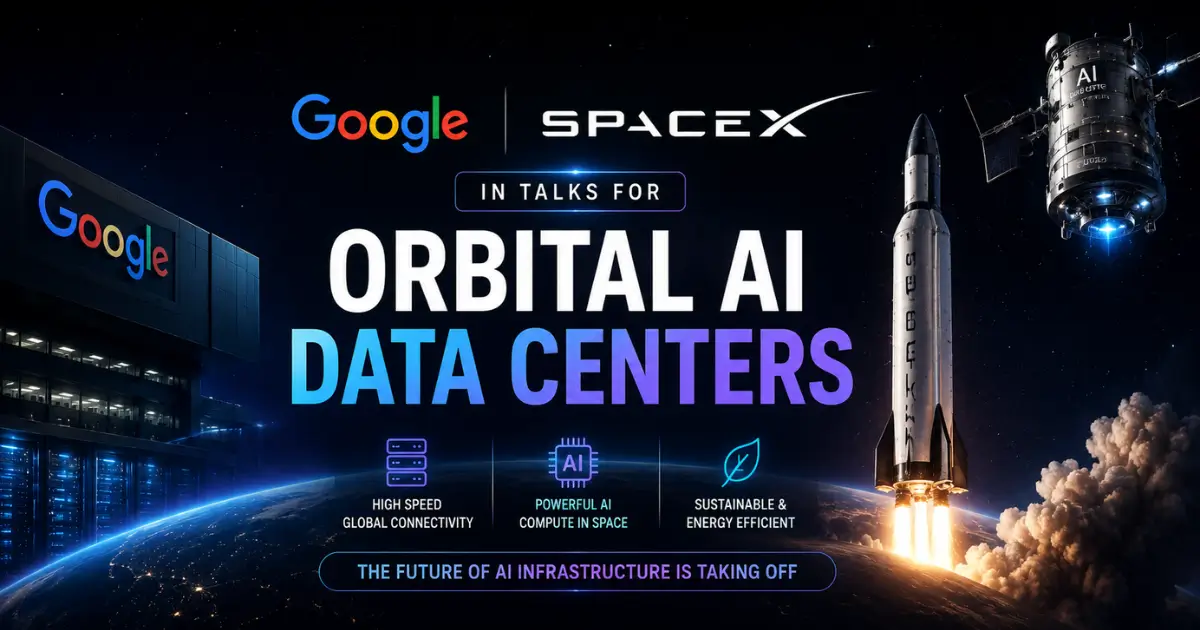
Google and SpaceX are reportedly in discussions to launch AI data centers into space. The partnership would combine Google's custom TPU chips and cloud infrastructure with SpaceX's Starship rockets — creating orbital computing facilities powered by unlimited solar energy and free from the land, power, and regulatory constraints choking terrestrial data center growth.
Why Space Makes Sense Now
The AI industry is running out of room on Earth. Google Cloud has a $462 billion backlog it cannot fulfill because of capacity constraints. AWS reported its fastest growth in 15 quarters while struggling to build data centers fast enough. Wisconsin banned new data center construction. And the global chip shortage means even companies with unlimited budgets cannot get enough hardware.
Google Cloud COO Francis deSouza confirmed at the Milken conference that the company is exploring orbital data centers as a serious response to energy constraints. Space offers continuous solar energy. No land permits. No grid connections. No neighbors. The physics work. The question has always been cost.
SpaceX's Starship — once fully operational — could change the cost equation. The rocket is designed to carry over 100 tons to low Earth orbit. That is enough to launch a meaningful data center module in a single flight. If launch costs drop to SpaceX's target range, orbital compute could become cost-competitive with building in remote terrestrial locations where power and cooling infrastructure must be constructed from scratch.
Who Else Is Going to Space
Google and SpaceX are not the first to pursue this idea. Meta signed a deal with Overview Energy for space-based solar power beamed to terrestrial data centers. Cowboy Space raised $275 million to build its own rockets specifically for launching AI data centers into orbit. And an orbital compute cluster is already operational in low Earth orbit.
The Google-SpaceX partnership would be the largest and most credible effort yet. Google brings the AI infrastructure expertise — chips, networking, cooling systems, and the software stack that runs one of the world's three largest clouds. SpaceX brings the only operational super-heavy launch vehicle capable of putting data center-scale payloads into orbit.
The Technical Challenges
Orbital data centers face real engineering problems. Cooling is the most significant. On Earth, data centers use air and liquid cooling systems. In space, the only way to shed heat is radiation — a slower process that requires large radiator panels. Google's full-stack approach — designing TPU chips optimized for its own models — could help. Chips designed for space operation from the start would generate less waste heat than repurposed terrestrial hardware.
Latency is another concern. Data traveling from orbit to Earth adds milliseconds of delay. For inference workloads — responding to user prompts — that delay matters. For training workloads — processing massive datasets over hours or days — it matters less. Orbital data centers are more likely to handle training and batch processing initially, with real-time inference remaining on the ground.
Maintenance is effectively impossible. If a chip fails in a terrestrial data center, a technician replaces it. In orbit, failed hardware stays failed. Redundancy and fault tolerance must be built into every system from the start.
The SpaceX Angle
For SpaceX, the deal would create a massive new revenue stream beyond satellite internet and government launches. The company is preparing for what could be the largest tech IPO ever. Adding Google as an orbital data center customer alongside its Cursor partnership and Starlink business would strengthen the IPO story significantly.
The partnership also fits Elon Musk's broader strategy of connecting his companies. SpaceX provides the rockets. xAI — which just sold a data center to Anthropic — provides AI models. And now Google provides the cloud infrastructure for orbital deployment. The pieces are aligning for a space-based AI computing ecosystem.
What It Means
The Google-SpaceX orbital data center talks represent the most extreme response yet to the AI energy crisis. When the world's largest cloud providers cannot build fast enough on Earth — when energy costs, land disputes, chip shortages, and construction bans limit what is possible on the ground — looking up is not science fiction. It is strategic planning.
Whether orbital data centers become operational in two years, five years, or ten depends on Starship's reliability, cost trajectory, and Google's willingness to invest billions in unproven infrastructure. But the fact that two of the world's most capable technology companies are in serious discussions about it says everything about where the AI industry believes it needs to go next.