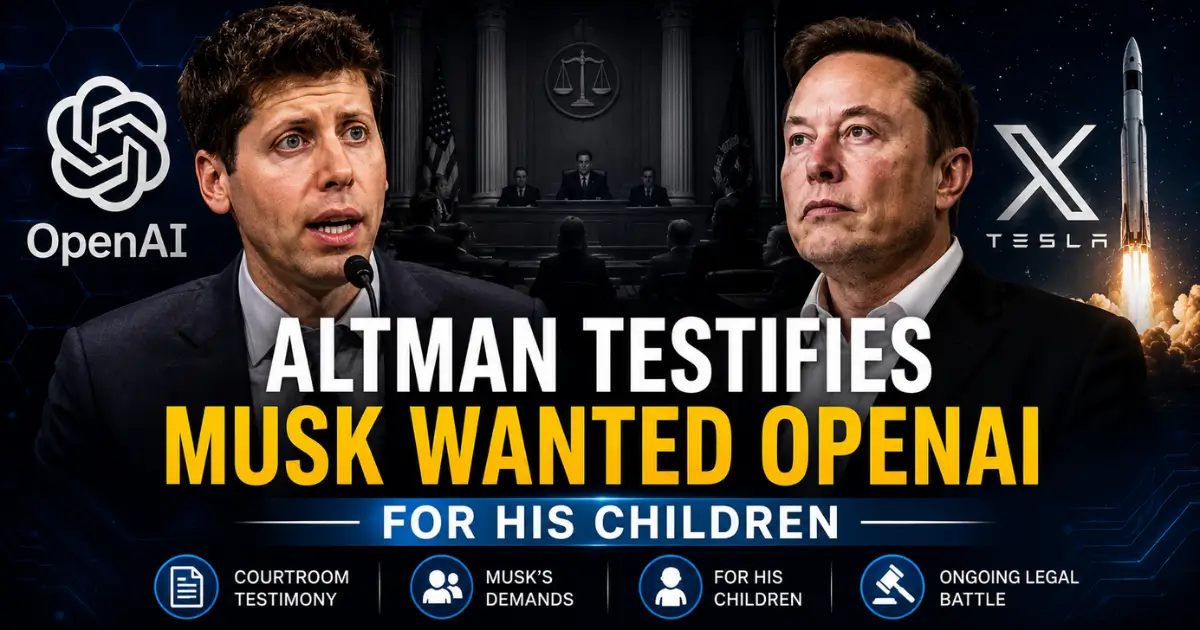
Sam Altman took the witness stand in the Musk vs Altman trial on Monday and dropped a bombshell. He testified that during early discussions about OpenAI's structure, Elon Musk proposed handing control of the AI lab to his children. Altman said the suggestion was one of several ideas Musk floated for maintaining personal influence over the organization he co-founded.
What Altman Said
Altman's testimony covered the full arc of his relationship with Musk. He confirmed that Musk was instrumental in founding OpenAI. He acknowledged Musk's financial contributions. And he said Musk's concerns about AI safety were genuine — at least initially.
But Altman painted a picture of a co-founder whose priorities shifted over time. Early conversations about keeping OpenAI as a nonprofit gave way to proposals where Musk would hold majority equity. When the board rejected that structure, Musk explored alternatives — including having his children assume a controlling position.
Altman described the suggestion as reflective of Musk's broader approach to his companies. Musk wants control. When he cannot get it directly, he looks for indirect paths. Handing OpenAI to family members would have kept the organization within Musk's sphere of influence without Musk formally running it.
The testimony aligns with Brockman's earlier account that Musk left OpenAI after the board refused to give him majority control. Altman added a new detail: the family succession idea was discussed before Musk departed, not after.
The Diary Entry Revisited
Altman was asked about Brockman's 2017 diary entry — the one where Brockman wrote that committing to nonprofit status felt like a lie if they were discussing a for-profit conversion three months later. Altman said the entry reflected genuine frustration but not deception.
He testified that the for-profit discussion was always about how to compete for talent and compute — not about personal enrichment. The nonprofit structure made it impossible to offer competitive compensation. Engineers could earn millions at Google or Meta. OpenAI could offer a mission and a modest salary. That gap was unsustainable.
The eventual conversion, Altman argued, preserved the mission while giving OpenAI the financial tools to compete. The nonprofit retains a 26 percent stake. Safety commitments remain in the charter. And the board structure includes independent directors who can override management on safety grounds.
Altman Addresses the Tumbler Ridge Tragedy
Altman was also questioned about the Tumbler Ridge shooting. He repeated his public apology. He said the company's decision not to alert law enforcement was wrong. And he described the new safety protocols — including trusted contact alerts and improved reporting criteria — as direct responses to the failure.
Musk's lawyers used the incident to argue that OpenAI's safety commitments are hollow. Altman responded that no AI company has a perfect safety record. He pointed to Anthropic's Mythos breach and xAI's Grok controversies as evidence that safety failures are industry-wide, not unique to OpenAI.
The Competitive Landscape
Altman addressed OpenAI's competitive position directly. He acknowledged that Anthropic has surpassed OpenAI in enterprise revenue. He said Claude Code has been a formidable competitor. And he conceded that OpenAI's recent executive departures and public image challenges have created real headwinds.
But he argued that OpenAI's consumer reach — over 400 million ChatGPT users — gives it a distribution advantage that no competitor can match. The superapp vision, the Infosys partnership, and the Microsoft renegotiation that freed OpenAI to operate across multiple clouds were all positioned as evidence that the company is executing on a broader strategy.
What It Means for the Trial
Altman's testimony is the most important moment of the trial so far. The jury has heard from Musk, Brockman, and multiple expert witnesses. Now it has heard from the man Musk accuses of stealing a charity.
Altman's defense is consistent. OpenAI converted to for-profit because it had to. The mission is intact. The nonprofit retains its stake. And the person who wanted to take personal control — or hand it to his children — was Musk, not Altman.
The trial continues with Microsoft CEO Satya Nadella, former CTO Mira Murati, and co-founder Ilya Sutskever still expected to testify. The $134 billion in damages and the future of OpenAI's corporate structure remain at stake.
For the AI industry, Altman's testimony adds the final perspective to a case that has already reshaped how the public understands the origins of the world's most prominent AI company.