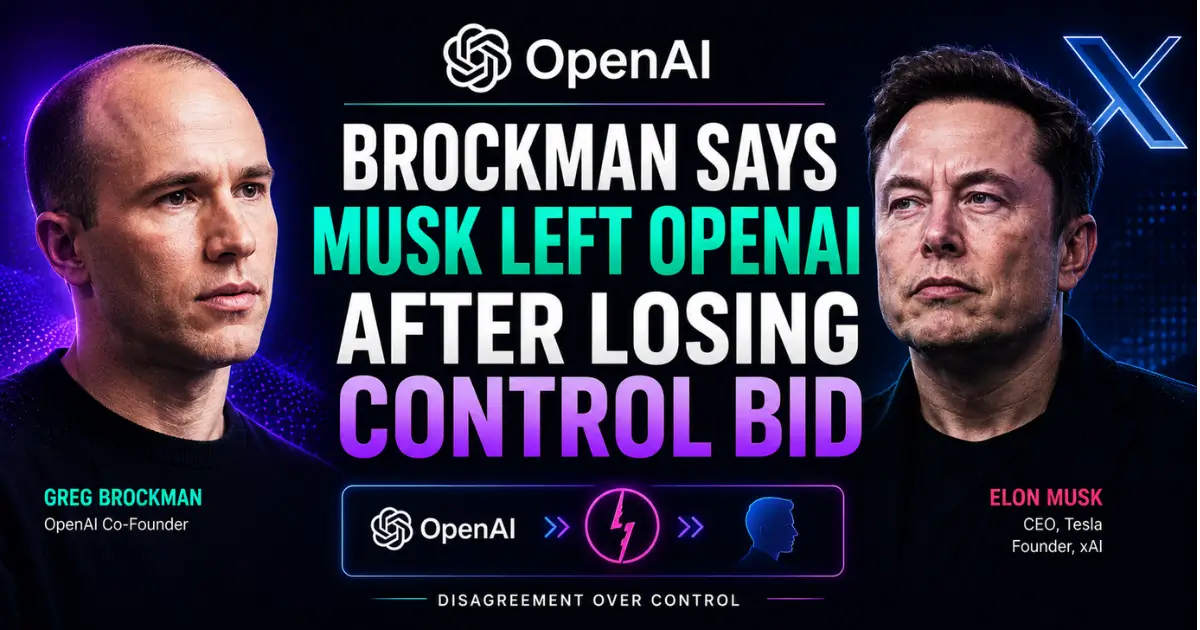
OpenAI president Greg Brockman took the stand in the Musk vs Altman trial on Tuesday and delivered a detailed account of how Elon Musk departed OpenAI in 2018. According to Brockman's testimony, Musk did not leave over safety concerns or a betrayal of the nonprofit mission. He left because the board rejected his demand to take control of the company.
Brockman's Version of Events
Brockman testified that in late 2017 and early 2018, Musk proposed restructuring OpenAI so that he would hold majority equity and operational control. Musk wanted the organization converted into a for-profit entity — the same conversion he now sues over — but with himself as the controlling shareholder.
The board declined. Brockman said the founders believed that concentrating control in any single individual contradicted OpenAI's mission of building AI that benefits humanity. Musk responded by withdrawing financial support and eventually departing the board.
Brockman acknowledged that Musk's frustrations were partly legitimate. OpenAI was struggling to compete for talent against Google and Facebook, which could offer significantly higher salaries. The for-profit conversation was real. But Brockman maintained the disagreement was about who would control the for-profit entity — not whether one should exist.
The Diary Entry Returns
OpenAI's lawyers returned to the 2017 diary entry that has haunted Brockman throughout the case. In the entry, he wrote that he could not believe they committed to nonprofit status if three months later they were discussing a for-profit conversion — calling it a lie.
Under questioning from OpenAI's own legal team, Brockman explained the context. He said the entry reflected his frustration in the moment. The nonprofit commitment felt inconsistent with the emerging reality that competing for talent and compute required commercial-scale capital. But he maintained the eventual conversion was done transparently, with board approval, and in service of the mission rather than personal enrichment.
The diary entry remains the most damaging piece of evidence for OpenAI's defense. Musk's lawyers have used it repeatedly to argue that the founders knew the nonprofit structure was a temporary facade.
The Employee Poaching Question
Brockman also addressed Musk's employee poaching. He confirmed that after leaving OpenAI's board, Musk recruited several senior employees to Tesla and Neuralink — including Andrej Karpathy, who became Tesla's head of self-driving AI.
Brockman described the departures as painful but not unusual. He said the AI talent market was intensely competitive. What he objected to was the combination: Musk stopped funding OpenAI, recruited its talent, founded a competing company in xAI, and then sued OpenAI for doing the same thing — building a for-profit AI company — that Musk himself had proposed.
The Safety Argument Weakens
Brockman's testimony put additional pressure on Musk's safety argument. The trial's first week established that Musk's own company distilled OpenAI's models to train Grok. Musk contradicted his own tweets about Tesla pursuing AGI. He threatened Brockman before the trial. And his only AI expert witness described an AGI arms race that Musk himself is actively participating in.
Brockman's account adds another dimension. If Musk's primary concern was safety, why did he propose taking personal control of a for-profit version of OpenAI? And if the for-profit conversion was the betrayal, why did Musk himself push for it first?
What Comes Next
Altman is expected to testify later this week. Microsoft CEO Satya Nadella, former CTO Mira Murati, and co-founder Ilya Sutskever are also on the witness list. The trial is roughly halfway through its scheduled four-week run.
The $134 billion in potential damages and the possible unwinding of OpenAI's corporate structure remain at stake. But with each day of testimony, the narrative has shifted. What began as a case about charitable mission and AI safety is increasingly looking like a case about a co-founder who wanted control, did not get it, and is now using the legal system to extract what the boardroom denied him.
The Bigger Picture
Brockman's testimony matters because it provides the first detailed insider account of OpenAI's most consequential decision. Every major AI company today is wrestling with similar questions. How do you structure a company that needs billions in capital while maintaining a commitment to safety and public benefit? Who gets control? And what happens when the founders disagree?
OpenAI chose a path that made it the most valuable AI company in the world. Musk chose to sue. The jury — and ultimately the judge — will decide which side of that story the law supports.