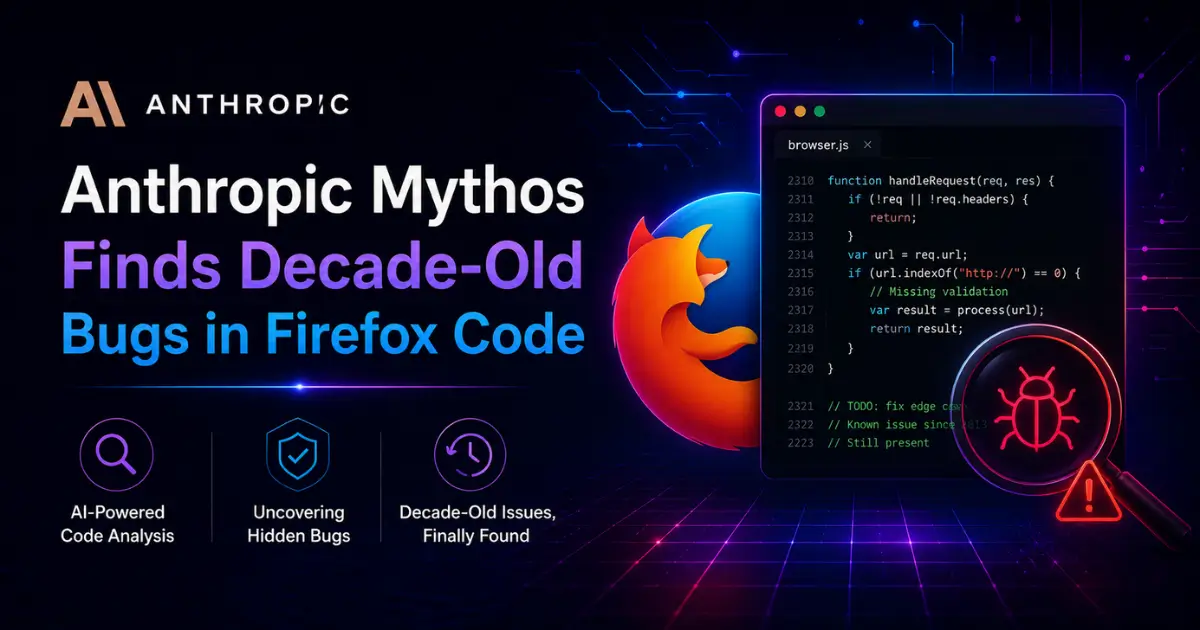
Anthropic's Mythos model has unearthed a wealth of high-severity bugs in Firefox — including vulnerabilities that had been hiding in the browser's code for over a decade. Mozilla's security team published a detailed account of how Mythos transformed their approach to cybersecurity, driving Firefox bug fixes from 31 in April 2025 to 423 in April 2026. The results are the most concrete evidence yet that Anthropic's restricted AI model delivers on its promised capabilities.
What Mythos Found
Mozilla's researchers said Mythos discovered bugs that human security experts had missed for years. Among the findings were sandbox vulnerabilities — the most complex and dangerous class of browser bugs, worth up to $20,000 each through Mozilla's bounty program.
Finding sandbox bugs requires an especially sophisticated approach. The model must write a compromised patch for the browser, then attack the most secure part of the software with the new code in place. It is a multi-step process requiring both creativity and precision. Mozilla said Mythos is finding more sandbox issues than human researchers ever did.
The model also uncovered a 15-year-old error in how Firefox parses an HTML element. Bugs that old are typically invisible to automated scanners and overlooked by human reviewers who assume legacy code has already been vetted.
A Turning Point for AI Security Tools
Six months ago, AI bug-finding tools were more frustrating than helpful. They flooded security teams with low-quality reports and false positives. Mozilla's researchers described a dramatic shift in recent months. The models got significantly more capable. And the techniques for harnessing them improved equally fast.
The combination of better AI models and agentic systems that can assess their own work has transformed the equation. Instead of drowning in noise, security teams now receive actionable results that they can verify and fix. Mozilla's engineers called it difficult to overstate how much the dynamic changed in just a few months.
The 423 bug fixes shipped in April 2026 compared to 31 the previous year represent a more than 13x increase in security output. That is not an incremental improvement. It is a fundamental change in how browser security works.
Humans Still Write the Fixes
Despite the breakthrough in finding bugs, Mozilla is not using AI to fix them. The team asks Mythos to generate patches for each bug. The code is useful as a reference. But it cannot be deployed directly. Every fix is written by a human engineer and reviewed by another human engineer.
The distinction matters. Mythos can identify what is broken with extraordinary precision. But translating that finding into production-ready code that does not introduce new problems remains a human skill. The same code quality concerns that affect AI-generated software in other domains apply equally to security patches.
The Attacker-Defender Balance
The most important question Mythos raises is whether AI-powered security tools ultimately favor attackers or defenders. Anthropic CEO Dario Amodei has argued that defenders have the advantage. If AI finds and fixes thousands of bugs, there are fewer bugs left to exploit. The finite supply of vulnerabilities means defense can eventually win.
Mozilla's engineers are more cautious. Distinguished engineer Brian Grinstead told TechCrunch that AI is useful for both sides. Having the tool available shifts the advantage slightly toward defense. But realistically, nobody knows the answer yet.
The Vulnpocalypse — the growing imbalance between AI-powered attacks and traditional defenses — remains a live concern. An unauthorized group already accessed Mythos through a vendor breach. If similar capabilities reach bad actors — through distillation, leaks, or independent development — the same power that defends Firefox could be used to attack other software.
Vindication for Anthropic's Strategy
The Firefox results validate Anthropic's controversial decision to restrict Mythos to approved organizations. The company withheld the model from public release specifically because its cybersecurity capabilities were too powerful. Critics — including Sam Altman — called the approach fear-based marketing. OpenAI subsequently adopted the same restricted access model for its own cyber tool.
Mozilla's results show the capabilities are real. A 13x increase in security output is not marketing. It is a measurable transformation in how one of the world's most important browsers finds and fixes vulnerabilities. Whether that transformation can be sustained — and whether the benefits outweigh the risks of the technology existing at all — will define the next chapter of AI-powered cybersecurity.
The Bigger Picture
Mythos and Firefox represent the most compelling real-world demonstration of AI's cybersecurity potential to date. The model found bugs that humans missed for 15 years. It cracked sandbox vulnerabilities that command the highest bounties. And it drove a 13x increase in security fixes within a single year.
For the AI industry, the lesson is that the most impactful AI applications are often not the ones that generate headlines. They are the ones that quietly make the software we all depend on more secure. Firefox just got dramatically safer. And the model that made it possible is one that most people will never have access to.