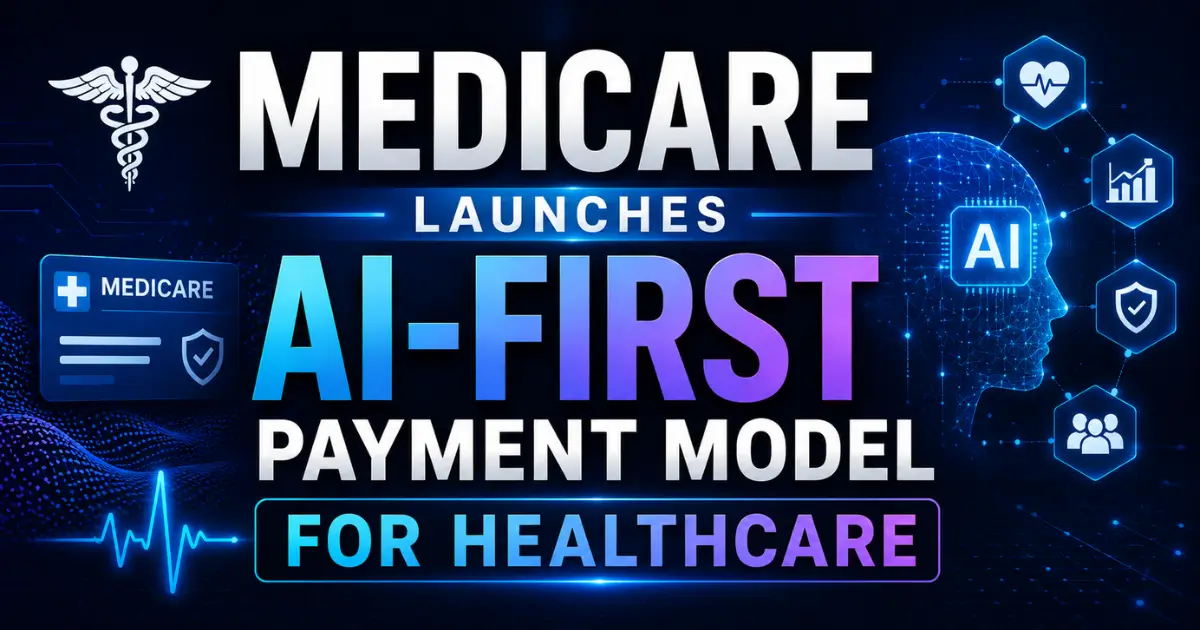
Medicare has launched a 10-year program called ACCESS that creates the first federal payment mechanism for AI-driven patient care. The program pays healthcare providers based on outcomes not time spent with a clinician. That distinction opens the door for AI agents to handle patient monitoring, check-ins, care coordination, and medication management between doctor visits. It is the most significant government policy shift for healthcare AI to date — and most of the tech world has not noticed.
Why ACCESS Matters
Traditional Medicare reimburses based on clinician time. A doctor bills for a 15-minute visit. A nurse bills for a phone call. There is no mechanism to pay for an AI agent that monitors a patient overnight, calls to check in at 3 AM, coordinates a housing referral, or reminds someone to pick up their medication.
ACCESS changes that. Participating organizations receive predictable payments for managing chronic conditions. They earn the full amount only when patients meet measurable health goals — lower blood pressure, reduced pain, better diabetes management. How those outcomes are achieved — whether by a human clinician, an AI voice agent, or a combination — is up to the provider.
The program covers diabetes, hypertension, chronic kidney disease, obesity, depression, and anxiety. It goes live July 5 with 150 participants selected by the Centers for Medicare and Medicaid Services.
Pair Team and the Voice Agent Flora
One of the 150 participants is Pair Team, a Kleiner Perkins-backed startup that has spent seven years building AI-powered care for Medicare patients dealing with chronic conditions, unstable housing, and food insecurity. About a third of Americans fall somewhere in that category.
Nine months ago, Pair Team deployed a voice AI agent called Flora as its primary patient-facing interface. Flora handles intake, coordinates referrals, and conducts the check-ins that keep patients engaged between clinical visits. She is available 24 hours a day.
CEO Neil Batlivala described one early call. A 67-year-old woman living out of her car, managing PTSD and congestive heart failure, spoke with Flora for over an hour. Hour-long conversations are now routine. The AI provides what Batlivala calls companionship — and it turns out that companionship is itself an intervention.
The results are measurable. Peer-reviewed research published in the Journal of General Internal Medicine showed Pair Team's model reduces hospital visits by 25 percent and ER visits by 50 percent. The company now employs 850 clinical professionals and generates revenue above nine figures.
The Economics Only Work With AI
ACCESS deliberately set low reimbursement rates per patient per month. Many participants expected higher payments. Batlivala says the low rates are a feature, not a bug. If you want to build a model that truly incentivizes the use of AI, the rates have to be low enough that the economics only work for AI-first operations.
Human-only care at ACCESS reimbursement rates does not pencil out. The math requires AI handling the majority of patient interactions — monitoring, check-ins, coordination, reminders — with humans focusing on complex clinical decisions that AI cannot yet handle reliably.
The design is intentional. The program's architects — CMS Innovation Center Director Abe Sutton and Chief AI Officer Jacob Shiff — are both former startup operators. Their backgrounds are reflected in the program's structure: outcome-based payments, direct-to-consumer enrollment, and a deliberate push for competition among participants.
The Risks Are Real
Feeding sensitive patient data — conversations about housing, mental illness, substance abuse, and chronic disease — into federal infrastructure carries genuine risk. CMS has a documented history of data breaches, including exposed Social Security numbers. For vulnerable populations, that is not theoretical.
Financial risks exist too. A 2023 Congressional Budget Office analysis found that the CMS Innovation Center increased federal spending by $5.4 billion during its first decade rather than producing projected savings. Whether ACCESS delivers better results remains to be proven over its 10-year run.
And the AI reliability question applies here as well. AI voice agents that handle patient interactions must be accurate, empathetic, and safe. A chatbot that gives wrong health advice 50 percent of the time — as one study found — cannot be trusted with medication reminders and care coordination for elderly patients living in their cars.
Why the Tech World Should Care
ACCESS represents something the AI industry has been waiting for: government creating a payment mechanism that rewards AI-driven outcomes rather than human labor inputs. If it works, the model could expand beyond chronic disease management into primary care, mental health, post-surgical recovery, and eldercare.
Healthcare AI startups like Basata, 10x Science, and Pair Team have been building for years toward exactly this moment. The federal government just created the swim lanes for them to compete in.
Digital health funding hit its highest Q1 total since the pandemic this year. But ACCESS has barely registered outside health tech trade press. That is about to change. When Medicare starts paying for AI agents to manage patient care at federal scale, every AI company in the healthcare space will want in.