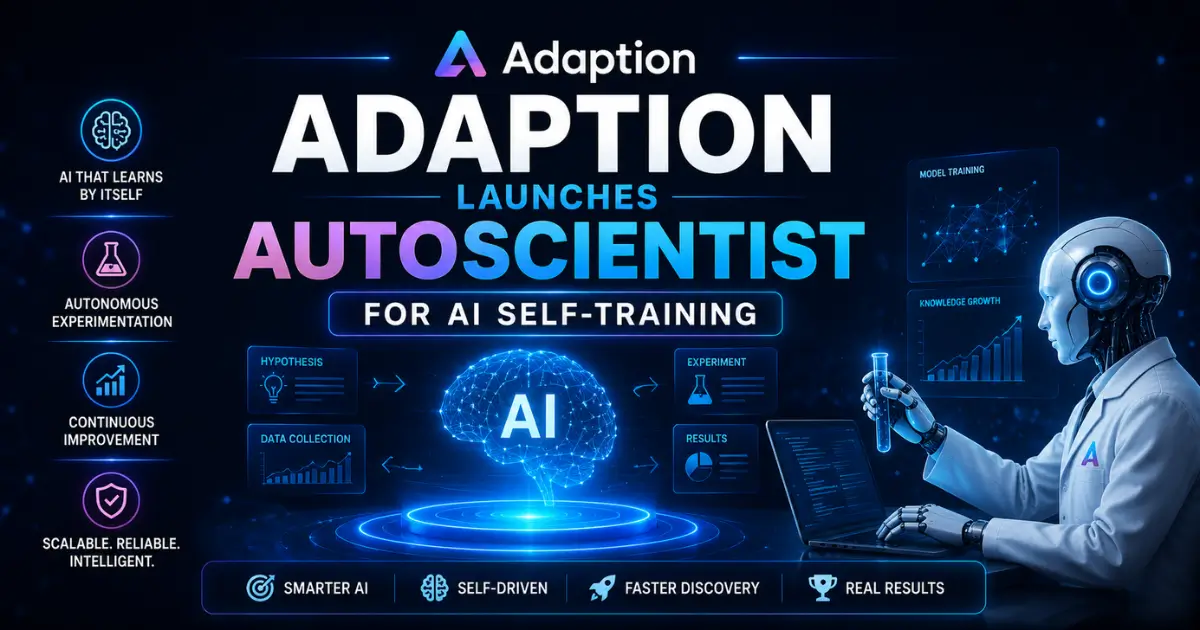
Adaption, the AI startup founded by former Cohere VP of research Sara Hooker, has launched AutoScientist — a tool that automates the fine-tuning process and lets AI models learn new capabilities on their own. The tool co-optimizes both data and model simultaneously, claims to more than double performance win-rates, and is free for 30 days. The launch represents a step toward the long-anticipated moment when AI systems improve themselves better than humans can.
What AutoScientist Does
Fine-tuning is how companies customize general-purpose AI models for specific tasks. A frontier model like Claude or GPT knows a lot about everything. Fine-tuning teaches it to excel at something specific — medical diagnosis, legal research, code review, or customer service. The process traditionally requires human researchers to curate data, design training runs, and iterate through multiple experiments.
AutoScientist automates that loop. The tool takes a target capability, generates and optimizes the training data, runs the fine-tuning process, evaluates the results, and iterates — all without human intervention. Hooker described it as a system that learns the best way to learn any capability.
The approach builds on Adaption's existing product, Adaptive Data, which helps companies build high-quality training datasets. AutoScientist takes those continuously improving datasets and turns them into continuously improving models. The whole stack adapts on the fly to whatever task the user specifies.
Why Self-Training Matters
The AI industry is hitting a wall. Training frontier models requires hundreds of billions of dollars in compute. High-quality training data is running out. And the human researchers who design training runs are among the scarcest talent in the industry.
AutoScientist addresses all three constraints. By automating the fine-tuning process, it reduces the need for expensive human researchers. By co-optimizing data and model together, it extracts more capability from less data. And by running the process autonomously, it makes frontier-level training accessible to organizations that do not have the resources of Anthropic, OpenAI, or Google.
Hooker framed the potential broadly. The same way that code generation unlocked productivity across software development, self-training could unlock innovation across every field that uses AI models.
The Self-Improvement Question
AutoScientist touches on one of the most debated topics in AI. The idea that AI systems could eventually improve themselves — creating a recursive loop of self-enhancement — has been both the promise and the fear of the field for decades.
Adaption's tool is not recursive self-improvement in the existential sense. It does not create new AI architectures or discover novel training methods. It automates and optimizes an existing process — fine-tuning — that human researchers currently do manually. But it represents a meaningful step on the spectrum. If AI can learn how to learn better than humans can teach it, the implications for the pace of AI development are significant.
NeoCognition is pursuing a related approach — building agents that teach themselves to become domain experts. Ineffable Intelligence is building AI that learns entirely from experience without human data. Adaption occupies a middle ground — automating the existing training process rather than replacing it entirely.
The Bigger Picture
Adaption's AutoScientist is a practical tool with profound implications. Today, it helps companies fine-tune models faster and cheaper. Tomorrow, it could change who gets to build frontier AI. If self-training tools democratize the training process, the next breakthrough model might not come from a lab with $100 billion in compute. It might come from a small team with the right data and an AI system that knows how to learn from it.