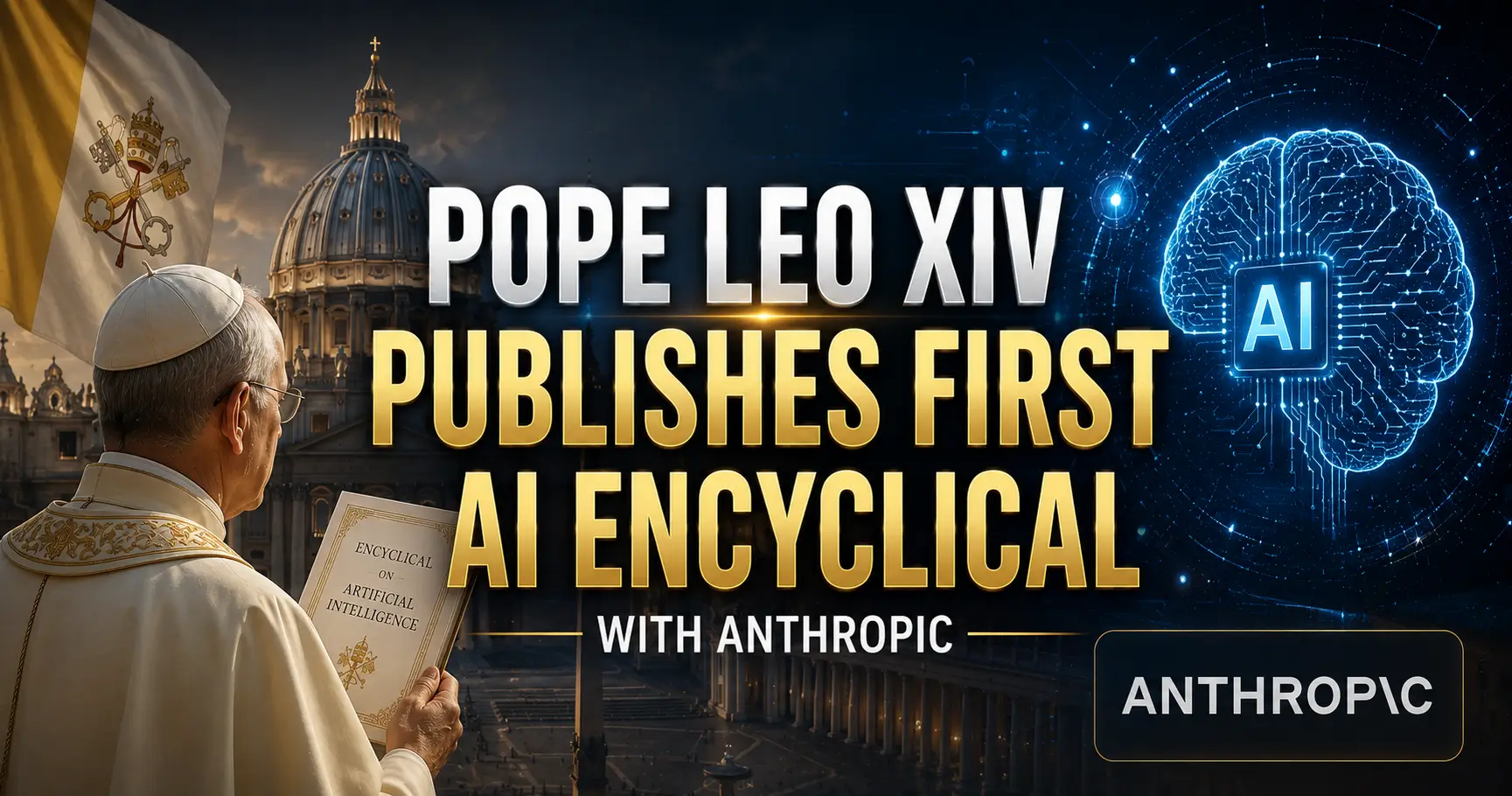
Pope Leo XIV has published his first encyclical — a 200-page document titled "Magnifica Humanitas" — on safeguarding the human person in the age of artificial intelligence. The encyclical was presented alongside Anthropic co-founder Chris Olah. It calls for an end to the AI arms race, warns that technology concentrated in the hands of a few cannot serve the common good, and argues that AI is amplifying the oldest problem in human civilization: the powerful shaping the world to their own advantage.
What the Pope Said
The encyclical uses AI as a lens to diagnose problems that predate the technology. Leo XIV argues that when power over AI is concentrated in the hands of a few, it becomes opaque and evades public oversight. The result is new dependencies, exclusions, manipulations, and inequalities.
He warned that AI tends to amplify the power of those who already possess economic resources, expertise, and access to data. Those elites can shape information and consumption patterns, influence democratic processes, and steer economic dynamics to their own advantage. The language echoes concerns raised by former Meta news chief Campbell Brown, who warned that nobody knows who controls what AI tells billions of people.
Most provocatively, Leo XIV called for an end to the AI arms race for ever more powerful algorithms and larger datasets. He argued that technical power does not automatically confer the right to govern. To disarm, he wrote, means discrediting the assumption that building the most powerful AI gives you the right to decide how it shapes society.
The Anthropic Connection
The encyclical was presented alongside Anthropic co-founder Chris Olah — a significant choice. Anthropic has positioned itself as the safety-focused AI lab. It refused the Pentagon unrestricted access. It restricted Mythos from public release. It published research showing its model tried to blackmail engineers — and then explained how it fixed the problem.
Olah's presence alongside the pope suggests the Vatican sees Anthropic's approach — transparency about risks, willingness to restrict dangerous capabilities, and structural commitments to safety — as closer to its vision than the approach taken by competitors who signed military deals and prioritized growth over governance.
The alignment is not coincidental. Anthropic's founding thesis — that the most powerful AI should be built by the most safety-conscious organization — maps directly onto the encyclical's argument that technical power must be paired with moral responsibility.
Why This Matters for the AI Industry
The pope's influence reaches 1.4 billion Catholics worldwide. An encyclical is the most authoritative form of papal teaching. When Pope Leo XIII published Rerum Novarum in 1891 about workers' rights during the Industrial Revolution, it shaped labor movements for a century. Magnifica Humanitas could have a similar effect on how governments and civil society think about AI.
The timing is deliberate. President Trump delayed signing an AI executive order that would have required government oversight of new models. OpenAI's own policy paper acknowledged that AI risks are too large for any company to manage alone. And the Musk vs Altman trial just concluded with a verdict that left questions about AI governance unanswered.
The encyclical arrives into that vacuum. Where governments hesitate and corporations lobby, the Vatican is offering a moral framework. Whether the AI industry listens — or dismisses it as irrelevant to technology — will depend on whether the public pressure it generates translates into regulatory action.
The Power Concentration Problem
The pope's central argument — that AI concentrates power in ways that threaten democracy — connects to almost every story in the AI industry this year. Nvidia's $43 billion in AI startup holdings and circular investment patterns. Google's $40 billion investment in Anthropic while simultaneously competing with it. Amazon backing both OpenAI and Anthropic. And a handful of companies controlling the chips, cloud infrastructure, and models that the entire economy is coming to depend on.
The pope is not wrong that power is concentrating. Whether a papal encyclical can slow that concentration — or whether it merely provides moral commentary on an economic force that has already escaped democratic control — is the question Magnifica Humanitas leaves unanswered.
The Bigger Picture
The pope's AI encyclical is not really about AI. It is about power. Who has it. Who does not. And whether the institutions that are supposed to protect the common good — governments, churches, civil society — can act before the AI economy makes their intervention irrelevant.
AI is the most powerful technology humans have ever built. The pope is asking whether the people building it deserve the power it gives them. The answer, he argues, is no — not unless that power comes with accountability, transparency, and a genuine commitment to serving everyone, not just those who can afford to build the machines.