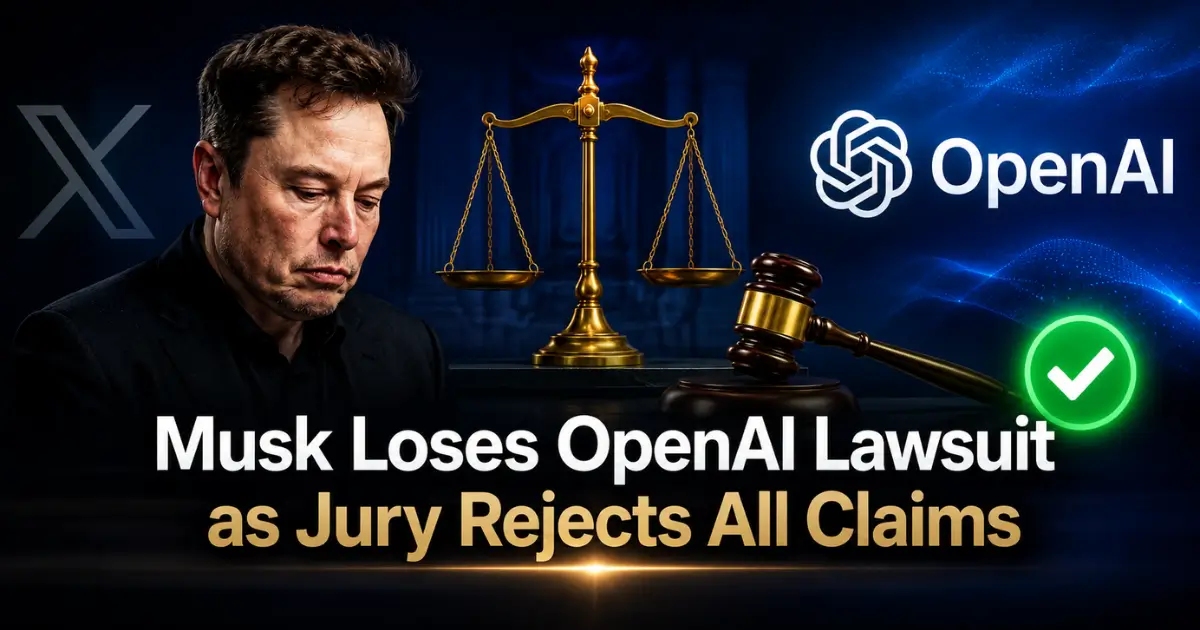
Elon Musk has lost his lawsuit against Sam Altman and OpenAI. The jury rejected both of Musk's claims — unjust enrichment and breach of charitable trust — finding that OpenAI's conversion from nonprofit to for-profit did not constitute a betrayal of its charitable mission. The verdict ends the most closely watched AI trial in history and leaves OpenAI's corporate structure intact.
The Verdict
After three weeks of testimony and two days of deliberation, the jury sided with OpenAI on every count. Musk sought up to $134 billion in damages and the unwinding of OpenAI's for-profit structure. He got neither.
The jury found that Musk failed to prove OpenAI's founders enriched themselves at the expense of the nonprofit mission. The conversion was approved by the board. The nonprofit retains a 26 percent stake. And the company's safety commitments — however imperfect — remain in its charter.
Judge Gonzalez Rogers, who will issue the final ruling on remedies, had signaled early in the trial that the case had merit. But the evidence that emerged over three weeks undermined Musk's narrative more than it supported it.
How Musk's Case Collapsed
The trial produced a devastating sequence of admissions and contradictions that destroyed Musk's credibility as a principled plaintiff.
Day one: Musk contradicted his own tweets under oath, admitting Tesla is not pursuing AGI despite posting otherwise. He inflated his OpenAI investment from $38 million to $100 million.
Day two: Musk admitted xAI distilled OpenAI's models to train Grok — using the very technology he claims was wrongfully commercialized. He ranked Anthropic as the world's top AI lab, above his own company.
Before trial: Musk texted Brockman threatening to make him and Altman the most hated men in America unless OpenAI settled.
Brockman testified that Musk left OpenAI after the board rejected his demand for majority control — not over safety concerns. Altman testified that Musk proposed handing OpenAI to his children to maintain influence.
And Musk's only expert witness, Stuart Russell, warned about AGI risks — but could not connect those risks specifically to OpenAI's corporate conversion.
What the Jury Saw
The jury saw a plaintiff who wanted control of OpenAI, did not get it, left, founded a competing company, used OpenAI's technology to build his own products, and then sued when the company he abandoned became the most valuable AI company in the world.
Musk's argument that he was protecting the public interest was undercut by his own behavior. He operates xAI as a for-profit with no safety board. His data centers run 50 gas turbines without permits in a residential community. And he sold xAI's compute to Anthropic — the company he praised under oath as superior to his own.
The jury concluded that whatever frustrations Musk had with OpenAI's direction, they did not amount to a legal violation of charitable trust.
What It Means for OpenAI
The verdict removes the most immediate threat to OpenAI's corporate structure. The company can proceed with its planned operations without the risk of being forced to unwind its for-profit conversion.
OpenAI still faces significant challenges. The potential Apple lawsuit. The Microsoft renegotiation aftermath. The loss of Andrej Karpathy to Anthropic. And an enterprise market where Anthropic now has more business customers.
But the existential legal threat is gone. OpenAI can focus on competing rather than defending itself in court.
What It Means for Musk
Musk invested years and significant legal resources in the case. The loss is a blow to his credibility on AI governance. His arguments about safety and mission were overwhelmed by evidence of personal grievance and competitive self-interest.
The trial also generated damaging public disclosures — the distillation admission, the threatening texts, the inflated investment claims — that will follow Musk in future AI debates and regulatory discussions.
What It Means for the AI Industry
The verdict establishes that converting an AI nonprofit to a for-profit structure is not inherently illegal — at least not under the facts of this case. For AI companies weighing similar structural decisions, the ruling provides some legal comfort.
But the trial raised questions that the verdict did not answer. Should AI companies be required to maintain nonprofit structures when their technology becomes enormously valuable? Should safety commitments be legally enforceable? And when an AI company's safety record includes genuine failures — from Tumbler Ridge to misleading health advice — who holds them accountable?
The jury said Musk was not the right person to do it. The AI industry is still waiting for the right answer.