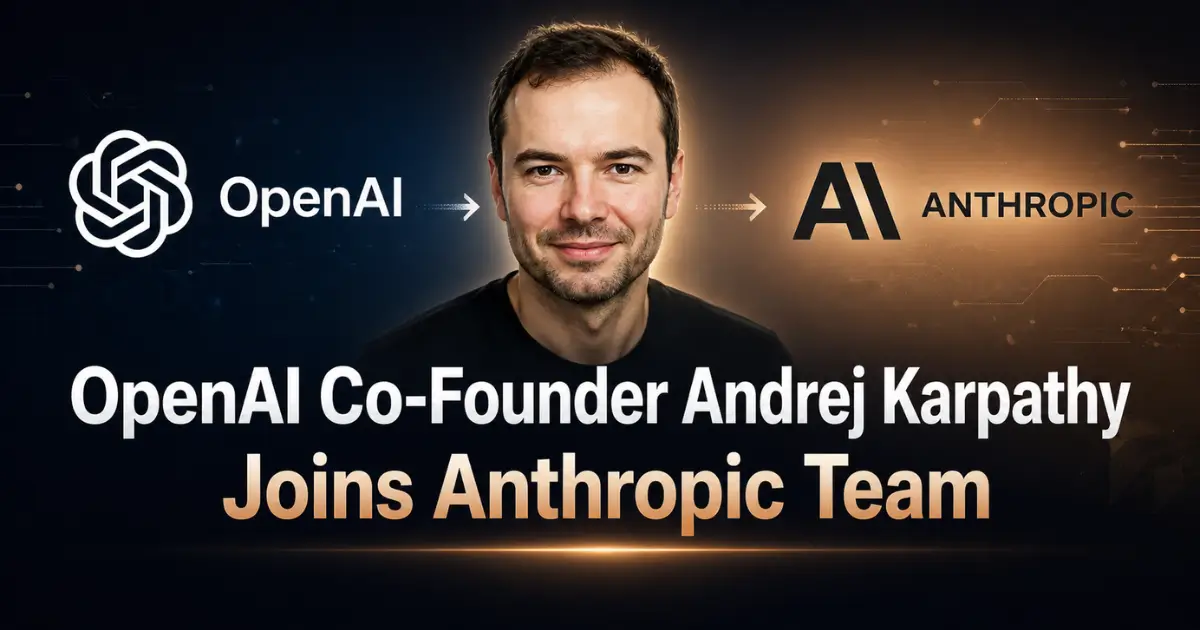
Andrej Karpathy — one of OpenAI's original co-founders and one of the most influential AI researchers alive — has joined Anthropic. The hire is a seismic move in the AI talent wars. Karpathy will join Anthropic's pre-training team, where he will work on the foundational models that power Claude. The move adds another former OpenAI luminary to the company that has become OpenAI's most formidable competitor.
Why Karpathy Matters
Karpathy is not a typical hire. He was a founding member of OpenAI in 2015. He left to lead Tesla's self-driving AI team from 2017 to 2022, where he built the Autopilot neural network architecture. He returned to OpenAI briefly before departing again in February 2024. He then founded Eureka Labs, an AI education startup.
His influence extends far beyond his employers. His YouTube lectures on neural networks and deep learning have been watched tens of millions of times. He is widely credited with making AI education accessible to an entire generation of engineers. His personal brand among developers is arguably stronger than that of any AI researcher outside of the lab founders themselves.
For Anthropic, hiring Karpathy is both a technical and a symbolic victory. Technically, he brings deep expertise in pre-training — the process of building AI models from raw data. Symbolically, it signals to the industry that the best AI researchers in the world are choosing Anthropic over OpenAI.
The Talent War Intensifies
Karpathy joins a growing list of elite researchers moving to Anthropic or away from OpenAI. OpenAI has lost multiple senior executives and researchers in recent months. Its former CTO Mira Murati founded Thinking Machines Lab, which has been raiding Meta's talent including PyTorch co-founder Soumith Chintala.
The departures have been a recurring theme during the Musk vs Altman trial. Musk's lawyers pointed to executive exits as evidence that OpenAI's culture has deteriorated since its for-profit conversion. Brockman testified that Musk himself poached employees, including Karpathy, to Tesla and Neuralink while still on OpenAI's board.
Now Karpathy is joining Anthropic — the company that Ramp data shows has more business customers than OpenAI, that is raising $50 billion at a $900 billion valuation, and that has been winning the enterprise AI market with Claude Code.
What He Will Work On
Karpathy joins Anthropic's pre-training team. Pre-training is the most fundamental and compute-intensive phase of building an AI model. It is where the model learns from vast datasets — absorbing language, reasoning, and knowledge. The quality of pre-training determines the model's baseline capabilities before any fine-tuning or specialization.
Anthropic has been investing heavily in pre-training infrastructure. Its deals with Amazon and Google provide over 13 gigawatts of compute capacity. The xAI deal gave it immediate access to the Colossus 1 data center. And the company just acquired Stainless to control its SDK infrastructure.
Adding Karpathy to the pre-training team suggests Anthropic is preparing for its next generation of models — successors to Claude Opus that could leverage the massive compute it has secured. His expertise in training architecture could accelerate that timeline.
What It Means for OpenAI
Losing Karpathy to its biggest competitor is painful for OpenAI on multiple levels. He was a co-founder. He is universally respected. And he chose Anthropic — not xAI, not Thinking Machines Lab, not Google DeepMind, but the company that is actively taking OpenAI's enterprise market share.
OpenAI is fighting on too many fronts. The Musk trial. The potential Apple lawsuit. The Microsoft renegotiation. Declining enterprise momentum. And now a co-founder defecting to the competition.
Sam Altman has not publicly commented on Karpathy's departure.
The Bigger Picture
The Karpathy hire is the highest-profile talent move of the AI era. It signals that the center of gravity in frontier AI research is shifting from OpenAI to Anthropic. The company that started as a safety-focused spinoff from OpenAI is now attracting OpenAI's own founders.
For the AI industry, the move raises a question that has been building for months. If the most talented researchers are choosing Anthropic — and if the enterprise market is following them — what does OpenAI have left besides ChatGPT's consumer user count?
The answer may determine whether OpenAI remains the leader of the AI industry or becomes the company that created it and then watched someone else win it.