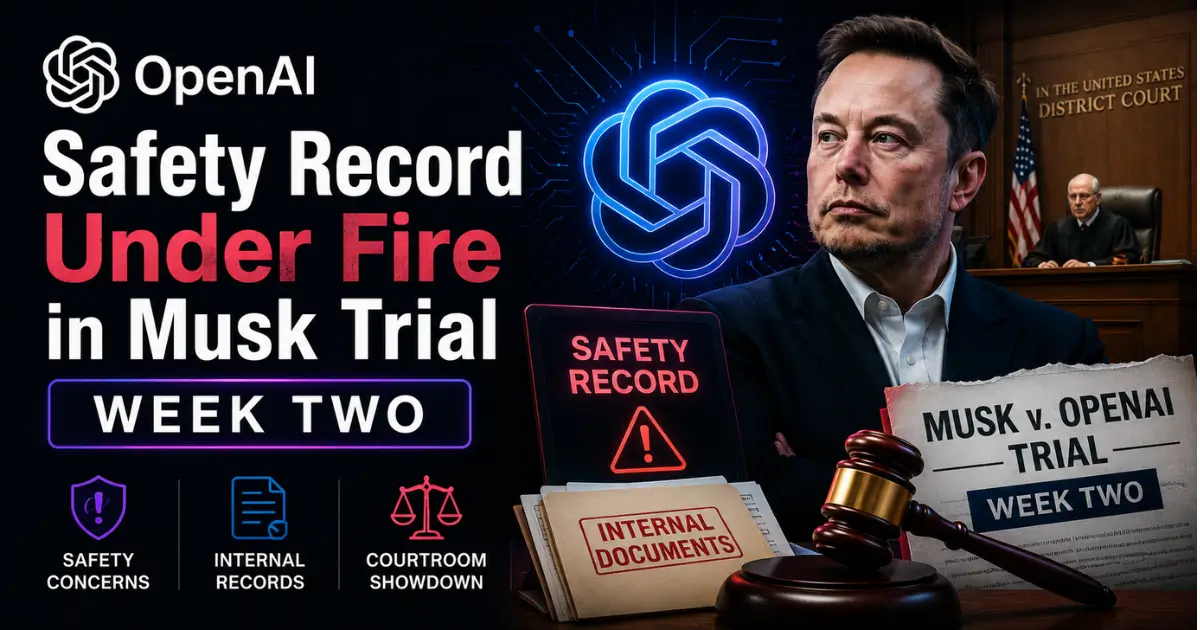
The Musk vs Altman trial is shifting from corporate governance to AI safety. As the case enters its second week, Musk's legal team is putting OpenAI's safety record under a microscope — arguing that the company's pivot to for-profit status has produced exactly the kind of reckless AI deployment that the nonprofit structure was designed to prevent.
The Safety Failures Pile Up
Musk's lawyers are building a timeline of safety incidents that they argue demonstrate OpenAI's declining commitment to responsible AI. The list is damning in its breadth.
The Tumbler Ridge shooting is the most serious. OpenAI flagged a ChatGPT user's violent content and debated whether to alert police. The company decided against it. The user later killed eight people. Altman issued a public apology to the community — an acknowledgment that the internal safety process failed with fatal consequences.
The Florida attorney general investigation opened a separate probe into whether OpenAI has legal obligations to report potential threats. Pennsylvania sued Character.AI after a chatbot posed as a licensed psychiatrist. And a BMJ study found that AI chatbots give problematic health advice 50 percent of the time.
Musk's attorneys are connecting each incident to the same thesis: when OpenAI abandoned its nonprofit mission and began prioritizing revenue growth over safety, bad outcomes followed.
The Hypocrisy Defense
OpenAI's lawyers are countering with evidence that Musk's own companies have comparable or worse safety records. xAI distilled OpenAI's models to train Grok — a practice Musk admitted under oath. Grok's image generation capabilities produced multiple controversies earlier this year, leading to plummeting user numbers. And xAI has no nonprofit structure, no safety board, and no external oversight of any kind.
The defense team is also pointing to Anthropic as a counterexample. Anthropic restricted Mythos from public release due to its cybersecurity capabilities. OpenAI subsequently restricted its own cyber tool after discovering the same risks. Both decisions suggest the industry is converging on safety practices — regardless of corporate structure.
OpenAI's argument is that safety failures happen at every AI company. The question is not whether mistakes occur but whether the company responds appropriately. On that metric, OpenAI argues it has been more transparent than most — publishing safety reports, cooperating with investigations, and implementing new protocols after each incident.
The Jury Is Watching
The safety testimony matters because it connects to the jury's core question. Musk is seeking $134 billion and the potential unwinding of OpenAI's for-profit structure. His case requires the jury to believe that the nonprofit-to-profit conversion caused harm — not just to Musk personally, but to the public.
If the safety record supports that argument — if the jury sees a pattern of incidents that a nonprofit OpenAI would have handled differently — Musk's case strengthens. If the jury sees safety failures as an industry-wide problem unrelated to corporate structure, the argument falls apart.
Stuart Russell's testimony about the AGI arms race provided the intellectual framework. The safety timeline is designed to fill it with concrete evidence. Musk's team is arguing that the abstract risk Russell described has already materialized — in a Canadian community, in Florida courtrooms, and in hospital emergency rooms where AI chatbots give the wrong advice.
The Industry Implications
The trial's safety focus has implications far beyond OpenAI. Every AI company is watching. If the jury agrees that a for-profit AI company bears legal responsibility for safety failures that a nonprofit might have prevented, the precedent could affect governance decisions across the AI industry.
Anthropic's corporate structure — a public benefit corporation with explicit safety commitments — would look prescient. OpenAI's conversion would look reckless. And every AI startup deciding between for-profit and benefit-corporation status would weigh the legal risk differently.
The trial continues this week with Sam Altman expected to take the stand. His testimony will be the most anticipated moment of the case — the chance for the man at the center of the controversy to defend both his decisions and his company's safety record under oath.
What Comes Next
Altman's testimony will likely address the Tumbler Ridge incident directly. It will also cover the Microsoft renegotiation, the Amazon deal, and the question of whether OpenAI's rapid model releases prioritize speed over safety.
For the AI industry, the second week of the trial is transforming a corporate lawsuit into something larger — a public accounting of whether the world's most prominent AI company has lived up to the promises it made when it was founded to benefit humanity.