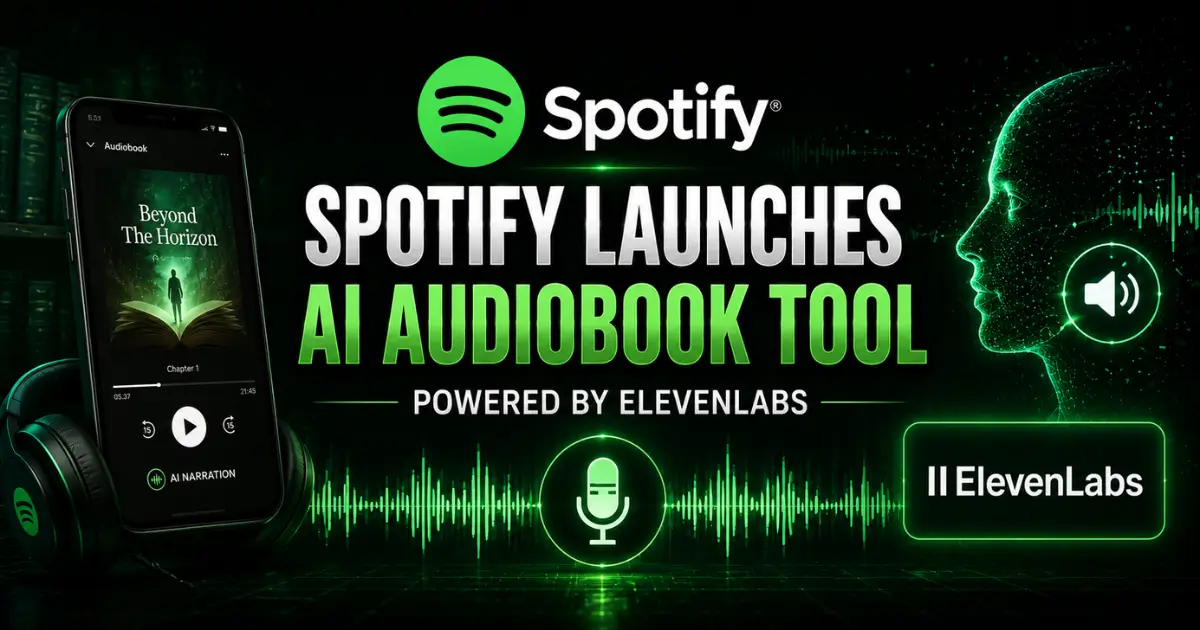
Spotify has launched an AI audiobook creation tool powered by ElevenLabs' voice synthesis technology. Authors and publishers can now convert any text into a professionally narrated audiobook using AI-generated voices — for a fraction of the cost and time of traditional production. The tool is integrated directly into Spotify's publishing platform and represents the company's most aggressive move yet into AI-generated audio content.
How It Works
Authors upload their manuscript. They choose from a library of AI voices — or create a custom voice by recording a short sample. The system generates a full audiobook narration with natural pacing, emotional inflection, and chapter-by-chapter organization. The entire process takes hours rather than the weeks or months required for a human narrator in a recording studio.
The tool handles multiple voices for dialogue. It adjusts tone based on context — quieter for intimate scenes, more energetic for action sequences. And it produces output that Spotify says meets its quality standards for the audiobook marketplace.
Pricing is significantly lower than traditional audiobook production. A human narrator charges thousands of dollars for a full-length book. Studio time adds thousands more. Editing and mastering add further costs. Spotify's AI tool reduces the total production cost to a fraction of that — making audiobook creation accessible to self-published authors and small publishers who could never afford traditional narration.
Why Spotify Built This
Spotify has been investing heavily in audiobooks. The company acquired audiobook distributor Findaway in 2022. It has been expanding its audiobook library and integrating it into its subscription tiers. But the supply of audiobooks has been constrained by production costs. Only a small percentage of published books have audiobook editions.
AI narration solves the supply problem. If every book can become an audiobook for minimal cost, Spotify's library expands dramatically. More audiobooks means more listening hours. More listening hours means more subscriber retention. And subscriber retention is the metric that drives Spotify's business.
The ElevenLabs partnership gives Spotify access to the most advanced commercial voice synthesis technology available. ElevenLabs' voices are widely regarded as the most natural-sounding in the industry. The combination of Spotify's distribution platform and ElevenLabs' voice quality creates a product that could transform audiobook publishing.
The Narrator Problem
The launch immediately raises concerns for professional voice actors and audiobook narrators. Narration is a specialized skill. Top narrators like Scott Brick, Julia Whelan, and Bahni Turpin have built careers around their ability to bring books to life through voice performance. AI narration threatens to commoditize that craft.
The debate mirrors what is happening across every creative industry. The Academy banned AI-generated performances from Oscar eligibility. Stability AI released an AI music model that generates six-minute songs. And the "This is Fine" creator is suing an AI startup for using his artwork without permission.
Voice actors have been particularly vocal about AI threats. SAG-AFTRA, the actors' union, has fought to include AI voice protections in its contracts. The 2023 strikes produced language limiting how studios can use AI-generated voices. But those protections apply to film and television — not audiobooks.
Spotify's launch creates a new front in the AI voice debate. If publishers can produce audiobooks with AI voices for a fraction of the cost, the economic incentive to hire human narrators diminishes. The quality gap is narrowing. The cost gap is enormous. And the market will follow the economics.
The Copyright Question
The tool also raises training data questions. ElevenLabs' voice models were trained on audio data. What audio? Whose voices? Were the speakers compensated? These are the same questions facing AI training data across every medium.
ElevenLabs has said its models are trained on licensed and consented data. But the broader AI voice industry has faced accusations of training on scraped audio — YouTube videos, podcasts, audiobooks — without permission. If a synthetic voice sounds natural because it learned from thousands of human narrators' recordings, those narrators arguably deserve compensation.
The Market Opportunity
The global audiobook market was worth $7.5 billion in 2025 and is projected to reach $35 billion by 2030. Growth has been constrained by production costs. AI narration removes that constraint. If every self-published ebook on Amazon can become an audiobook through Spotify's tool, the addressable market expands by orders of magnitude.
For Spotify, audiobooks represent a diversification play beyond music. The company's AI audio strategy already includes AI-generated playlists, personalized meditations, and podcast summaries. Adding AI-narrated audiobooks extends the platform's content library into a category with significantly better margin potential than licensed music.
The Bigger Picture
Spotify's AI audiobook tool is another step toward a future where most audio content is generated rather than performed. AI playlists. AI meditations. AI podcast summaries. AI narrated books. AI generated songs. Each addition moves Spotify further from a music distribution platform toward an AI content factory.
For listeners, the promise is more content, more personalization, and lower prices. For human creators — musicians, narrators, podcasters — the promise is less clear. The economics of AI-generated audio are so compelling that the transition may be unstoppable. The question is whether the humans whose skills trained the AI receive any share of the value it creates.