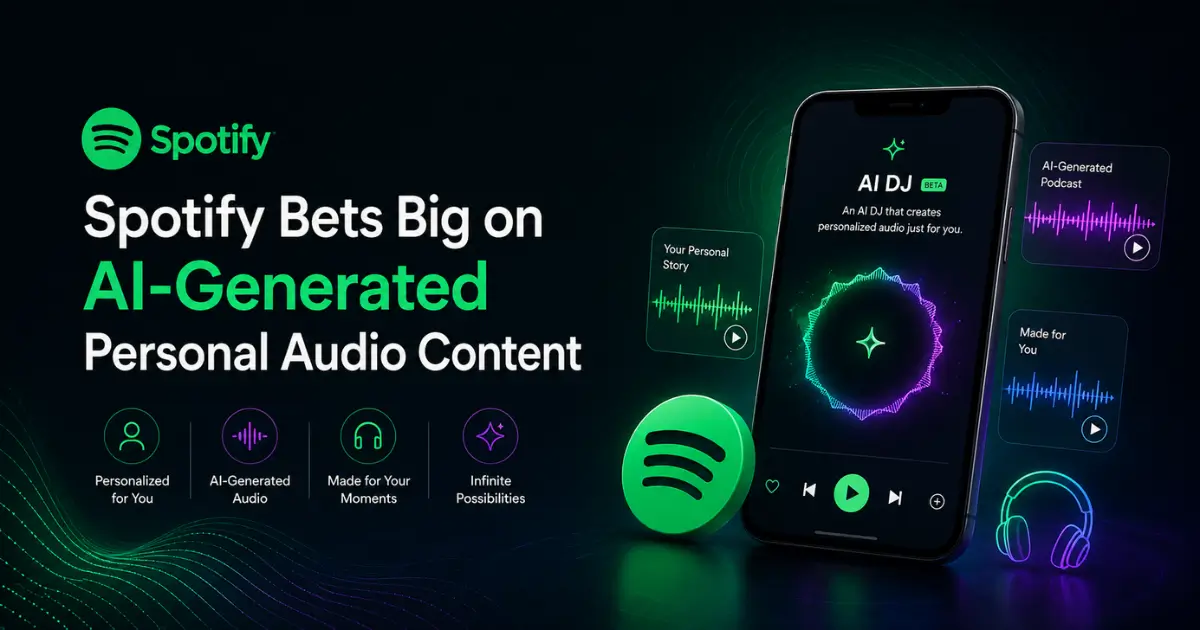
Spotify is making its biggest push into AI-generated content. The streaming platform is positioning itself as the home for personalized AI audio — playlists, podcasts, meditations, and educational content created dynamically for each listener by AI. The move transforms Spotify from a music distribution platform into a personalized audio experience powered by AI models.
What Spotify Is Launching
Spotify has been rolling out AI features for months. AI DJ, which uses a synthetic voice to introduce and narrate personalized music selections, was an early experiment. Now the company is expanding the concept across its entire platform.
New features include AI-generated guided meditations tailored to a user's mood and listening history. Personalized educational audio that adapts to a listener's interests and knowledge level. And dynamically generated podcast summaries that condense hour-long episodes into five-minute audio briefings voiced by AI.
The most ambitious feature is AI Playlist, which lets users describe what they want to hear in natural language. Instead of searching for an existing playlist, users type a prompt and Spotify's AI assembles a custom mix from its catalog of over 100 million tracks. The system learns from listening behavior and refines its recommendations over time.
Why AI Audio Matters for Spotify
Spotify has 675 million monthly users but has struggled to convert free listeners into paying subscribers. The premium conversion rate has plateaued. Music licensing costs consume the majority of revenue. And competition from Apple Music, YouTube Music, and Amazon Music limits pricing power.
AI-generated content offers a path around these constraints. Unlike licensed music, AI-generated audio does not carry per-stream royalty costs. A personalized meditation, an AI-narrated podcast summary, or a dynamically generated study playlist costs Spotify compute cycles rather than licensing fees. If listeners value these features enough to subscribe, the margin profile improves dramatically.
The strategy connects to a broader shift in how consumers interact with AI. Products like Noscroll are replacing doomscrolling with AI-curated digests. Bond is replacing social media feeds with AI-powered experience recommendations. Spotify is applying the same logic to audio: let AI create the content rather than just recommending existing content.
The Creator Question
AI-generated audio raises immediate concerns for musicians, podcasters, and voice actors. If Spotify can generate meditation content, study playlists, and podcast summaries using AI, does it need to pay human creators for those categories?
The Academy Awards just banned AI-generated performances from Oscar eligibility. The meme artist behind "This is Fine" is suing an AI startup for using his work without permission. And the broader debate about AI and creative work is intensifying across every medium.
Spotify has been careful to frame AI features as complementary to human creators rather than replacing them. AI DJ introduces human-made music. AI Playlist assembles existing tracks. The company is not generating synthetic music — yet. But the trajectory is clear. As AI audio generation improves, the line between curation and creation will blur.
Competition in AI Audio
Spotify is not the only company pursuing AI-powered audio experiences. Apple is integrating AI into Apple Music and podcasts through Siri enhancements. Amazon has been embedding Alexa AI into its music and audiobook platforms. And Google is adding Gemini to every media surface it owns — from TV to cars to browsers.
The advantage Spotify holds is data. With 675 million users generating billions of listening hours, Spotify knows what people listen to, when they listen, how they feel, and what they skip. That behavioral data is the raw material for AI personalization. No other audio platform has the same depth of user understanding.
The Business Model Shift
If Spotify succeeds in making AI-generated audio a core part of its value proposition, the business model shifts fundamentally. Today, Spotify pays roughly 70 cents of every dollar in revenue to rights holders. AI-generated content that does not carry licensing costs would flow directly to Spotify's bottom line.
The company is not abandoning music licensing. But it is building a parallel content layer — AI-generated, personalized, and owned by Spotify — that could eventually become as important to subscribers as the music catalog itself. For a company that has never achieved consistent profitability despite hundreds of millions of users, that shift could be transformative.
The Bigger Picture
Spotify's AI audio bet reflects a broader pattern in the tech industry. Every major platform is embedding AI into its core product. Microsoft put Copilot in Office. Google put Gemini in Workspace. Meta put AI in WhatsApp. Spotify is doing the same for audio — betting that personalized AI content will keep listeners engaged longer, convert more free users to premium, and create a margin structure that music licensing alone could never deliver.
Whether listeners embrace AI-generated audio or view it as an inferior substitute for human creativity will determine whether Spotify's bet pays off. But the direction is set. The future of audio is not just streamed. It is generated.