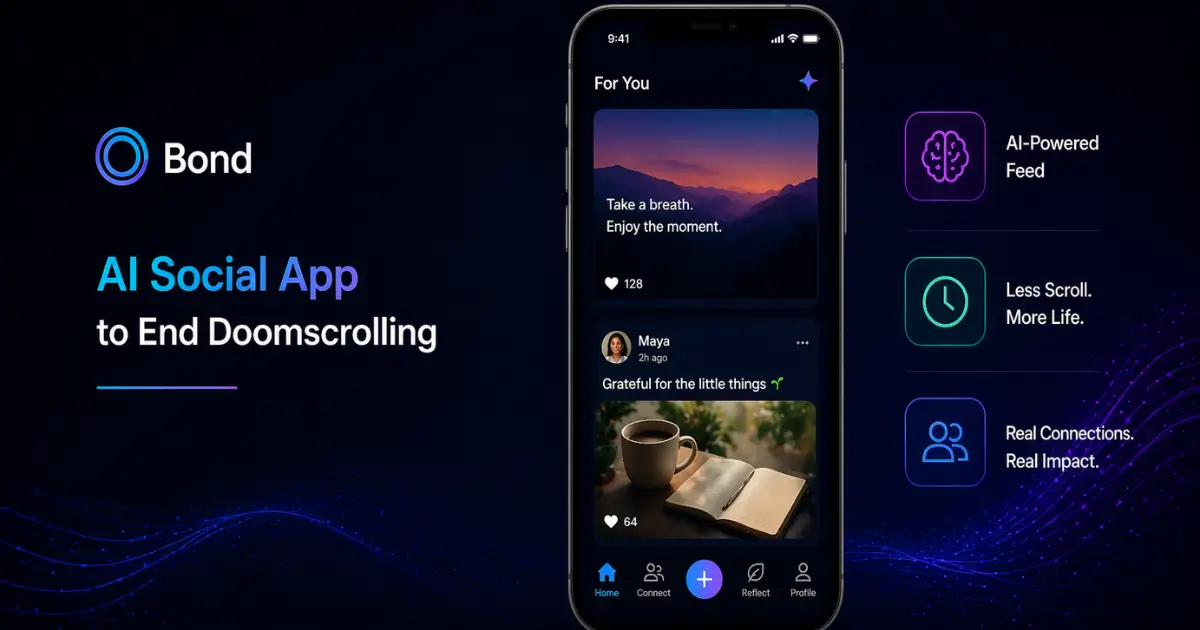
A new social media platform called Bond launched on Tuesday with an unusual pitch: instead of keeping you glued to your screen, it wants to use AI to push you back into the real world. The app uses your posted memories and experiences to generate personalized recommendations for things to actually go out and do restaurants to visit, concerts to attend, activities to try.
How Bond Works
Bond looks a little like Instagram, but there is no feed to scroll through. Users post what the platform calls "memories" photos, videos, and audio files documenting their recent experiences. These stories appear on your public profile for 24 hours before moving into a private archive that only you can search.
The AI system learns from your accumulated memories to build a personalized understanding of your interests, habits, and preferences. Based on that profile, it generates event-based recommendations tailored to your life. If you have been posting about how much you enjoy Vietnamese food, Bond might recommend a highly rated Pho restaurant nearby. If your memories show you are into heavy metal, the app might flag that Iron Maiden is performing in your city next week.
The more you post, the better the recommendations get. The system is designed to create a feedback loop where real-world experiences generate better AI suggestions, which lead to more real-world experiences the opposite of the engagement trap that traditional social media platforms rely on.
No Feed, No Ads, No Doomscrolling
Bond's design is deliberately anti-addictive. There is no infinite scroll. There are no algorithmically optimized feeds designed to maximize time spent in the app. And there are no advertisements a significant departure from the model that powers virtually every major social media company.
Co-founder and CEO Dino Becirovic, who previously worked at Kleiner Perkins and Index Ventures, says the platform is built to give users more value the more they capture their experiences not the more they consume content. The founding team includes people who previously built products at TikTok, Twitter, and Facebook, and the company's founding researcher, Arthur Bražinskas, co-led integration of user signals at Google Gemini.
The Revenue Model: You Own Your Data
Without advertising, Bond needs a different path to revenue. Becirovic envisions two potential models. The first is a data licensing system where users can opt in to sell their own accumulated data to AI companies looking for high-quality training material. Bond would take a small licensing fee from each transaction, positioning itself as a data marketplace where users control and profit from their own information.
The second model involves product recommendations integrated with e-commerce. If Bond's AI knows your preferences deeply enough, it could surface product and experience recommendations that connect to merchants generating revenue from conversions without traditional advertising.
Becirovic was clear that Bond would never sell user data for advertising purposes. Users can delete any memories through the app or by using natural language in the memory chat, and can delete their entire profile if they choose.
Privacy Questions Remain
Despite the user-friendly privacy language, some questions remain. Becirovic acknowledged that end-to-end encryption is a near-future priority rather than a launch feature. For now, the company says user data is stored securely in its database a standard assurance that falls short of the strongest data privacy protections available.
Given that Bond's entire value proposition depends on users sharing detailed, personal information about their daily lives, the gap between current protections and full encryption is worth noting. In an era where AI tools are increasingly being targeted by supply chain attacks and data breaches, launching a personal memory platform without E2EE is a calculated risk.
Can Anti-Addictive Social Media Work?
Bond enters a growing category of social platforms designed to counter the toxic engagement patterns of legacy social media. Bluesky recently launched Attie, an AI-powered app that lets users design their own algorithms. BeReal carved out a niche by limiting posts to once per day. And a growing body of research including Stanford's finding that public anxiety about AI and technology is rising sharply suggests there is real demand for alternatives to the current model.
Whether Bond can build a sustainable business without the advertising revenue that powers its competitors is the central question. Becirovic acknowledges that monetization is not a short-term priority the focus right now is on making the app genuinely useful. But in a market where even the most well-intentioned social platforms struggle to survive without ads, Bond's long-term viability will depend on whether its data licensing and e-commerce models can generate enough revenue to compete.
For now, Bond is betting that people are tired of being harvested for engagement metrics and that an AI assistant that tells you to go outside and live your life is a more compelling product than one that keeps you trapped inside an infinite scroll.