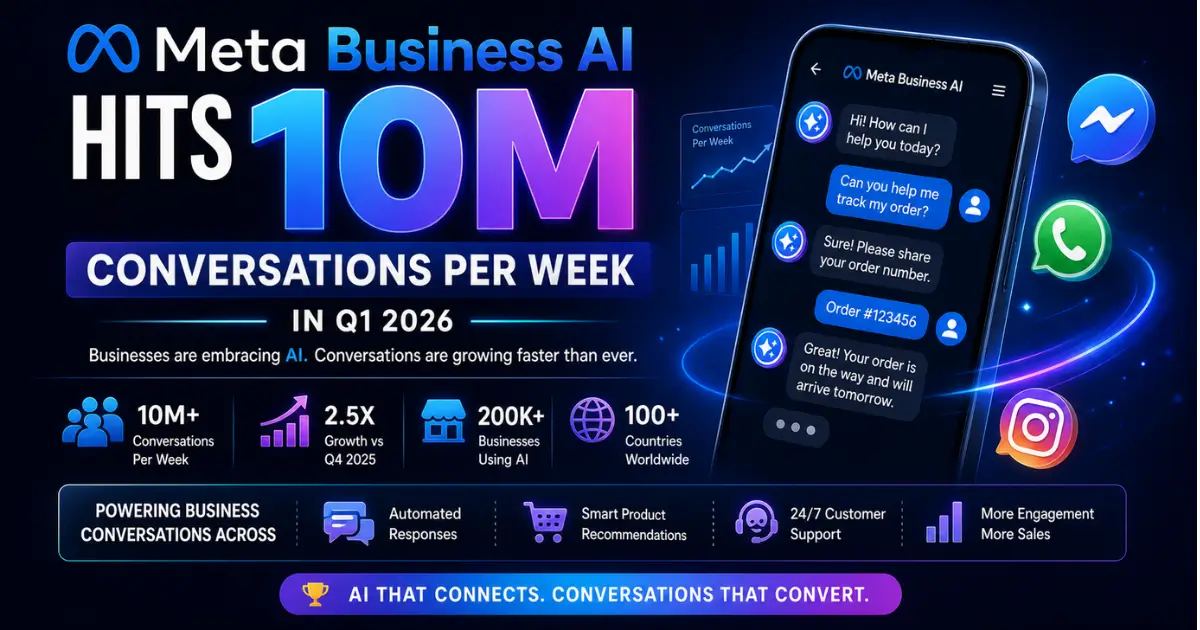
Meta's business AI tools now handle 10 million conversations per week — up from just 1 million at the start of the year. The 10x growth in three months signals that small businesses are rapidly adopting AI-powered customer engagement. Meta is not charging for the tools yet. But CEO Mark Zuckerberg hinted during the earnings call that monetization is coming.
The Growth Trajectory
The business AI assistant helps companies respond to customer messages across WhatsApp, Messenger, and Instagram. Meta expanded the beta program globally earlier this year, rolling it out across the US, EMEA, APAC, and LATAM regions. The result: conversations jumped from 1 million to 10 million weekly in roughly three months.
The tools are currently free. Meta is offering them at no cost to achieve scale before introducing paid features. Zuckerberg said the company expects to establish a longer-term monetization model as the products mature. The strategy mirrors how Meta built its advertising business — give away the platform, build a massive user base, then monetize once adoption is entrenched.
Muse Spark Powers the Backend
The business AI tools are being powered by Muse Spark, Meta's new large language model released under its Superintelligence Labs division. Muse Spark represents a ground-up overhaul of Meta's AI capabilities. By running business conversations on its own model rather than third-party AI, Meta controls the full stack — from model to distribution to customer relationship.
The approach is different from competitors like Microsoft Copilot, which targets enterprise productivity, or Anthropic and OpenAI, which primarily sell through APIs and cloud partnerships. Meta's business AI is embedded directly into messaging apps that billions of people already use. The distribution advantage is enormous.
AI Ad Creative Tools Are Scaling
Beyond conversations, Meta's AI creative tools for advertisers are also gaining traction. Over 8 million advertisers now use at least one of Meta's generative AI ad creative tools. Adoption is particularly strong among small and medium-sized businesses. Advertisers using Meta's video generation feature are seeing more than 3 percent higher conversion rates in tests.
Meta is also launching an open beta of Ads AI Connectors this week. The feature lets advertisers connect their Meta ad account to an AI agent — creating a direct link between AI-powered ad creation and campaign management.
The ad creative numbers are significant because they point toward Meta's real AI monetization opportunity. If AI tools measurably improve ad performance, advertisers will spend more. That spending flows directly into Meta's revenue. Unlike the business messaging tools, which are still free, AI-enhanced advertising is already generating incremental revenue.
The Financial Picture
Meta reported $56.3 billion in Q1 2026 revenue, up 33 percent year-over-year. Profit reached $26.8 billion, up from $16.6 billion a year earlier. Apps revenue — including paid WhatsApp messaging and subscriptions — reached $885 million.
The earnings came alongside the company's ongoing Reality Labs losses of $4.2 billion and massive capital expenditure projections of $115 to $135 billion for the year. Meta is spending on every front simultaneously — AI infrastructure, AR/VR hardware, custom chips, and even space-based solar power.
Why It Matters
Meta's business AI growth matters because it represents something most AI companies have struggled to achieve: genuine adoption by non-technical users at massive scale. Small business owners are not AI researchers. They need tools that work inside the apps they already use — WhatsApp, Messenger, Instagram. Meta is the only company that controls all three.
If Meta successfully monetizes 10 million weekly business conversations — and that number keeps growing — it creates a new revenue stream that is completely independent of advertising. Combined with AI-enhanced ad tools that are already improving conversion rates, Meta's AI strategy is beginning to produce measurable business results rather than just impressive user numbers.
For the broader AI industry, Meta's earnings show that AI monetization is not limited to enterprise coding tools and cloud infrastructure. The biggest opportunity may be embedding AI into the platforms where small businesses already live and charging them once they cannot imagine working without it.