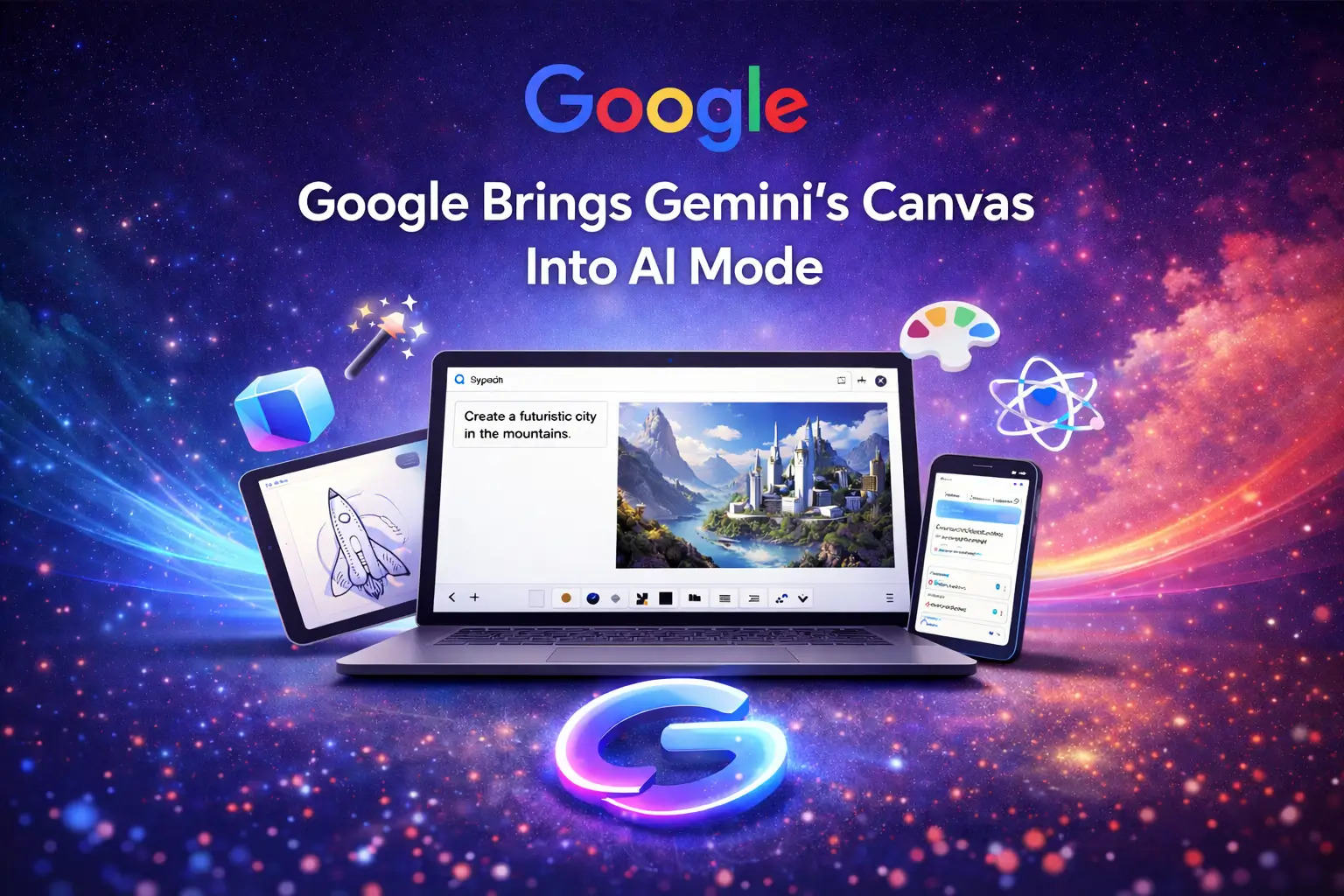
With Canvas now accessible to every U.S. user directly from Google Search, the company has quietly redefined what a search engine is supposed to do.
The Lead: A Search Bar That Builds Things
The moment Google Search became a creation tool is March 4, 2026. That is the date Canvas previously confined to paying Gemini subscribers landed inside AI Mode for every U.S. user, at no additional cost. No subscription. No sign-up. Just a search box that can now write your documents, generate functional web apps, build quizzes, and produce audio overviews.
This is not an incremental update. For twenty-five years, search engines have been retrieval machines. You ask; they point. What Google shipped this week turns that paradigm on its head: you describe, and Search builds. The implications for how people work, learn, and create online are substantial and the competitive fallout for rivals is immediate.
How It Works: Under the Hood of Canvas in AI Mode
The Access Point
Canvas surfaces through a new option in the tool menu the '+' icon inside Google's AI Mode interface. Users tap it, describe what they want to create, and a side panel opens. That panel is the Canvas workspace.
What Canvas Can Actually Do
Once inside, users can pull in real-time information from the web and from Google's Knowledge Graph. The synthesis happens live Canvas does not paste content; it contextualizes it.
Documented capabilities include:
Drafting and refining long-form documents with iterative chat-based feedback
Converting a research report into a web page, interactive quiz, or audio overview
Writing and testing code for functional prototypes and shareable apps or games
Uploading external sources such as class notes to build structured study guides
Toggling between the rendered output and the underlying code for any generated app
The Gemini Engine Underneath
Canvas in AI Mode runs on Gemini. Paid subscribers to Google AI Pro and AI Ultra additionally access Gemini 3 and a 1 million-token context window enabling significantly more complex, multi-source projects. The free AI Mode version uses an unspecified model tier, giving Google a clean upsell path without stripping out core utility.
One Key Difference From ChatGPT's Canvas
ChatGPT's Canvas feature triggers automatically based on the query, while Google and Anthropic's Claude require more deliberate interaction. That is a design choice, not a limitation it keeps standard searches fast while offering depth on demand.
Why This Matters for the Industry
The Reach Advantage
Google Search processes an estimated 8.5 billion queries per day. By embedding Canvas inside AI Mode, Google has instantly given its generative creation tool a distribution footprint that rivals cannot match through standalone products. Most users who encounter Canvas this week have never opened Gemini.ai or ChatGPT.
Competitive Pressure Points
OpenAI / ChatGPT — Canvas competes directly with ChatGPT's equivalent feature. Google's edge is Knowledge Graph integration: Canvas draws on structured, curated real-world data, not just model inference. OpenAI does not have a comparable proprietary knowledge layer baked into its search surface.
NotebookLM — Canvas has notable functional overlap with Google's own NotebookLM research tool. Whether Google cannibalizes one product with the other, or carves out distinct positioning, is a strategic question the company has not yet answered publicly.
Microsoft Copilot — Canvas creates a free, browser-native alternative to Copilot's document-building features without requiring a Microsoft 365 subscription.
Risks, Limitations, and Ethical Considerations
Accuracy and Hallucination Risk
Canvas inherits the core weakness of all large language models: confident-sounding outputs that are factually wrong. When users build study guides or research reports directly inside Search, the risk of laundering a hallucination into a "finished document" increases significantly compared to traditional search, where users still cross-reference sources themselves.
Intellectual Property Concerns
When Canvas synthesizes web content into a document or transforms a research report into a new format, questions around copyright attribution surface quickly. Google has not publicly clarified how Canvas handles sourcing or whether generated outputs carry licensing implications for commercial use.
The Dependency Problem
Lowering the friction for AI-generated content is a double-edged move. Users who rely on Canvas to draft, organize, and publish without developing underlying skills trade short-term efficiency for long-term capability erosion. This is particularly relevant in educational contexts, where Canvas's study-guide feature is explicitly positioned.
The Road Ahead: Where Canvas Goes From Here
Canvas in AI Mode is a foundation, not a finished product. Over the next year, expect:
Deeper Google Workspace integration — Canvas outputs feeding directly into Docs, Sheets, and Slides without leaving the browser
Multimodal input expansion — image, video, and audio uploads feeding Canvas projects, not just text and PDFs
Collaborative Canvas sessions — shared workspaces for teams, bringing it closer to Notion or Coda territory
Tighter NotebookLM convergence — or a formal strategic split, once Google determines which product owns the "deep research" use case
Regulatory scrutiny — as Canvas blurs the line between search result and generated content, EU and U.S. regulators examining AI output labeling will likely take notice
The browser is becoming an IDE for thought. Google just made sure it controls the compiler.
Key Takeaways
Canvas in AI Mode is now free for all U.S. users in English no Gemini subscription required
Users can draft documents, build apps, create quizzes, and generate audio overviews directly inside Search
Knowledge Graph integration distinguishes Canvas from pure LLM tools offered by rivals
Paid tiers (Google AI Pro / Ultra) unlock Gemini 3 and a 1 million-token context window for heavier workloads
The rollout intensifies pressure on OpenAI, Microsoft Copilot, and Google's own NotebookLM
Hallucination risk, IP ambiguity, and skill dependency remain unresolved concerns