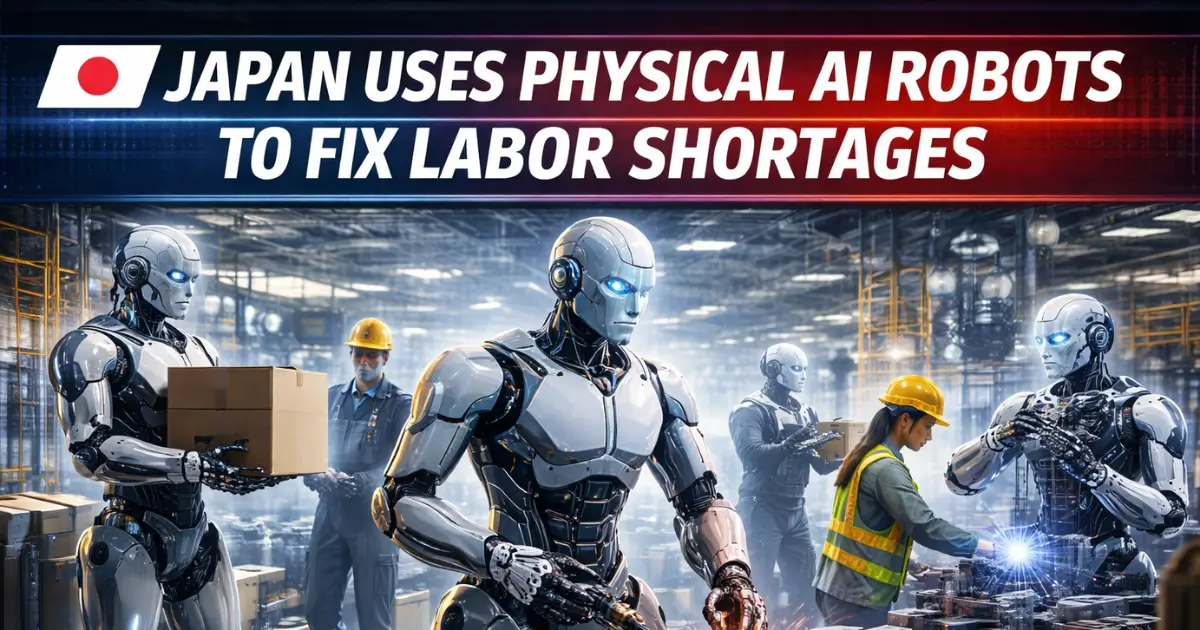
Across Japan's factories, warehouses, and infrastructure sites, a quiet revolution is underway. Robots powered by physical AI are no longer experimental they are stepping in to fill roles that a shrinking human workforce simply cannot cover. Japan's push into physical AI is not about chasing a tech trend; it is about national survival.
Driven by Labor Shortages
Japan's demographic crunch is accelerating. The population declined for a 14th straight year in 2024, and those of working age make up just 59.6% of the total a share projected to shrink by nearly 15 million over the next 20 years.
A 2024 Reuters/Nikkei survey found that labor shortages are the main force pushing Japanese firms to adopt AI. This is not about efficiency gains it is about keeping the lights on.
Sho Yamanaka, a principal with Salesforce Ventures, put it plainly: Japan faces a physical supply constraint where essential services cannot be sustained due to a lack of labor, making physical AI a matter of national urgency to maintain industrial standards and social services.
Japan's Ministry of Economy, Trade and Industry has set an ambitious target to build a domestic physical AI sector and capture a 30% share of the global market by 2040, building on a position where Japanese manufacturers already account for about 70% of the global industrial robotics market.
Hardware Strength, System Risk
Japan continues to demonstrate strength in core robotics components such as actuators, sensors, and control systems, while the U.S. and China are moving more quickly to develop full-stack systems that integrate hardware, software, and data.
Yamanaka described Japan's expertise in high-precision components as a strategic moat, calling it the critical physical interface between AI and the real world one that provides significant competitive advantage in the global supply chain.
However, translating hardware dominance into the AI era is not automatic. Mujin CEO Issei Takino noted that in robotics and physical AI, a deep understanding of hardware's physical characteristics is critical requiring not only software capabilities but also highly specialized control technologies that take significant time to develop and involve high costs of failure.
From Pilots to Real-World Deployment
The shift from experimentation to genuine deployment is already well underway. Under Prime Minister Sanae Takaichi, Japan has committed about $6.3 billion to strengthen core AI capabilities, advance robotics integration, and support industrial deployment.
Industrial automation remains the most advanced segment, with Japan installing tens of thousands of robots each year, particularly in the automotive sector. In logistics, automated forklifts and warehouse systems are becoming standard, while inspection robots are being deployed in data centers and industrial sites.
Hogil Doh, general partner at Global Brain, described the key signals of maturity: customer-paid deployments rather than vendor-funded trials, reliable operation across full shifts, and measurable performance metrics such as uptime, human intervention rates, and productivity impact.
The Rise of Hybrid Ecosystems
Rather than a winner-take-all dynamic, industry participants expect a hybrid model with established companies providing scale and reliability, while startups drive innovation in software and system design.
Large incumbents including Toyota, Mitsubishi Electric, and Honda retain significant advantages in manufacturing scale, customer relationships, and deployment capabilities. But startups are carving out critical roles in emerging areas such as orchestration software, perception systems, and workflow automation.
Yamanaka described the relationship between startups and established corporations as a mutually complementary ecosystem one where fusing the vast assets of major corporations with the disruptive innovation of startups can strengthen Japan's collective global competitiveness.
Doh summed up where the lasting value will be created: whoever owns deployment, integration, and continuous improvement will hold the most defensible position.
Japan is not waiting for the future of physical AI to arrive. It is already building it one robot at a time, in the jobs no one else will take.