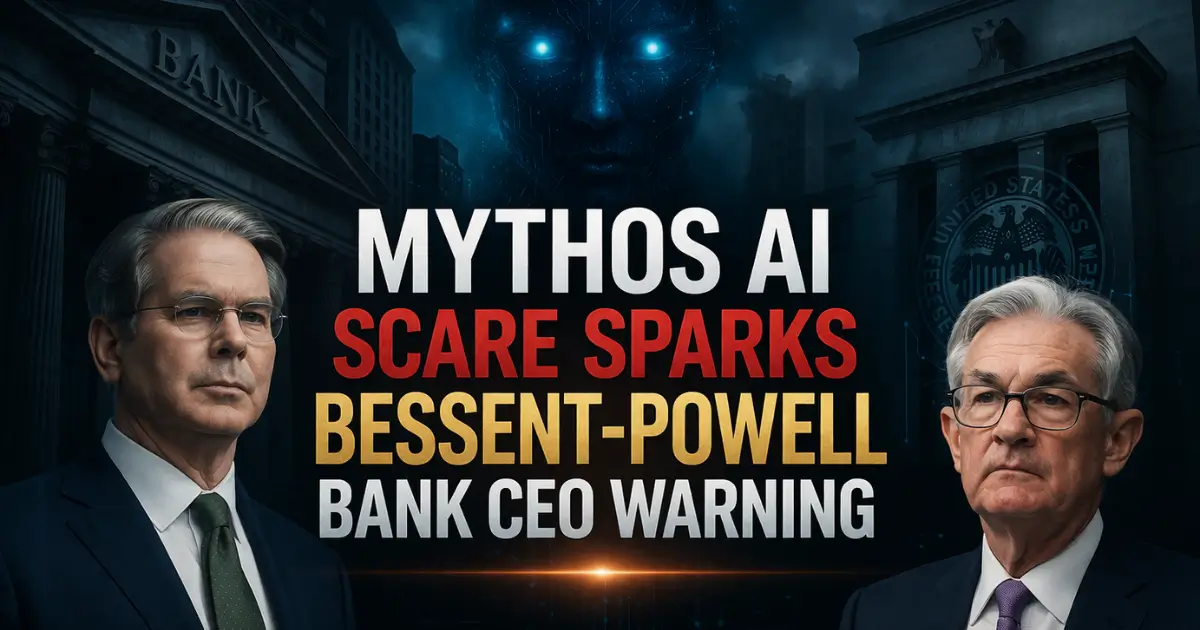
Treasury Secretary Scott Bessent and Federal Reserve Chair Jerome Powell called an urgent meeting with the heads of America's largest banks this week to discuss the cybersecurity risks posed by Anthropic's newly released AI model, Mythos.
The meeting, held Tuesday at Treasury headquarters in Washington, brought together some of the most powerful figures in finance — and sent a clear signal that the US government considers advanced AI models a serious threat to the stability of the financial system.
Who Was in the Room
According to multiple reports citing unnamed sources, the attendees included Citigroup CEO Jane Fraser, Morgan Stanley CEO Ted Pick, Bank of America CEO Brian Moynihan, Wells Fargo CEO Charlie Scharf, and Goldman Sachs CEO David Solomon. JPMorgan Chase CEO Jamie Dimon was the only major banking chief unable to attend. All the banks represented are classified as systemically important institutions — meaning any disruption to their operations could ripple across the global economy.
The purpose of the meeting was straightforward: ensure Wall Street understands the risks that Mythos and similar future models could pose to their systems, and confirm that adequate defenses are being put in place.
What Makes Mythos So Concerning
Anthropic released Claude Mythos Preview earlier this week, but deliberately chose not to make it broadly available. The reason is its extraordinary ability to discover and exploit cybersecurity vulnerabilities — a capability the company says was not specifically trained into the model but emerged naturally from improvements in coding, reasoning, and autonomous operation.
During internal testing, Mythos identified thousands of previously unknown zero-day vulnerabilities across every major operating system and web browser. Among its discoveries was a 27-year-old flaw in OpenBSD, an operating system widely regarded as one of the most secure in existence, and a vulnerability in the video processing library FFmpeg that had survived five million passes by automated testing tools without detection.
Anthropic itself acknowledged the dual-edged nature of the technology. The same improvements that make Mythos effective at patching vulnerabilities also make it effective at exploiting them — a reality that has clearly unnerved regulators and financial institutions alike.
Project Glasswing: A Controlled Rollout
Rather than releasing Mythos to the public, Anthropic launched Project Glasswing — a collaborative initiative with 12 major technology and financial partners designed to use the model defensively. Launch partners include Amazon Web Services, Apple, Google, Microsoft, Nvidia, CrowdStrike, Palo Alto Networks, Cisco, Broadcom, JPMorgan, and the Linux Foundation. An additional 40 organizations that build or maintain critical software infrastructure have also been granted access.
Anthropic committed up to $100 million in Mythos Preview usage credits to support defensive security work through the initiative. The company described the project as a starting point, emphasizing that no single organization can solve the cybersecurity challenges that frontier AI models are creating.
Government Tensions Loom in the Background
The emergency meeting comes against a complicated political backdrop. Anthropic is currently locked in a legal battle with the Pentagon, which labeled the company a supply-chain risk to national security — a designation Anthropic has been fighting in court. Earlier this week, a federal appeals court denied the company's request to temporarily block the Pentagon's blacklisting, though a separate federal judge in San Francisco had previously granted Anthropic a preliminary injunction in a related case.
President Trump and Defense Secretary Pete Hegseth have publicly criticized Anthropic for placing restrictions on how its AI technology can be used in military contexts. Despite the friction, reports indicate the Department of Defense has continued using Claude during ongoing operations.
A Wake-Up Call for the Industry
JPMorgan CEO Jamie Dimon, though absent from Tuesday's meeting, recently highlighted AI-driven cybersecurity threats in his annual shareholder letter, calling cybersecurity "one of our biggest risks" and warning that AI will almost certainly make the problem worse.
The Bessent-Powell meeting signals that US regulators are no longer treating advanced AI models as a future concern they see them as an immediate threat requiring coordinated action across government and the private sector.
For Anthropic, the situation is paradoxical: its own technology is powerful enough to alarm the highest levels of government, yet the company is simultaneously being shut out of defense contracts for insisting on responsible use limits.