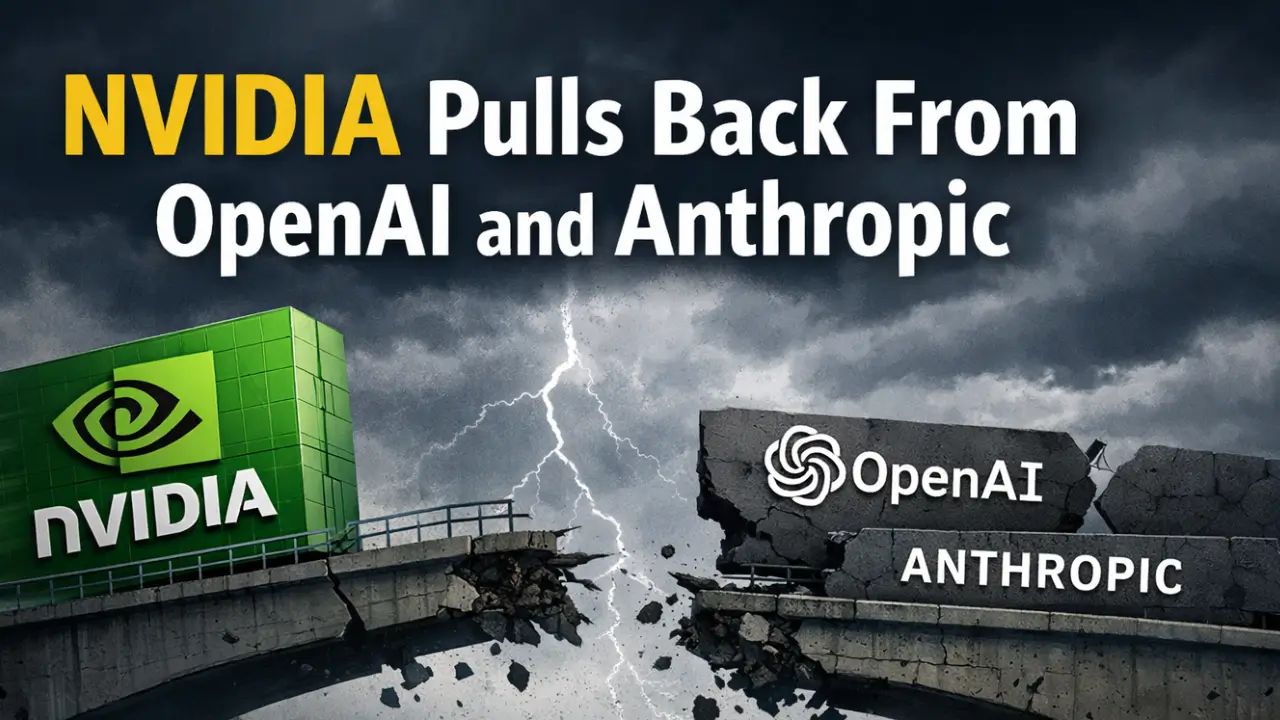
Jensen Huang's stated reason for stepping away from two of the most valuable AI companies on earth is technically plausible. It is also hard to fully believe.
The Lead: When the Chip Maker Quietly Exits the Room
Nvidia built its current dominance by selling shovels in a gold rush. OpenAI and Anthropic are two of its biggest customers. So when CEO Jensen Huang confirmed this week that Nvidia will likely make no further investments in either company, the obvious question is not whether it happened — it is why.
At the Morgan Stanley Technology, Media and Telecom conference in San Francisco, Huang said that once OpenAI and Anthropic go public as anticipated later this year, the opportunity to invest closes. Simple enough. Except that is not really how late-stage private investing works — and the political firestorm surrounding both companies suggests the real explanation runs considerably deeper.
How It Works: The Investment Structure Behind the Headlines
The Circular Money Loop
When Nvidia first announced it would invest up to $100 billion in OpenAI last September, MIT Sloan professor Michael Cusumano described it as "kind of a wash," observing that Nvidia is investing in OpenAI stock while OpenAI commits to buying Nvidia chips.
In plain terms: Nvidia's money goes into OpenAI, and OpenAI's money comes back to Nvidia as hardware purchases. The investment was always more about strategic signaling than financial return.
The Shrinking Commitment
The investment Nvidia finalized last week as part of OpenAI's $110 billion round came in at $30 billion — well short of the $100 billion it had once pledged. Huang acknowledged as much, saying investing the full amount is "probably not in the cards."
That is a $70 billion retreat that deserves more than a shrug.
Nvidia's Official Explanation
Asked for comment, a Nvidia spokesman pointed to a transcript from the company's fourth-quarter earnings call, where Huang said all of Nvidia's investments are "focused very squarely, strategically on expanding and deepening our ecosystem reach."
That is a non-answer dressed as a strategy statement.
Why This Matters for the Industry
The OpenAI–Anthropic Fault Line Widens
Nvidia now holds stakes in two companies that are pulling in very different directions — one newly aligned with the Defense Department, and the other blacklisted by it.
This is not an abstract portfolio problem. It is a reputational and political liability that no amount of chip revenue can easily offset.
The Anthropic Fallout
Just two months after Nvidia announced a $10 billion investment in Anthropic alongside a "deep technology partnership," CEO Dario Amodei took the stage at Davos and, without naming Nvidia directly, compared the act of U.S. chip companies selling high-performance AI processors to approved Chinese customers to "selling nuclear weapons to North Korea."
When your portfolio company publicly attacks your core business from a global stage, the partnership dynamic has fundamentally broken down.
The Pentagon Dimension
The Trump administration blacklisted Anthropic, barring federal agencies and military contractors from using its tech after the company refused to allow its models to be used for autonomous weapons or mass domestic surveillance. Within hours of that announcement, OpenAI struck its own deal with the Pentagon.
Nvidia now sits at the intersection of that conflict — invested in both sides of one of the most politically charged disputes in the AI industry.
What It Signals to the Market
The pullback tells other investors that even the most strategically positioned players in AI are finding these relationships difficult to manage. When Nvidia — with every financial incentive to stay close to both companies — quietly steps back, it validates concerns about the long-term stability of AI's current investment architecture.
Risks, Limitations, and Ethical Considerations
The IPO Excuse Doesn't Hold Up
Huang's stated reason for pulling back — that the IPO window closes the door on this kind of deal — is hard to square with how late-stage private investing actually works. Firms routinely invest in pre-IPO companies at valuations that dwarf earlier rounds. The door does not close; it just gets more expensive.
Conflict of Interest at Scale
Nvidia supplies chips to OpenAI, Anthropic, Google, Microsoft, and virtually every major AI lab simultaneously. Taking equity positions in any of them creates a structural conflict — favoritism in chip allocation, preferential pricing, or technology access becomes a legitimate concern. Pulling back may be less about opportunity and more about legal and reputational hygiene.
The National Security Variable
As AI becomes entwined with defense contracts and government policy, private investment stakes carry geopolitical weight. Nvidia's exposure to Chinese markets, its role in U.S. AI infrastructure, and the Pentagon's growing interest in AI governance create a compliance environment where holding equity in a blacklisted company is not a neutral act.
The Road Ahead: Where Nvidia's AI Strategy Goes From Here
The pullback does not weaken Nvidia's position — it may actually clarify it. Over the next 12 months, expect:
Nvidia doubles down on infrastructure neutrality — positioning itself as the Switzerland of AI compute, supplying all sides without taking sides
Ecosystem investment shifts downstream — rather than backing frontier model labs, Nvidia funds enterprise software, tooling, and deployment platforms built on its hardware
IPO complications surface — if OpenAI or Anthropic's valuations contract post-listing, Nvidia's reduced stake becomes retroactively smart risk management
Regulatory pressure increases — Congress and the EU will scrutinize chip-maker equity positions in AI labs as a potential vector for market concentration
New strategic bets emerge — Nvidia's next investments will likely target robotics, physical AI, and sovereign compute infrastructure — areas with less political turbulence than frontier LLM labs
The chip business prints money regardless of who wins the model race. Nvidia stepping back from the equity game is not a retreat — it is a recalibration toward a position that does not require picking a winner.
Key Takeaways
Nvidia will likely make no further investments in OpenAI or Anthropic once both companies go public
The official reason — IPO access closing — does not fully explain the scale of the retreat
The $100 billion OpenAI pledge shrank to $30 billion; Anthropic's partnership soured publicly at Davos
Nvidia now holds stakes in two companies on opposite sides of a Pentagon dispute
The real driver appears to be political, reputational, and strategic complexity — not opportunity cost
Nvidia's hardware dominance remains untouched regardless of investment posture