Imagine two AI giants, both knocking on the Pentagon's door. One walks away empty-handed. The other rushes in, signs on the dotted lineand immediately faces a storm of questions. This is the story of what happened between Anthropic, OpenAI, and the U.S. Department of Defense. And it's a story with no clear heroes yet.
First, the Fallout at Anthropic
Last Friday, negotiations between Anthropic the company behind Claude and the Pentagon fell apart completely. prompting a massive wave of users to switch to Claude.
What followed was swift and brutal. President Donald Trump directed federal agencies to stop using Anthropic's technology after a six-month transition period. Secretary of Defense Pete Hegseth went even further, labeling Anthropic a supply-chain risk a serious designation that signals deep mistrust.
Why did talks break down? Anthropic had drawn clear red lines:
No use of its AI in fully autonomous weapons
No use for mass domestic surveillance
These weren't vague preferences. They were firm conditions. And apparently, they were dealbreakers.
Then OpenAI Moved Fast
With Anthropic out of the picture, OpenAI moved quickly perhaps too quickly.
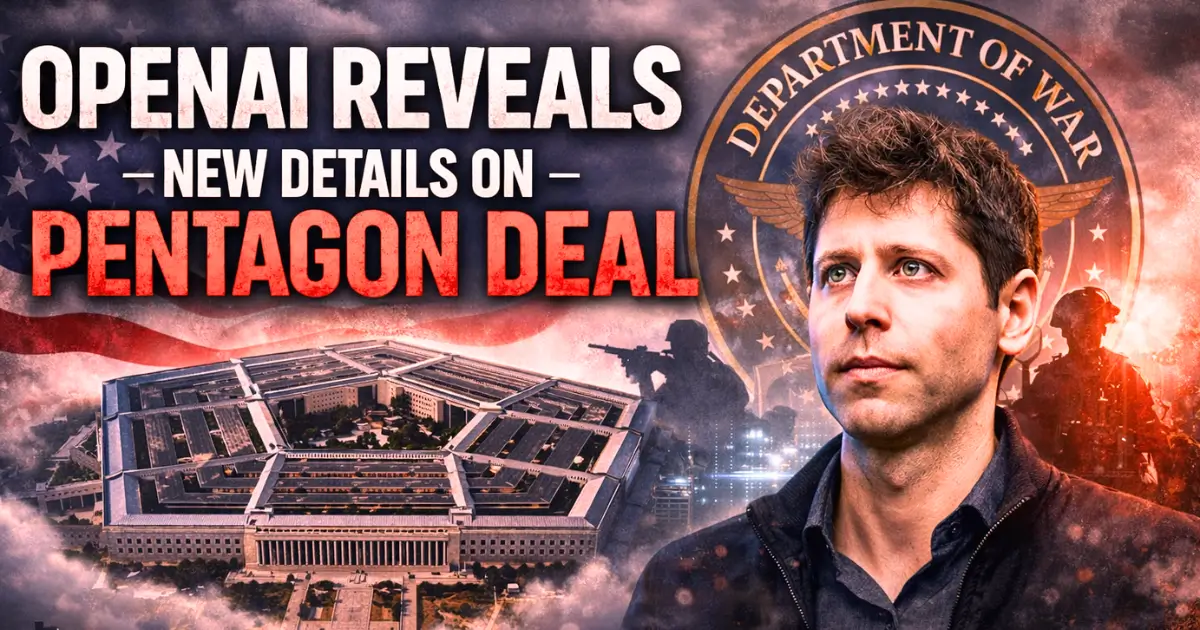
Within days, OpenAI announced it had secured its own deal with the Pentagon, with its models approved for deployment in classified environments. CEO Sam Altman later admitted the agreement was "definitely rushed" and that "the optics don't look good."
That's quite an admission from the head of one of the world's most powerful AI companies.
But here's where it gets interesting: Altman claimed OpenAI had the same red lines as Anthropic no autonomous weapons, no mass surveillance. So the obvious question on everyone's mind became: If they have the same limits, why could OpenAI make a deal while Anthropic couldn't?
What OpenAI's Blog Post Actually Said
To answer the growing criticism, OpenAI published a detailed blog post explaining their approach.
According to the company, its models cannot be used for:
Mass domestic surveillance
Autonomous weapon systems
High-stakes automated decisions (like social credit scoring systems)
OpenAI also took a subtle dig at competitors, claiming that unlike other AI companies that have "reduced or removed their safety guardrails" in national security deployments, OpenAI protects its limits through a multi-layered approach:
They retain full control over their safety systems
Deployment is done via cloud (not direct hardware integration)
Cleared OpenAI personnel remain involved
Strong contractual protections are in place
The post ended with a line that raised more than a few eyebrows: "We don't know why Anthropic could not reach this deal, and we hope that they and more labs will consider it."
The Controversy Doesn't Stop There
Not everyone was convinced by OpenAI's explanations.
Tech writer Mike Masnick from Techdirt argued that the deal does allow for domestic surveillance pointing to a reference in the contract to Executive Order 12333, a legal framework that critics say allows the NSA to capture communications outside U.S. borders, even when those communications involve American citizens.
In plain terms: the language OpenAI used may have a very large loophole baked right into it.
OpenAI's Head of National Security Partnerships, Katrina Mulligan, pushed back on this reading. She argued that people were focusing too much on contract language and not enough on deployment architecture the technical structure of how the AI is actually used.
"By limiting our deployment to cloud API, we can ensure that our models cannot be integrated directly into weapons systems, sensors, or other operational hardware," she wrote on LinkedIn.
It's a fair point. But it hasn't fully silenced the critics.
The Real Reason OpenAI Rushed In
So why did OpenAI sign a deal it knew looked bad?
Altman's answer was surprisingly candid. He said OpenAI wanted to de-escalate tensions between the Pentagon and the broader AI industry and believed the terms on offer were acceptable.
"If we are right and this does lead to a de-escalation," Altman said, "we will look like geniuses. If not, we will continue to be characterized as rushed and uncareful."
The market had its own immediate verdict. By Saturday, Anthropic's Claude had overtaken OpenAI's ChatGPT in Apple's App Store rankings a sign that many users sided with the company that walked away.
What This Means Going Forward
This story is far from over. It raises questions that the entire AI industry will have to answer:
Where exactly is the line between national security and civil liberties?
Can AI companies truly enforce red lines once their models are inside government systems?
And is moving fast even in the name of de-escalation ever actually a good strategy?
The Pentagon deal may have been signed. But the debate it sparked has only just begun.