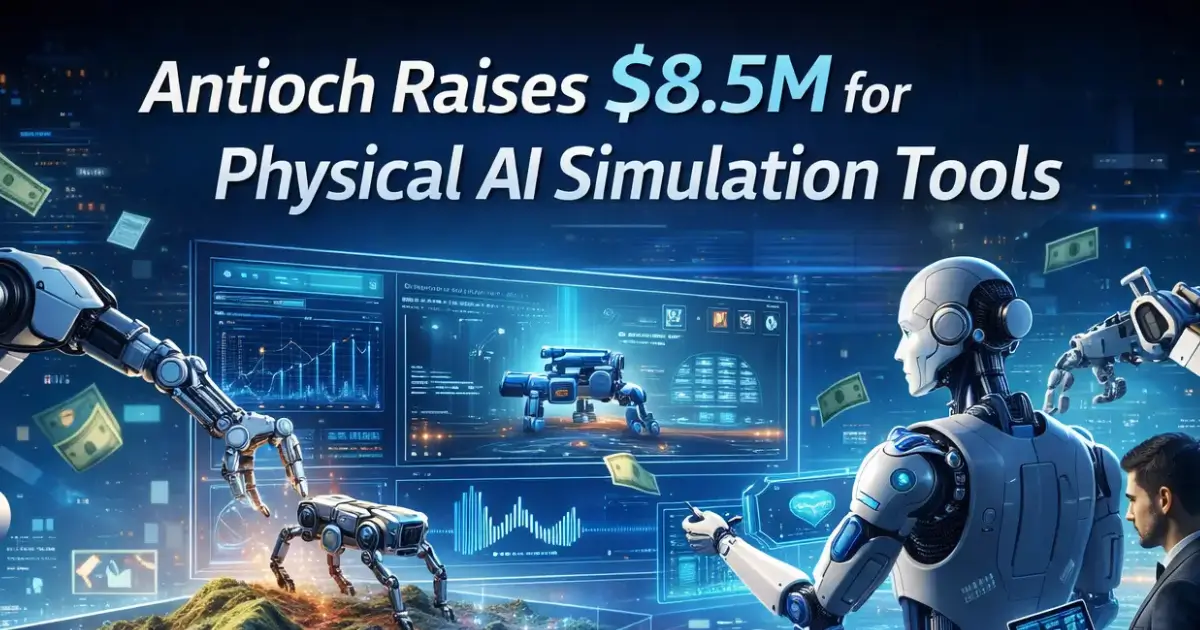
The robotics industry has a data problem. Unlike software, where developers can test and iterate in seconds, training physical AI systems requires enormous amounts of real-world data — data that is expensive, slow, and often dangerous to collect. A New York-based startup called Antioch believes simulation is the answer, and it just raised $8.5 million to prove it.
What Antioch Is Building
Antioch is developing a simulation platform that lets robotics companies create detailed virtual replicas of real-world environments. Inside these digital spaces, developers can spin up multiple instances of their hardware, connect them to simulated sensors, and test everything from edge cases to reinforcement learning — all without building a single physical prototype.
The company's pitch is straightforward: close the sim-to-real gap. That gap refers to the persistent challenge of making virtual environments realistic enough that robots trained inside them can operate reliably in the physical world. If the physics in the simulation do not match reality, the robot fails when it encounters the real thing.
Antioch CEO Harry Mellsop explained that the goal is to make simulation feel indistinguishable from the real world from the perspective of an autonomous system. The company starts with models built by Nvidia, World Labs, and others, then builds domain-specific libraries to make them practical for robot developers.
The Cursor Comparison
Antioch executives compare their product to Cursor, the popular AI-powered coding tool. Just as Cursor helps software developers write better code faster, Antioch wants to help robotics engineers build and test autonomous systems entirely in software before deploying them in the real world.
The comparison highlights a broader trend. What happened with AI agents in software engineering is beginning to happen in physical AI. Digital tools are replacing manual processes, and the companies that build the best platforms for this transition stand to capture enormous value.
Why Simulation Matters Now
The demand for better simulation tools is growing across multiple industries. Self-driving car companies like Waymo already use Google DeepMind's world model to test driving systems in virtual environments. But most of the robotics industry — from warehouse automation to agricultural machinery to aerial drones — still operates without simulation entirely.
Mellsop says the vast majority of physical AI companies do not use simulation at all, and the industry is only now recognizing that it needs to move faster. Smaller companies lack the capital to build physical testing arenas or drive sensor-equipped vehicles for millions of miles. Simulation offers a scalable alternative.
Category Ventures partner Çağla Kaymaz drew a sharp distinction between software and physical AI development. In software, a bad coding tool carries limited risk. In the physical world, the stakes are dramatically higher — a robot that fails in a warehouse or on a highway can cause real damage.
The Team and the Funding
The $8.5 million seed round values Antioch at $60 million. The round was led by A* and Category Ventures, with participation from MaC Venture Capital, Abstract, Box Group, and Icehouse Ventures. Angel investor Adrian Macneil, who previously built data infrastructure at self-driving startup Cruise, also backed the company.
Mellsop founded Antioch in May 2025 with four cofounders. Two of them — Alex Langshur and Michael Calvey — previously helped him build and sell Transpose, a security startup acquired by Chainalysis. The other two — Collin Schlager and Colton Swingle — came from Google DeepMind and Meta Reality Labs, bringing deep expertise in simulation and perception systems.
Early Customers and Research
Although Antioch is positioning itself as a startup tool, some of its earliest engagements have been with large multinationals already investing heavily in robotics. The platform is also being used in academic research — MIT researcher David Mayo is using Antioch's simulator to evaluate large language models by having them design robots and test them in simulated competitions.
The Bigger Picture
The physical AI revolution is still in its early stages, but the infrastructure supporting it is evolving rapidly. Antioch's bet is that within two to three years, anyone building an autonomous system for the real world will do so primarily in software. If that prediction holds, the companies providing the simulation platforms will be just as essential as the ones building the robots themselves.
The sim-to-real gap is narrowing. The question now is which platform will close it first.