After years of mixed signals around its wearable ambitions, Apple is quietly working on what could be its most consequential hardware launch since the Apple Watch — a pair of smart glasses. According to Bloomberg's Mark Gurman, Apple plans to sell its first smart glasses in 2027, with a possible public unveiling as early as the end of this year.
The product is still in development, but new details are beginning to emerge — and they paint a clearer picture of what Apple is going for.
Four Designs, One Vision
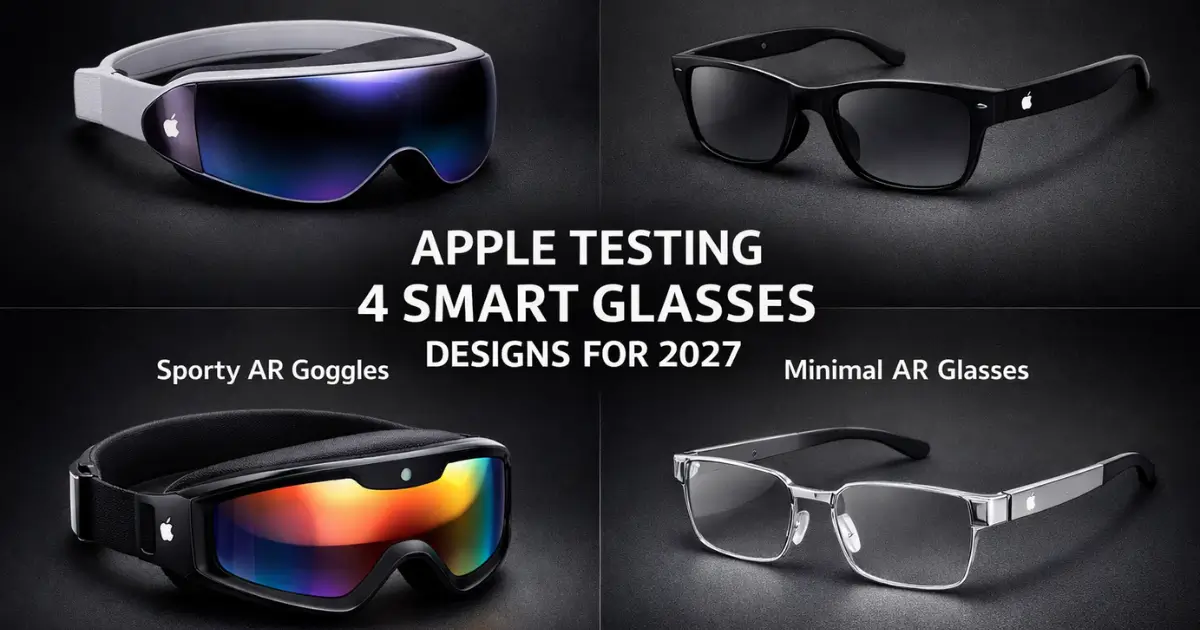
Apple is not walking into the smart glasses market with a single bet. Gurman reports that Apple is currently testing four distinct frame designs and could ultimately launch with some or all of them.
Those designs reportedly include a large rectangular frame, a slimmer rectangular frame similar to the glasses worn by CEO Tim Cook, a larger oval or circular frame, and a smaller oval or circular frame. Apple is also considering multiple color options including black, ocean blue, and light brown.
The variety of designs suggests Apple wants the glasses to feel like a genuine fashion accessory — not a gadget strapped to your face. This has been a persistent challenge for the wearables industry, and one that Meta has navigated more successfully than most with its Ray-Ban collaboration.
What These Glasses Will (and Won't) Do
Don't expect a heads-up display or holographic overlays. These glasses won't have any displays, but will allow users to take photos and videos — Apple is reportedly testing oval camera lenses — as well as answer phone calls, play music, and interact with the long-promised Siri upgrade.
That feature set puts Apple's offering firmly in the same category as Meta's Ray-Ban smart glasses, which have gained traction as a discreet, wearable AI companion. Apple's version will likely lean heavily on Siri — if the AI assistant can finally deliver on its long-delayed promises.
A Retreat From Bigger AR Ambitions
The smart glasses project represents a notable scaling back from Apple's original vision. In some ways, these glasses are a step back from an ambitious plan that once called for Apple to launch a variety of mixed and augmented reality devices — a plan that already stumbled with product delays and the lukewarm reception of the Vision Pro.
The Vision Pro, Apple's $3,499 spatial computing headset, never captured mass-market imagination the way the company had hoped. Production was reportedly scaled back due to disappointing demand, and Apple has since been rethinking its approach to wearable computing. The smart glasses appear to be a more pragmatic, consumer-friendly pivot.
The Meta Comparison Is Unavoidable
Apple's glasses sound closer to Meta's Ray-Ban glasses than to anything in the AR/VR space. Meta's Ray-Ban smart glasses — recently updated with prescription lens support — have become a quiet success story, offering camera, audio, and AI features in a form factor that people actually want to wear in public.
Apple will be entering a market where Meta has already built brand recognition and user habits. The key differentiator will likely be ecosystem integration — how seamlessly the glasses connect with iPhone, Apple Watch, AirPods, and the broader Apple universe — alongside the quality of the Siri-powered AI experience.
The Siri Problem
Any Apple smart glasses product will live or die by the quality of its AI assistant. Siri has long been the weakest link in Apple's lineup, consistently trailing Google Assistant and even ChatGPT in capability and reliability. Apple has promised a major Siri overhaul for years — and that upgrade has been delayed repeatedly.
If the smart glasses launch in 2027 as planned, Apple will need a significantly more capable Siri ready to go. The glasses will be a hands-free device by design, meaning voice interaction isn't just a feature — it's the entire user experience. A sluggish or unreliable assistant would undermine the product entirely.
What to Watch For
With a potential reveal before the end of 2026 and a commercial launch targeted for 2027, Apple's smart glasses are still a way off. But the fact that four designs are already in testing signals that the project is further along than many assumed.
The bigger question isn't whether Apple can build smart glasses — it's whether the company can deliver the AI experience that makes them worth wearing every day. If it can, Apple could quickly redefine what a smart glasses product looks like. If it can't, it risks repeating the Vision Pro's fate: impressive hardware, underwhelming reception.