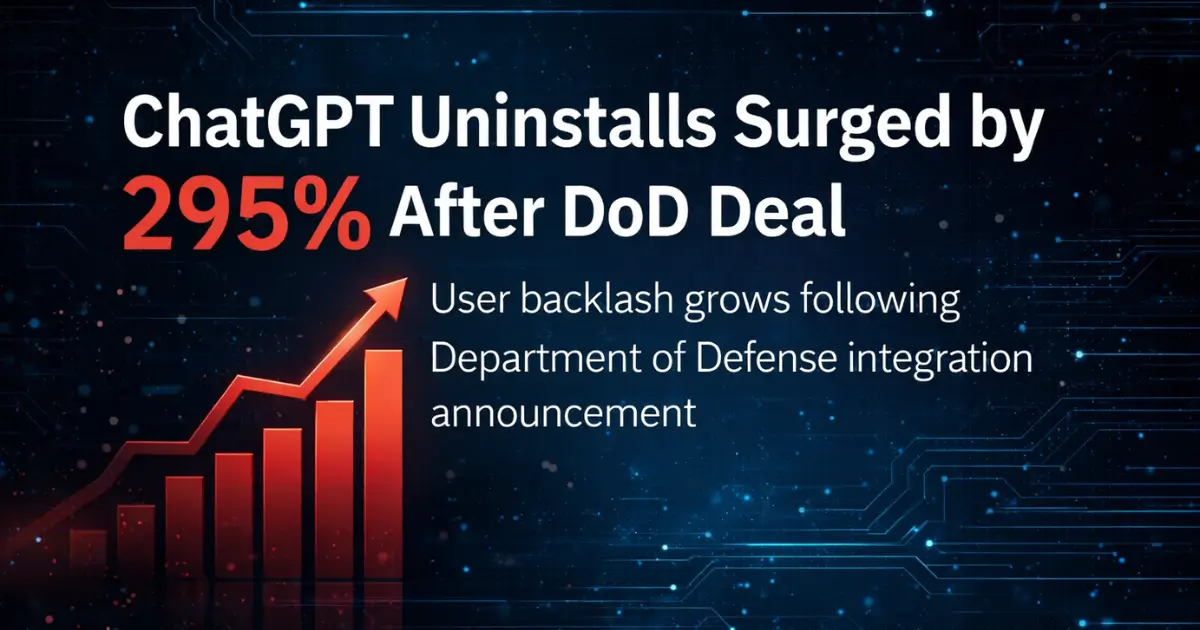
Within a day of news breaking that OpenAI would allow ChatGPT’s models to be deployed on a U.S. Department of Defense network, users reacted strongly. U.S. uninstalls of the ChatGPT mobile app jumped about 295% on Feb 28, 2026. This backlash reflects consumer concern over the Pentagon partnership. The article below explains why users are upset, how OpenAI’s DoD deal works technically, the strategic impact on the AI industry, and the ethical issues raised.
Key Takeaways
Instant user reaction: ChatGPT’s U.S. app uninstalls spiked 295% day-over-day once the DoD deal was announced. Meanwhile, downloads of Anthropic’s Claude surged (up 37% and 51% in the following days) as users switched to alternatives.
Regulatory context: The Department of Defense (recently renamed “Department of War”) had effectively blacklisted Anthropic because it refused unrestricted use. OpenAI stepped in with a modified deal.
Technical safeguards: The ChatGPT contract forbids certain uses: no mass domestic surveillance, no autonomous weapons, no high-stakes decision systems. ChatGPT will run on a government cloud (GenAI.mil) with OpenAI’s safety filters active. Only vetted OpenAI staff review flagged content.
Industry impact: The episode has reshaped the AI landscape. User trust matters for market share: ChatGPT’s ratings plummeted (1-star reviews jumped 775%) while Claude rose to #1 in the App Store. Competitors and regulators are rethinking how commercial AI products align with national security.
Ethical concerns: Observers warn that broad “all lawful uses” language could let the military do more than OpenAI admits. Experts note that, under current U.S. law, many surveillance actions are already permitted, so guardrails may be tested in practice. Privacy advocates worry about aggregated data analysis, while OpenAI and Anthropic emphasize that humans must stay “in the loop.”
Lead: Why It Matters Now
Tech companies rarely face this kind of immediate public backlash. The DoD partnership marks a first in which a military AI deal directly provoked mass user cancellations. Sensor Tower data show ChatGPT was averaging a 9% daily uninstall rate, but on Feb 28 it nearly tripled that baseline. Consumers apparently sided with Anthropic’s position: after Anthropic refused Pentagon terms for ethical reasons, its model Claude saw its downloads and App Store rank shoot up. This made news on March 2, 2026, highlighting how strategic decisions by AI labs are now playing out in consumer markets.
Meanwhile, the Pentagon’s official line was different. A Feb 9 press release from the U.S. Department of War celebrated “integrating ChatGPT into GenAI.mil,” its secure AI platform. The release touted improved mission readiness and a shift to an “AI-first enterprise,” without mentioning any limitations on use. In other words, the government emphasized capability over consumer concerns. This divergence—excited officials vs. uneasy users—drives the story’s tension.
Technical Breakdown: How the DoD Deal Works
OpenAI says it forced strict guardrails into the agreement. The company’s Feb 28 blog explicitly lists three forbidden use cases: (1) no mass domestic surveillance, (2) no directing autonomous weapon systems, and (3) no “high-stakes automated decisions” like social-credit scoring. These match Anthropic’s red lines, but OpenAI adds multiple layers of enforcement.
In practice, ChatGPT will be cloud-only on the DoD network. OpenAI will not provide a “guardrails-off” model and won’t install the model on any local weapons hardware. Instead, all queries flow through OpenAI’s servers, where a “safety stack” filters potentially harmful prompts. If a request violates a red line, the model is designed to refuse. OpenAI’s update explains that “cleared OpenAI personnel are in the loop,” meaning vetted staff will oversee flagged cases.
The contract reiterates that ChatGPT may only be used “for all lawful purposes,” but then specifies that “lawful” is bound by U.S. law such as the Fourth Amendment and the Foreign Intelligence Surveillance Act. In plain terms, OpenAI is promising that, as long as current law prohibits domestic spying and requires humans in weapons loops, ChatGPT will also abide. In fact, OpenAI notes the DoW agreed “our tools will not be used for domestic surveillance of U.S. persons” and that any use by intelligence agencies would need a new agreement.
In sum, the deal leaves on the table whatever U.S. law currently allows, but aims to prevent anything the law technically forbids. OpenAI claims these technical and contractual measures make this agreement more restrictive (“guardrails”) than past ones, even saying it has “more guardrails than any previous agreement ... including Anthropic’s.”
Why This Matters for the Industry
The ChatGPT–Pentagon deal jolted the AI market on several fronts:
Competitive landscape: Anthropic’s refusal now looks like a strategic win. Claude’s rapid climb to No. 1 on the App Store, driven by downloads surpassing ChatGPT, shows how consumer sentiment can reward “ethical branding.” Other firms (Google, Microsoft, etc.) will watch: those companies too have defense ties, but few users know the details. For example, Google quietly enabled Gemini on GenAI.mil earlier, yet it didn’t face mass boycotts. This shift pressures rivals to clearly state their own red lines or risk backlash.
User trust as business capital: The storm shows that trust and values are part of the product. Businesses using ChatGPT for customer support or research must now consider that some employees or customers might object if the brand is linked to controversial deals. Ensuring transparency about how ChatGPT is used could become a selling point.
Regulatory outlook: The incident is sparking policy debate. In the U.S., officials have already directed agencies to reject tech from companies that won’t make their models fully accessible. There’s talk of new AI export and procurement rules. Tech companies may pre-empt regulation by building in more explicit safety controls or audit hooks into their products.
End-user impact: Short term, end users experience potential benefits and downsides. On one hand, government involvement may accelerate improvements (for example, more funding for resilience and safety features). On the other, users worry their data might indirectly flow to the government. OpenAI claims user data on GenAI is siloed, but some still feel uneasy about privacy and sharing.
Ethical & Practical Considerations
The heated reaction highlights deep concerns about dual-use AI:
Privacy and surveillance: Even with OpenAI’s guarantees, experts warn the distinction between military and civilian use can blur. As one analysis noted, U.S. law currently allows broad data collection; a powerful AI could stitch together location, browsing, and other data into detailed profiles. If ChatGPT were tasked with analyzing such data (even if filtered), critics say it risks becoming a mass surveillance tool. OpenAI’s spokesperson insists the system “cannot be used to collect or analyze Americans’ data in a bulk,” but many users remain skeptical without independent oversight.
Weaponization: Autonomous weapons are another flashpoint. OpenAI argues its cloud-only model physically prevents embedding ChatGPT in a missile. Anthropic responded that today’s AI isn’t reliable enough for kill switches (they refused to hand off fully autonomous systems). The Pentagon says its AI use will follow existing laws and policies. But even the possibility of an AI error causing a wartime tragedy makes many uneasy.
Democratic oversight: OpenAI and Anthropic both emphasize that elected officials and military commanders (not tech CEOs) ultimately decide how to use the tech. OpenAI wrote it “believes strongly in democracy” and that lawmakers should guide AI’s role. Still, some argue that once a company builds the capability, even lawful use can change, so broad government access demands transparency. Calls for ongoing AI governance forums (as OpenAI and the War Dept. plan) reflect this need for continual evaluation.
Societal trust: This episode may permanently change how the public sees generative AI companies. If users feel their technology is “sold out” to military interests, it could dampen enthusiasm. Conversely, if handled well, companies that build in robust ethics might gain trust. Either way, the AI industry now recognizes that high-level deals can echo down to every end user.
Future Outlook (Next 12 Months)
In the coming year, expect more negotiation and scrutiny:
Working groups and standards: The DoW said it will convene leaders from AI labs to discuss “privacy and national security challenges.” This likely means formal protocols may emerge—for example, standardized security reviews or audit mechanisms. We may see new norms akin to how car safety standards developed.
Expanded contracts: Other companies (Google, xAI, Microsoft) may sign their own DoW deals or face pressure. Observers predict future agreements will lock in explicit permitted uses and compliance checks, rather than vague promises. Analysts suggest contracts will evolve to include things like audit rights and liability clauses to reinforce ethical commitments.
Regulatory response: Congress and regulators will watch closely. There are bills under discussion to regulate AI in the military and set privacy safeguards. Public concern could accelerate this. For instance, customers might demand “no military use” licensing tiers for AI, which could become a market niche.
Consumer behavior: ChatGPT’s consumer growth may pause or shift. If OpenAI rolls out new features or reassurances (like improved opt-out for data usage), it could stem the tide. But rivals will emphasize their positions. The market might become segmented by “trust and ethics” criteria in addition to features.
In short, this incident has already redefined the political economics of AI. We are entering an era where user sentiment, regulatory pressure, and national security concerns all shape technology roadmaps. Companies are likely to invest heavily in verifiable safety measures (cloud audits, AI alignment research, etc.) to avoid future revolts. Meanwhile, governments will push to embed AI responsibly in defense and public services. How this balancing act unfolds will steer the trajectory of generative AI over the next year.