
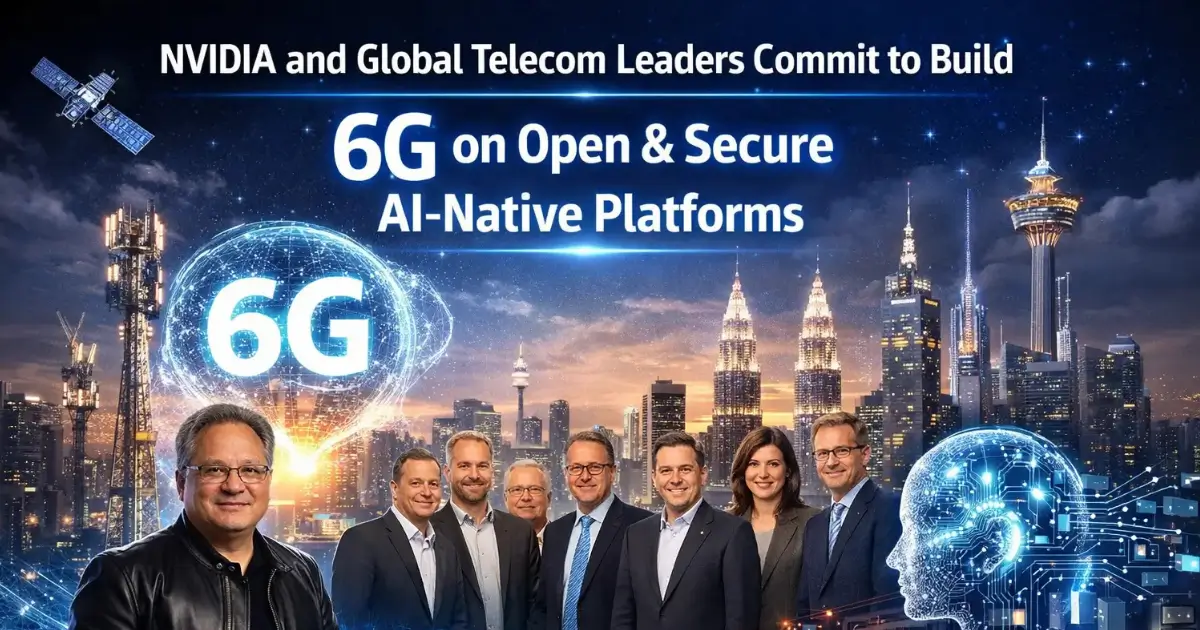
It's official. The race to 6G has just kicked into high gear. NVIDIA, alongside BT Group, Cisco, Deutsche Telekom, Ericsson, Nokia, SK Telecom, SoftBank, and T-Mobile, announced a joint commitment to build AI-native, open, and secure 6G networks. The initiative focuses on embedding AI across RAN, edge, and core infrastructure to power autonomous systems, enhance security, and drive global connectivity into a new era.
At Mobile World Congress in Barcelona, NVIDIA dropped a major announcement that could reshape the future of global connectivity. The chip giant, alongside some of the biggest names in telecom — including BT Group, Cisco, Deutsche Telekom, Ericsson, Nokia, SK Telecom, SoftBank, and T-Mobile — has committed to building the world's next-generation wireless networks on AI-native, open and secure platforms.
This isn't just a tech upgrade. This is the foundation for an entirely new era of connectivity.
Why 6G Matters More Than You Think
We're still in the middle of the 5G rollout, and already the industry is looking ahead. But 6G isn't just "faster 5G." It's being designed from the ground up to support something far bigger physical AI.
Think billions of autonomous machines, self-driving vehicles, intelligent robots, smart sensors, and connected systems that need to communicate in real time with zero room for error. The current wireless architecture simply wasn't built to handle this level of complexity, speed, and security.
That's exactly why NVIDIA is stepping in.
By embedding artificial intelligence directly into the radio access network, edge, and core infrastructure, 6G networks will be able to think, adapt, and secure themselves in ways that today's networks can't even imagine.
Jensen Huang's Bold Vision
NVIDIA CEO Jensen Huang didn't hold back in his statement. He called AI the force driving the largest infrastructure buildout in human history — and said telecommunications is the next frontier.
His vision is clear: transform the world's telecom networks into AI infrastructure that exists everywhere. Not just in data centers. Not just in the cloud. But in every cell tower, every edge device, every connected system across the globe. And he's not doing it alone.
This push comes as Microsoft's AI CEO predicts human-level automation of white-collar jobs within the next 18 months.
A Global Coalition Like No Other
The list of companies backing this initiative reads like a who's who of global telecom and technology. Booz Allen, MITRE, and ODC bring defense and security expertise. BT Group, Deutsche Telekom, SK Telecom, SoftBank, and T-Mobile represent the world's most influential network operators. Cisco, Ericsson, and Nokia provide the infrastructure backbone.
Together, they're committing to open, software-defined platforms that promote interoperability, supply-chain resilience, and faster innovation cycles.
T-Mobile CEO Srini Gopalan summed it up perfectly — telecom is about to become the nervous system of the digital economy.
Government Backing Adds Weight
This isn't just an industry play. Governments are paying attention too. The U.S. National Telecommunications and Information Administration called 6G leadership critical to America's economic prosperity and national security. NVIDIA is also collaborating with the U.K.'s Department for Science, Innovation and Technology, Korean industry consortiums, and public programs across Europe and Japan.
The message is clear — 6G isn't just a business opportunity. It's a matter of global competitiveness and trust.
The AI-RAN Alliance Is Growing Fast
NVIDIA is a founding member of the AI-RAN Alliance, which now includes over 130 companies driving innovation in AI-powered wireless networks. On top of that, the recently launched AI-Native Wireless Networks project — known as AI-WIN — is building an all-American AI-RAN stack to accelerate the path to 6G deployment.
The pieces are falling into place faster than most people realize.
What This Means for the Future
Meanwhile, Google is already advancing its own AI capabilities with the launch of Nano Banana 2, a game-changing image generation model.
We're witnessing the birth of a new wireless era — one where networks aren't just pipes for data but intelligent platforms that power autonomous systems, secure critical infrastructure, and enable innovations we haven't even dreamed of yet.
5G changed how we connect. 6G will change how machines think, move, and operate — everywhere, all at once.