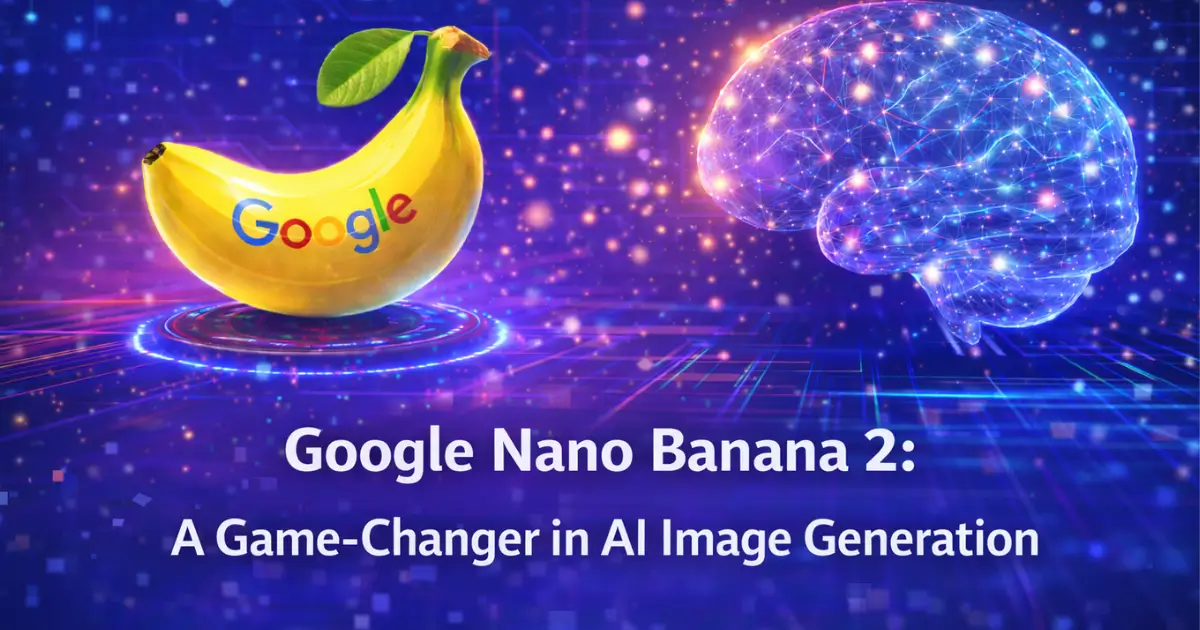
Google just raised the bar in AI image generation. On February 26, 2026, the company launched Nano Banana 2 — officially known as Gemini 3.1 Flash Image — and it is already the default image model across Gemini, Google Search, Lens, and Flow.
The update is significant. Nano Banana 2 combines the high-fidelity output of Nano Banana Pro with the speed of Gemini Flash, making advanced image generation accessible to every user — not just paid subscribers.
What Is Nano Banana 2?
Nano Banana 2 is Google DeepMind's latest image generation model. It replaces the original Nano Banana, which went viral after launching in August 2025, generating millions of images inside the Gemini app — especially in markets like India.
Google followed that with Nano Banana Pro in November 2025, which offered studio-quality output but was limited to paid plans. Nano Banana 2 bridges that gap. It delivers near-Pro quality at significantly faster speeds, and it is available to all Gemini users for free.
The technical name is Gemini 3.1 Flash Image, but everyone is calling it Nano Banana 2.
Key Features and Capabilities
Faster Speed With Higher Quality
The biggest improvement is the combination of speed and visual fidelity. Previous models forced users to choose between fast output or high quality. Nano Banana 2 eliminates that tradeoff. It generates photorealistic images with vibrant lighting, richer textures, and sharper details — all at Flash-level speed.
4K Resolution With Flexible Aspect Ratios
Users can now generate images from 512px all the way up to 4K resolution. Multiple aspect ratios are supported, making it practical for everything from vertical social media stories to widescreen presentation backgrounds.
Advanced World Knowledge
This is where Nano Banana 2 separates itself from competitors. The model pulls real-time information from Google's web search to accurately render specific subjects. It can create infographics from notes, turn rough sketches into diagrams, and generate data visualizations — all powered by Gemini's real-world knowledge base.
Character Consistency and Object Fidelity
Nano Banana 2 can maintain consistent character appearance for up to five characters and track fidelity of up to 14 objects within a single workflow. This makes it genuinely useful for storyboarding, sequential content creation, and brand-consistent visual campaigns.
Precise Text Rendering
One of the biggest complaints with AI image generators has been poor text rendering. Nano Banana 2 addresses this directly with improved accuracy for legible text in marketing mockups, greeting cards, and social media graphics. It even supports text translation and localization within generated images.
Where Is Nano Banana 2 Available?
Google has rolled out the model across its entire ecosystem:
The Gemini app now uses Nano Banana 2 as default across Fast, Thinking, and Pro modes. Google Search uses it through AI Mode and Google Lens in 141 countries. Flow, Google's video editing tool, also uses it as the default image generator. Google AI Pro and Ultra subscribers still retain access to Nano Banana Pro for specialized high-fidelity tasks through the regeneration menu.
For developers, the model is available in preview through the Gemini API, Gemini CLI, Vertex AI, Google AI Studio, and Antigravity.
AI Safety and Content Identification
Every image generated with Nano Banana 2 includes Google's SynthID watermark to indicate AI origin. The images are also interoperable with C2PA Content Credentials — an industry standard backed by Adobe, Microsoft, OpenAI, and Meta.
Since launching SynthID verification in the Gemini app last November, users have used it over 20 million times. This signals that both Google and users are taking AI content identification seriously.
Why This Matters for the AI Image Market
The AI image generation space is getting crowded. OpenAI, ByteDance, and Adobe are all pushing competitive products. Google's move to make Pro-level capabilities free and default across its ecosystem is a direct play for market dominance.
For creators, marketers, and developers, Nano Banana 2 removes the paywall that previously separated good AI images from great ones. The fact that it pulls from live web data gives it a practical edge that purely trained models cannot match.
Google is not just improving its image model. It is embedding AI-generated visuals into the core of how people search, create, and communicate online.
With predictions of human-level automation within 18 months, the pace of AI innovation is only accelerating.