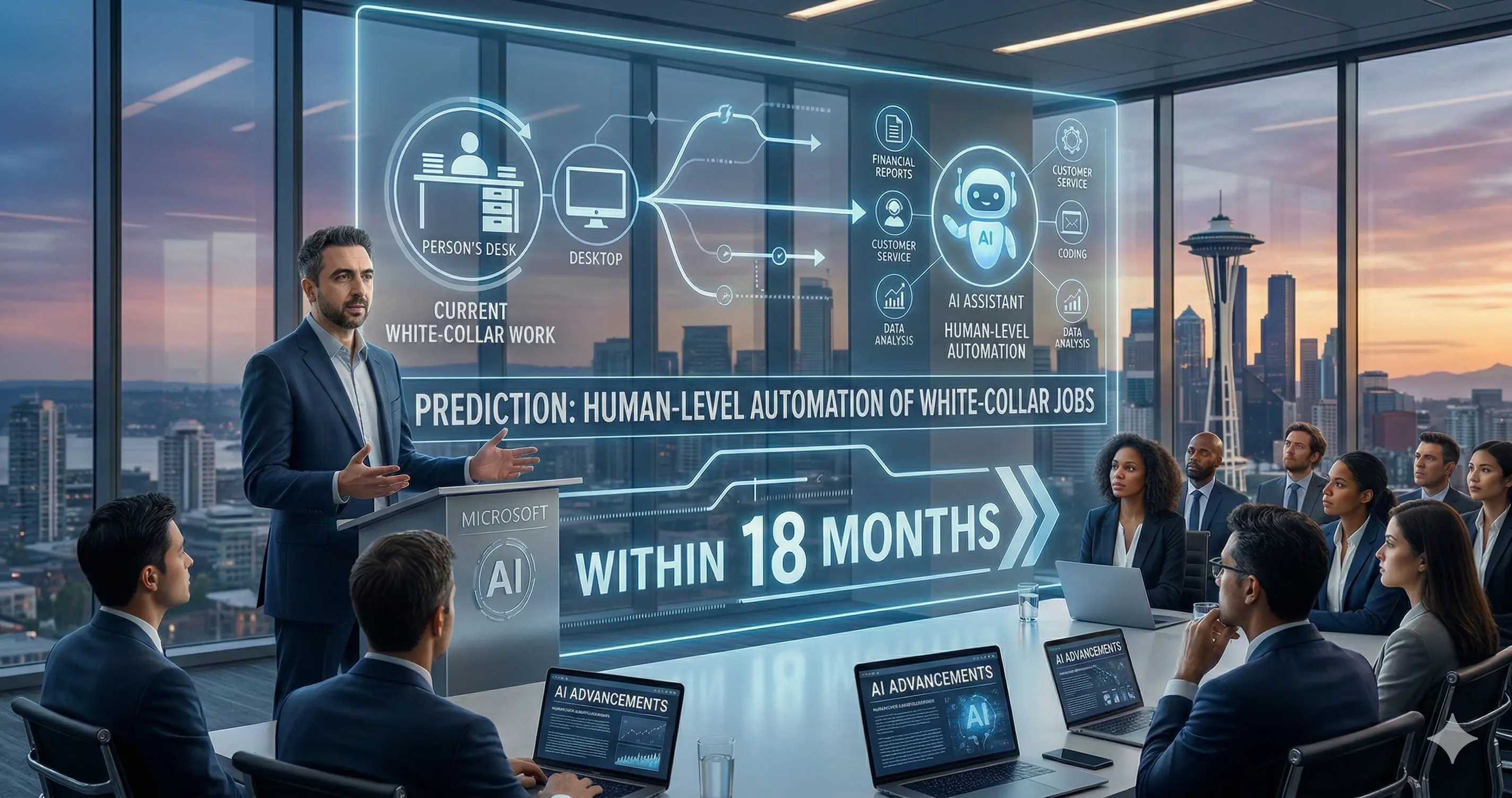
Let's not sugarcoat it. Microsoft's AI CEO, Mustafa Suleyman, just dropped a bomb that should wake up every white-collar professional on the planet. His prediction? Within the next 12 to 18 months, AI will perform at a human level across most professional tasks from law to accounting, project management to marketing.
Yes, you read that right. The clock is ticking.
But before you start updating your résumé in a cold sweat, take a breath. Because buried inside this headline is actually a roadmap not a death sentence.
The Shift Is Already Happening
Look around. Software engineers the very people building AI are already handing over the bulk of their coding to AI tools. Their job hasn't disappeared. It's transformed. They've moved up the chain: debugging, strategizing, architecting systems, making the big-picture decisions that machines still can't handle on their own.
This isn't theory. This is happening right now, in real offices, with real people.
And it's not just coders. Lawyers are using AI to draft contracts in minutes. Accountants are automating entire audit workflows. Marketing teams are generating campaigns, analyzing data, and optimizing content all with AI sitting right beside them. The transformation is spreading across every profession faster than most people realize.
Suleyman himself acknowledges that this relationship between humans and AI has evolved massively in just the last six months. The pace isn't slowing down. It's accelerating. And if the last six months brought this much change, imagine what the next eighteen will look like.
NVIDIA and global telecom leaders are already building AI-native 6G networks to support this future
Why "Working With AI" Isn't Just a Buzzword
Here's where most people get it wrong. They hear "automation" and think "replacement." But the smarter way to read this moment is through the lens of alignment.
Think of AI as a new colleague one that never sleeps, never complains, and processes information at lightning speed. Your job isn't to compete with that colleague. Your job is to direct it. To bring the human judgment, creativity, and context that no algorithm can replicate.
The truth is, AI is brilliant at repetitive, data-heavy, and pattern-driven tasks. But it still struggles with nuance, empathy, ethical reasoning, and the kind of creative problem-solving that comes from lived human experience. That's your edge. That's what makes you irreplaceable if you learn how to use it.
The professionals who thrive in the next 18 months won't be the ones who ignore AI or resist it. They'll be the ones who learn to ride the wave who figure out how to plug AI into their workflow and free themselves up for the work that actually matters.
The Real Risk? Standing Still
The danger isn't AI itself. The danger is pretending nothing is changing. Every industry legal, finance, healthcare, education, marketing is being reshaped in real time. The ones who refuse to adapt will find themselves outpaced not by machines, but by other humans who figured out how to use those machines better.
History has shown us this pattern before. The internet didn't kill businesses it killed the businesses that refused to go online. Social media didn't destroy marketing it destroyed marketers who wouldn't adapt. AI is the same story, just moving at ten times the speed.
This is not about doom and gloom. It's about a massive opportunity hiding inside a scary headline.
Your Move
So what should you do right now? Start experimenting. Pick one AI tool relevant to your field and use it daily. Google's new Nano Banana 2 image generator is one example of how fast AI tools are evolving. Learn what it's good at. Learn where it falls short. Build that muscle memory of working alongside intelligence, not against it.
Don't wait for your company to train you. Don't wait for a formal course or certification. The people winning right now are the ones who started experimenting six months ago. The next best time to start? Today. Spend thirty minutes a day exploring AI tools. Read about how your industry is changing. Talk to people who are already ahead of the curve.
Suleyman's prediction isn't a threat it's a wake-up call. The future of work isn't human versus machine. It's human plus machine. And the sooner you embrace that equation, the more valuable you become.
The countdown has started. Eighteen months. What will you do with them?