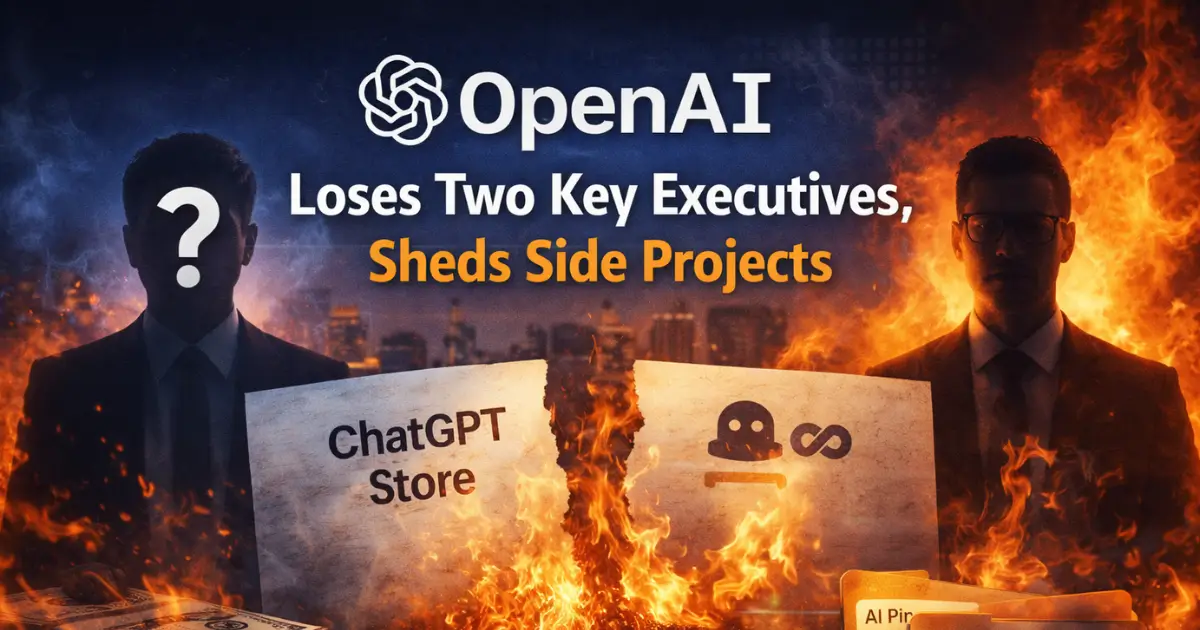
OpenAI is losing two of the architects behind its most ambitious moonshot projects. Kevin Weil, who led the company's science research initiative, and Bill Peebles, the researcher behind AI video tool Sora, both announced their departures on Friday. The exits come as OpenAI consolidates around enterprise AI and its forthcoming superapp and continues to cut what insiders have called "side quests."
Who Left and Why
Kevin Weil served as OpenAI's Chief Product Officer before transitioning to the research side to lead OpenAI for Science, the internal group behind Prism — an AI-powered platform designed to accelerate scientific discovery. In his farewell post, Weil called his time at OpenAI "mind-expanding" and expressed his belief that accelerating science will be one of the most positive outcomes of the push toward AGI.
His departure came just one day after his team released GPT-Rosalind, a new model focused on life sciences research and drug discovery. Despite that milestone, the OpenAI for Science group is being absorbed into other research teams rather than continuing as a standalone initiative.
Bill Peebles, the researcher who built Sora, also announced his exit. In his farewell post, Peebles credited Sora with sparking massive industry investment in AI video, but argued that the kind of exploratory research that produced the tool needs space away from a company's core product roadmap. He described cultivating entropy as essential for any research lab's long-term survival.
Sora's Costly End
The departures follow OpenAI's decision last month to shut down Sora, its AI video generation tool. Sora was reportedly losing an estimated $1 million per day in compute costs — a staggering burn rate that made it unsustainable even for a company with OpenAI's resources.
The shutdown was part of a broader pattern. OpenAI has been systematically pulling back from consumer-facing experiments to focus on enterprise products like Codex, its revamped coding tool, and its upcoming superapp that aims to combine chat, browsing, and coding into a single platform.
A Pattern of Narrowing Focus
The exits fit squarely into OpenAI's recent strategic shift. Over the past several months, the company has abandoned or scaled back several ambitious projects — including Sora, an erotic ChatGPT concept, and now the science research initiative. Each time, the message has been the same: OpenAI is refocusing on business and coding services where the revenue opportunity is clearest.
This narrowing focus stands in contrast to Anthropic's approach, which has been expanding its product line into areas like Claude Code, Claude Cowork, and the recently announced Claude Design — all while growing revenue at a pace that has overtaken OpenAI's own numbers.
The competitive pressure is real. At the HumanX conference earlier this month, multiple vendors described ChatGPT as declining in relevance compared to Claude, and investor sentiment has begun shifting in Anthropic's favor as well. OpenAI's $852 billion valuation is increasingly being questioned as Anthropic's trajectory steepens.
The Science Team's Rocky Road
The OpenAI for Science team had a short and turbulent run since its formal announcement in October 2025. In one notable incident, Weil posted a claim that GPT-5 had solved ten previously unsolved mathematical problems posed by legendary mathematician Paul Erdős. The claim quickly fell apart when the mathematician maintaining the relevant database publicly disputed it, forcing Weil to delete the tweet.
Despite the setbacks, the team did produce tangible work. GPT-Rosalind, released the day before Weil's departure, represents a genuine contribution to AI-assisted drug discovery. Whether OpenAI continues to invest in that line of research under its reorganized structure remains unclear.
What It Means for OpenAI
The loss of two senior figures in a single day is notable, but perhaps more significant is what it reveals about OpenAI's direction. The company that once positioned itself as a research lab pursuing artificial general intelligence for the benefit of humanity is increasingly operating like an enterprise software company — one focused on revenue, margins, and product-market fit.
That is not inherently a bad thing. Enterprise AI is where the money is, and OpenAI's IPO ambitions require a clear and profitable business model. But shedding the researchers and projects that once defined its identity carries a cost — one that may not show up in quarterly revenue numbers but could matter deeply in the long run.
As Peebles put it in his departure post: cultivating entropy is the only way for a research lab to thrive. Whether OpenAI can maintain that creative chaos while chasing enterprise billions will be one of the defining questions of its next chapter.