When Uber quietly expanded its contract with Amazon Web Services this week, the headlines focused on cloud computing and AI chips. But dig a little deeper and this story becomes a tangled web of Silicon Valley power plays, billion-dollar chip rivalries, and one former Intel executive whose career moves connected all the dots.
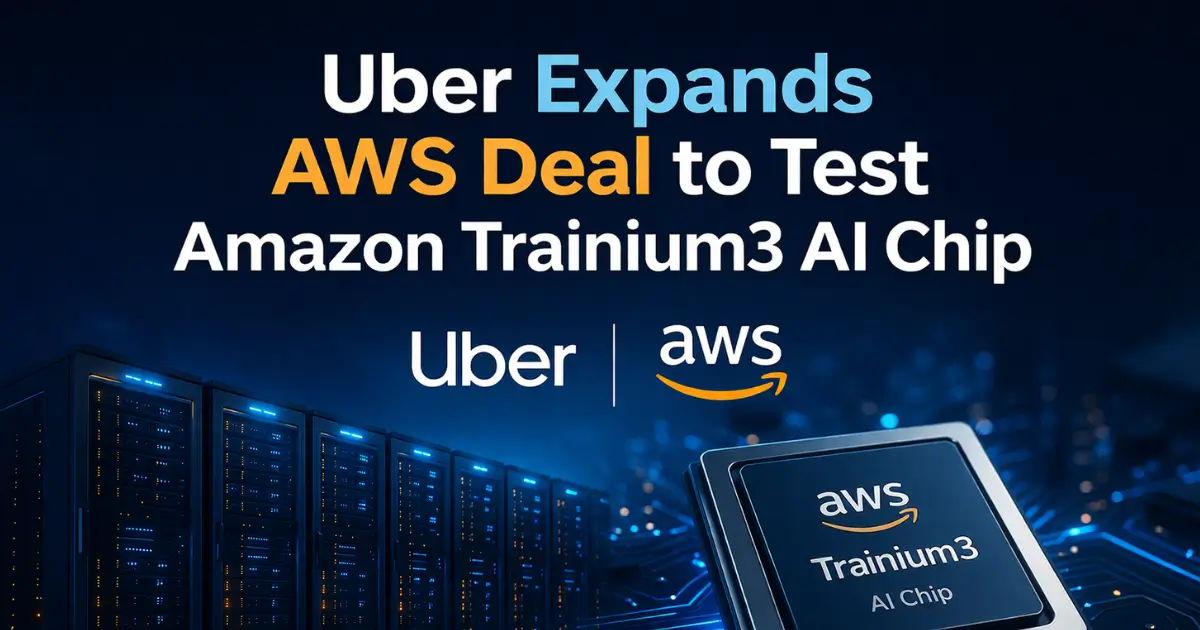
Amazon announced Tuesday that Uber was expanding its contract for AWS cloud services to run more of its ride-sharing features on Amazon's chips. Specifically, Uber will expand its use of AWS's Graviton, a low-power ARM-based server CPU, and begin a new trial testing Trainium3, Amazon's Nvidia competitor AI chip.
On the surface, this looks like a routine cloud deal. But beneath it lies a direct shot at two of Amazon's biggest cloud rivals Google and Oracle.
From Its Own Data Centers to Oracle and Google
While Uber historically ran its own data centers, back in 2023 the ride-hailing company signed giant multi-year cloud computing deals with Oracle and Google. The plan was simple: move everything off its own infrastructure and onto these two clouds.
As recently as December, Uber publicly reiterated that goal, highlighting its transition from on-premise data centers to Oracle Cloud Infrastructure and Google Cloud Platform. Uber was particularly enthusiastic about ARM chips made by Ampere that powered Oracle's cloud.
And this is where the story takes a fascinating turn.
The Ampere Connection
Ampere was founded by former Intel executive Renee James after she was passed over for the CEO role at the chipmaker. James leveraged her extensive connections including her position as an investor at private equity firm Carlyle and a board seat at Oracle to launch the company. Oracle ended up owning about one-third of Ampere, and James had to give up her status as an independent Oracle director because of that investment.
The connections run even deeper. James was a key board member who helped vote in Oracle's $9.3 billion purchase of NetSuite in 2016, a company where Oracle founder Larry Ellison was a major stockholder. That deal sparked an unsuccessful shareholder lawsuit alleging Oracle had overpaid for the acquisition.
But the Ampere chapter eventually closed. In December, SoftBank acquired Ampere, and Oracle sold its stake for a handsome $2.7 billion pre-tax gain. James left Oracle's board at the end of 2024 and is no longer working at Ampere.
So why did Oracle walk away from the chip business? Larry Ellison said Oracle sold Ampere because he believed designing chips in-house for its data centers was no longer a competitive advantage. Oracle now prefers to simply buy chips and has signed massive deals with Nvidia.
Amazon's Power Play
Here is the irony: while Oracle decided that making its own chips was not worth the effort, Amazon went all in on the opposite strategy and it is now stealing Oracle's customers because of it.
Uber joins Anthropic, OpenAI, and Apple as major companies that have signed on or increased their usage of AWS specifically because of Amazon's custom AI chips. These are not small customers. They represent the most significant AI workloads in the world.
In December, Amazon CEO Andy Jassy said Trainium was already a multibillion-dollar business. The chip has gone from an experimental alternative to Nvidia's GPUs to a serious commercial product that some of the biggest names in tech are willing to bet on.
A Tangled Web of Deals
The cloud and chip wars are not playing out in neat, separate lanes. They are deeply interconnected. Oracle, SoftBank, and Nvidia are all part of OpenAI's orbit of circular deals that are supposed to fund the AI model maker's massive data center buildout. Everyone is simultaneously competing with and depending on each other.
Amazon building its own chips gives it an advantage that Oracle voluntarily surrendered. Google has its own TPUs but is watching AWS pick off customers with competitive pricing and performance. And Nvidia, despite being the dominant player, now faces credible alternatives from both Amazon and Google.
What It Means for the AI Race
The Uber deal may not be the largest cloud contract ever announced, but it is symbolically significant. It shows that Amazon's in-house chip strategy is working not just for AI startups, but for massive enterprises with complex, real-world workloads like ride-hailing.
For Oracle, losing a showcase customer to a rival's custom silicon must sting, especially after choosing to exit the chip design game entirely. For Amazon, it is validation that the billions spent on Trainium and Graviton are paying off in the most competitive market in technology.
And for everyone else watching the AI chip wars unfold, the lesson is clear: in this race, the companies that control their own silicon may end up controlling the future.