
 Compiled by Amit Kumar
FlexQueries is a pay-as-you-go SEO research tool for keyword research, backlinks, rank tracking, site audits and AI-search visibility, built for freelancers, small businesses and solo marketers who do not want a monthly plan. There is no subscription or seat fee: eligible new accounts get $1 of credit, and reloads start at $5.
MPAT read the FlexQueries homepage, the FlexQueries pricing page, the billing, getting-started, workspace and MCP documentation, several feature pages, and the terms, privacy and refund policies on 6 October 2026. This listing is compiled from those vendor pages. It is not a hands-on review, and MPAT did not fund an account or run paid research for it. FlexQueries is operated by CYBRCOAST LLC, a Delaware limited liability company, according to the FlexQueries terms. The product was featured on BetaList on 5 October 2026 and also launched on the MPAT launch board, where this page lives at /tools/flexqueries.
FlexQueries in one paragraph
FlexQueries replaces the usual monthly SEO subscription with a prepaid dollar balance. You open a project for a website, choose a piece of research, see an estimated price, and the balance is charged only for the work that runs. One web workspace covers keyword research and trends, current and historical Google results, backlinks, domain and competitor research, scheduled rank tracking, site audits, App Store and Amazon keyword research, and checks on how ChatGPT and Google AI Overviews mention a brand. As of 6 October 2026, the pricing page lists a typical keyword report at $0.15, a backlink overview at $0.20, a 500-page site audit at about $1.30 and an AI visibility run at about $0.85. Search Console and Google Analytics reports cost nothing. The same tools also work inside Claude, ChatGPT, Codex and Cursor through a hosted MCP server.
What FlexQueries does
The FlexQueries features page groups the product into research, planning and monitoring. The parts a buyer is most likely to use are below (read on 6 October 2026).
- Keyword research and trends. Expand a topic into search phrases with volume, difficulty, intent and CPC, compare demand over time and by region, and save the shortlist with tags.
- SERP history. Compare monthly Google result snapshots for a keyword across up to twelve months, including pages that arrived or dropped out.
- Domain, competitor and backlink research. Estimated organic traffic, ranking keywords and top pages for any domain, keyword and page gaps against rivals, and a backlink profile with referring domains, link history and a 0 to 100 DR score that the vendor says can differ from Ahrefs' own DR. Competitor Watch follows up to three rivals with a one-off or capped weekly run.
- Rank tracking. Scheduled position checks by market and device. The rank tracking page prices 50 keywords checked weekly on one site and device, top 40 results, at about $1.96 a month.
- Site audit. Crawls pages for status codes, titles, meta descriptions, indexability, structured data, robots.txt access for search and AI crawlers, and optional Lighthouse samples. Free accounts can audit up to 50 pages per run; funded accounts can choose up to 10,000.
- AI visibility. The AI visibility page describes brand and domain lookups across supported ChatGPT and Google AI Overview data, Google AI Mode answers with their cited sources, and recurring monitoring of chosen prompts. A separate Prompt Explorer sends one question to selected models (the homepage names ChatGPT, Claude, Gemini and Perplexity) and compares the answers and citations.
- Planning and reporting. Opportunities, page plans, GA4 landing-page outcomes, identifiable AI referral visits, dated report snapshots and shared workspaces with Owner, Admin, Editor and Viewer roles and no seat fee.
- Flex AI Agent, MCP and API. A built-in agent answers research questions with the same project tools and exports PDF, Word or CSV. The FlexQueries MCP setup guide covers Claude, ChatGPT, Codex, Cursor, Antigravity, VS Code and Gemini CLI over browser OAuth at one server URL. A REST API offers 26 research operations with per-key spending caps.
Who it is for, and who should skip it
A good fit if you do SEO in bursts: a freelancer auditing a client site once a quarter, a small business checking a handful of keywords, or a blogger who wants backlink and ranking data without paying for idle months. It also suits people who already work in Claude or Cursor and want keyword data and their own Search Console numbers inside that chat. Every paid action shows an estimate first, and the balance is a hard ceiling unless you turn on automatic reload.
Skip it if you run heavy daily research across many sites, where a flat plan may cost less than metered calls; check your own volume in the vendor's estimator first. Skip it too if your team needs a vendor with published security certifications: MPAT found no SOC 2 or ISO 27001 claim on the site, and the about page returned a 404. The FlexQueries privacy policy also says product analytics include PostHog session recordings (with form inputs and project names masked) and a Reddit advertising pixel, which some agencies will want to clear with clients.
Plans and prices
| Plan | Price | What you get | Where the tier stops |
|---|---|---|---|
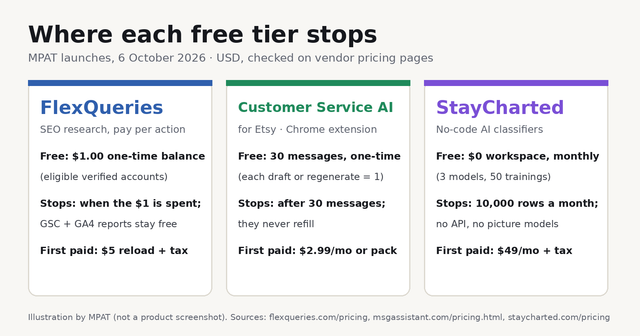
| Free start | $0 | $1.00 promotional balance for eligible verified new accounts, no card; Search Console and GA4 reports, saved-data reads, planning and team features use no credits | One-time grant; paid research stops when the $1 is spent, and audits are capped at 50 pages per run |
| Pay as you go | $0 a month; reloads from $5 | Every feature on every account; purchased funds do not expire; no seat fee; optional automatic reload | Your balance; paid actions stop when funds run out |
| Keyword research | $0.15 per report | A typical 225-row keyword report | Charged per run |
| Backlink overview | $0.20 per domain | One domain with one year of monthly history | Charged per run |
| Site audit | About $1.30 | Up to 500 crawled pages and 20 Lighthouse checks | Charged per audit |
| Rank tracking | About $1.96 a month | 50 keywords checked weekly, one site and device | Runs while the schedule is on |
| AI visibility | About $0.85 per run; $3.05 per brand check | ChatGPT and Google monitoring; a two-platform brand lookup | Charged per run or check |
| Prompt Explorer | Up to $0.90 per response | One prompt answered by one selected model | Settles to actual usage |
Tax is added at checkout on top of the credit amount, so a $20 reload buys $20 of usable credit. The FlexQueries billing guide explains that the app places a temporary hold before paid work, which can be larger than the estimate, then settles the real cost and releases the rest. Provider-backed actions round up to the next $0.05. The pricing page also compares its entry cost with Ahrefs and Semrush using list prices it says it checked on 20 September 2026; MPAT has not re-checked those third-party prices.
What the free $1 covers
At the listed estimates, $1 pays for about six keyword reports, five backlink overviews or one AI visibility run. It does not quite cover a full 500-page audit, and free accounts are held to 50 pages per audit anyway. The grant is limited to eligible verified accounts, and the billing guide says eligibility checks can withhold it without blocking paid use. Unused purchased balance can be refunded on request, while consumed balance and promotional credit are not refundable, per the FlexQueries refund policy.
How it compares to tools already on MPAT
- CrawlRaven, the GSC and GA4 SEO planner for AI agents, joins your own Search Console, Analytics and crawl data into one ranked to-do list. Its MPAT listing (checked 30 September 2026) records a free plan for one website and lifetime licences from $39 one-time. CrawlRaven plans work on your own site; FlexQueries buys outside research such as competitor keywords and backlinks per call.
- Prefer, the AEO platform for AI search visibility, tracks prompts across five answer engines from $24 a month on the Starter plan, per its MPAT listing checked 3 October 2026. Choose Prefer for continuous AI-answer tracking with content fixes; FlexQueries covers a narrower AI surface but bundles it with classic SEO data on one balance.
- Omnia, the GEO agent for AI search visibility, starts at €79 a month after a 14-day trial, per its MPAT listing checked 2 October 2026, and its agent drafts content and outreach for approval. FlexQueries does not publish to a CMS; it is a research and monitoring tool.
For the rest of the category, browse SEO tools on MPAT.
Is FlexQueries free?
Partly. There is no monthly fee, eligible new accounts get $1 of credit without a card, and Search Console and Google Analytics reports never reduce the balance. New research, crawls and AI generation are paid from a prepaid balance after that. Prices checked on 6 October 2026.
How much does FlexQueries cost?
Nothing per month. You pay per action from a balance that you top up from $5: about $0.15 for a keyword report, $0.20 for a backlink overview, $1.30 for a 500-page audit, $0.85 for an AI visibility run and $1.96 a month to track 50 keywords weekly. The vendor's own example month of mixed research comes to $26.96.
Does FlexQueries work with Claude or ChatGPT?
Yes. The hosted MCP server connects to Claude, ChatGPT, Codex, Cursor, VS Code, Gemini CLI and Antigravity through browser OAuth, with no API key. The Search Console MCP page says FlexQueries handles the Google connection, so you do not need your own Google Cloud project. MCP calls spend the shared balance without a per-client cap, so review tool approvals in your client.
What happens to my data?
The terms say keywords, domains and prompts you submit are sent to third-party data and AI providers to produce results, and the privacy policy (updated 26 September 2026) names OpenAI for AI-assisted features, Cloudflare for hosting and Stripe for payments. FlexQueries says it does not sell personal information and does not use private project content to train a general-purpose AI model that it operates. Retention periods are described in general terms, not fixed days.
Sources
Prices, the free balance and per-action estimates come from the FlexQueries pricing page and the billing and credits guide. Feature details come from the features overview and the MCP setup documentation. Operator, refund and data-handling details come from the terms and conditions (updated 25 July 2026) and the privacy policy (updated 26 September 2026). All pages were read on 6 October 2026.