
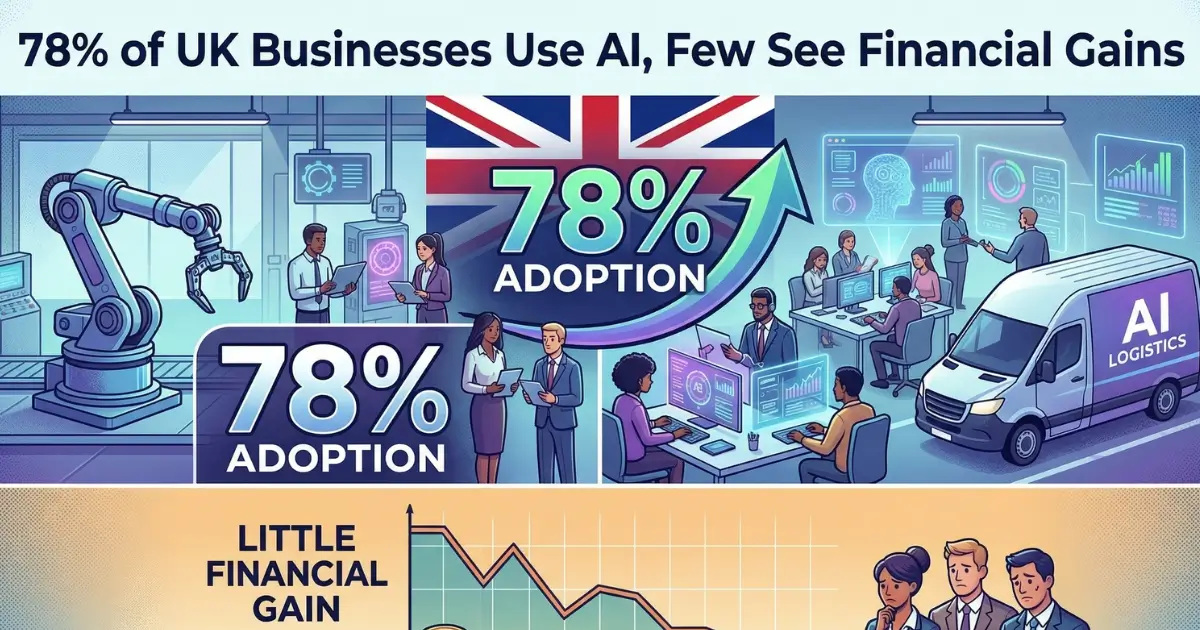
Artificial intelligence has become a near-universal fixture across British businesses, but the financial returns remain stubbornly elusive. A new study from digital product studio Studio Graphene reveals that 78 percent of UK businesses now use AI in some capacity. Yet fewer than a third of those companies report seeing any positive return on their investment — a sobering reality check for an industry still riding a wave of hype and heavy spending.
Adoption Is Soaring
The numbers on adoption are striking. Mid-sized organisations, those with 100 to 249 employees, lead the pack at 85 percent, the highest of any group surveyed. A further 14 percent of companies say they are exploring their options or plan to implement AI tools during 2026. Only 8 percent of businesses report having no involvement with AI and no plans to start. The rush to adopt has been fuelled by a proliferation of new tools, intense media attention, and a widespread belief that companies risk falling behind if they fail to embrace the technology. Private equity-backed mid-sized firms have been especially aggressive, viewing AI as a shortcut to automation, scalability, and competitive advantage.
The ROI Problem
Despite this enthusiasm, the financial picture is far less encouraging. The Studio Graphene research, conducted by Censuswide across 500 senior decision-makers including managers, directors, and C-suite executives, found that just 31 percent of businesses using AI have seen a positive return on investment. Nearly one in five — 18 percent — said their AI projects have not delivered the benefits they expected, while 16 percent said it was simply too early to judge. These findings echo a broader global pattern. A widely cited MIT study from late 2025 found that fewer than one in ten firms had seen positive financial impacts from AI implementation. An IBM survey of international CEOs found that while executives remained publicly enthusiastic about the technology, 60 percent were still stuck in the piloting and experimentation phase a full year after predicting they would move beyond it.
Nobody Knows What Success Looks Like
Perhaps the most revealing statistic in the report is this: fewer than half of all AI users — just 41 percent — have a clear idea of what success looks like when implementing AI solutions. Even among mid-sized businesses, the most enthusiastic adopters, only 46 percent can define what a successful AI deployment would actually mean for their organisation. This lack of clarity is a fundamental problem. Without agreed-upon criteria for success, it becomes nearly impossible to build a credible business case, measure progress, or justify continued investment to boards and investors. As Ritam Gandhi, founder of Studio Graphene, pointed out, teams often have not agreed whether AI is meant to save time, improve decision quality, reduce risk, or support growth — let alone all of the above.
The Strategy Gap
The issue is not the technology itself but how it is being deployed. Many companies have rushed to adopt AI tools without first defining where those tools fit within existing workflows, what decisions they will inform, or what processes they will support. The result is fragmented implementation — a patchwork of AI experiments scattered across departments with no coherent strategy tying them together. Gandhi warned that without rigorous planning, frustration at the board level will only grow. Executives who approved significant AI budgets will increasingly demand clear evidence of impact. If that evidence does not materialise, the appetite for further investment could dry up quickly.
Financial Services Feels the Pinch
The problem is especially acute in financial services. A related analysis found that 91 percent of finance professionals reported using AI, well above the 78 percent average. Yet only 13 percent of managers in finance said they had seen any return on investment, far below the already modest 31 percent across all industries. The heavily regulated nature of banking and financial services, combined with the complexity of integrating AI into compliance-sensitive workflows, appears to be making it harder for firms in the sector to extract tangible value.
A Crossroads for British Business
The UK stands at a critical juncture. Adoption has reached levels that would have seemed extraordinary just two years ago, but spending without strategy is a recipe for disillusionment. The companies that will ultimately benefit from AI are those that invest not just in tools but in the planning, measurement frameworks, and cultural change needed to make those tools genuinely useful. The hype cycle may be far from over, but the hard work of turning AI into real business value is only just beginning.