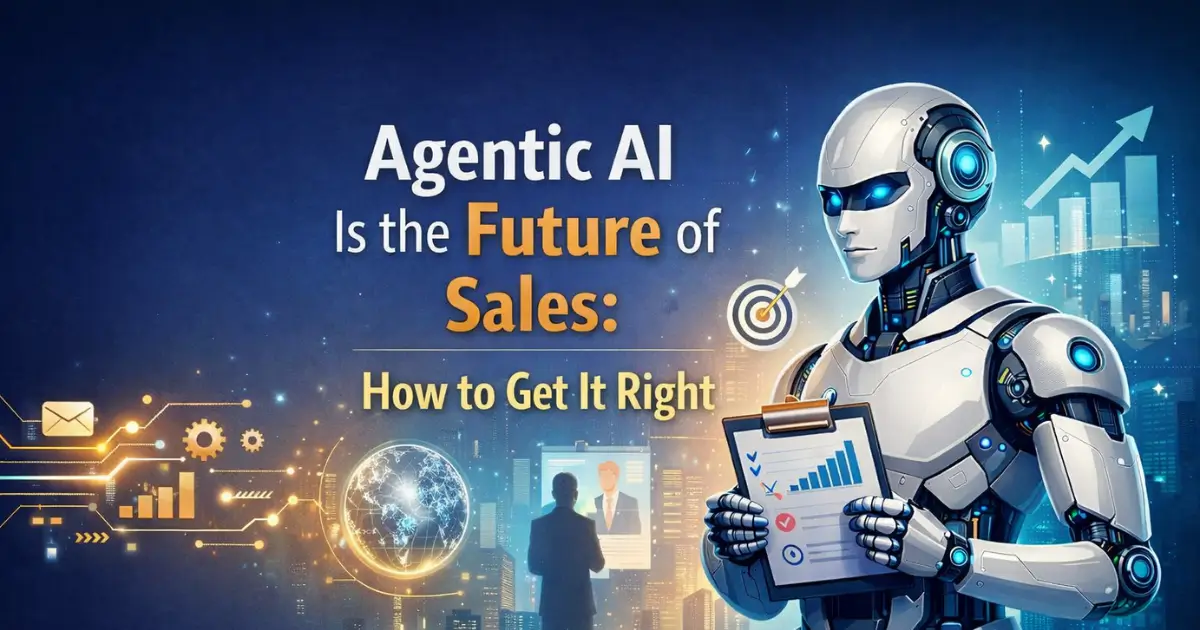
Artificial intelligence has been reshaping the business world for years, but the arrival of agentic AI represents something fundamentally different. Unlike traditional AI tools that simply respond to commands, agentic AI systems can act independently, pursue goals, adapt to context, and collaborate with humans throughout the entire sales cycle. For sales professionals and leaders, this is not just another tech upgrade it is the most significant transformation the profession will undergo this century.
What Is Agentic AI and Why Does It Matter for Sales?
Sales has historically been a proving ground for new technological breakthroughs. CRM systems, predictive analytics, and tools that promise better targeting, faster follow-up, and higher close rates have all been tested in the realm of sales. Now it is agentic AI's turn.
The market for autonomous AI agents is projected to grow from $7.6 billion in 2025 to more than $139 billion by 2033 an 18-fold increase. This explosive growth reflects how seriously businesses are taking this technology. Intelligent agents now automate lead scoring, risk detection, deal coaching, and forecasting, freeing sales professionals to focus on strategic activities.
From Human-Led Tasks to AI-Managed Sales Cycles
Currently, almost all sales teams spend massive amounts of time researching accounts, classifying leads, scheduling outreach, sending cold emails, logging activity in their CRM, and forecasting potential revenues. Agentic AI can automate most of this with minimal human input.
Today's SDRs spend a staggering 70 percent of their time on non-selling activities instead of having meaningful conversations with prospects. Agentic AI changes this equation dramatically. AI alone already saves sales team members over two hours a day in administrative tasks, and agentic systems will make this even more impactful.
In this new model, sales team members become the managers of AI agents. They can prompt their personal AI assistant to identify businesses within a particular vertical or geographical area that show signs of being in-market for what the team is selling. Once prospects are identified, the AI handles initial outreach, warming up leads before a human steps in.
How Sales Strategies Will Change
The impact goes beyond individual productivity. Campaigns will become dynamic and messaging will evolve in real time based on buyer behavior. Territory planning, pipeline management, and forecasting will be continuously optimized rather than reviewed in weekly meetings.
Companies that embed agentic AI across their sales stack consistently see a 35 percent reduction in customer acquisition costs and a 28 percent improvement in deal velocity. These are not incremental gains they represent a fundamental shift in how sales organizations operate and compete.
Getting It Right: Practical Steps for Adoption
Despite the promise, implementation requires careful planning. Gartner has discovered that companies that break sales roles down into specific actions, identify which tasks AI can accelerate, and then adapt those roles accordingly are two and a half times more likely to transform successfully.
Here are key steps for getting agentic AI right in your sales organization:
First, start with high-impact use cases. The number one thing holding companies back from achieving successful AI transformations is a lack of clarity on which AI use cases will drive ROI. Focus on areas like lead qualification, automated follow-ups, or pipeline forecasting before expanding.
Second, invest in the right talent. Instead of prioritizing sales experience alone, look for candidates with a growth mindset, proven flexibility when faced with challenges, and familiarity with AI tools.
Third, establish governance and trust. Partner with your CIO to build rules and visibility into your AI agents for increased trust and reduced risk. Create shared definitions, establish guardrails, and maintain open communication with the technical team.
Fourth, choose platforms over point solutions. A single agent can solve for a specific use case, but the power of agentic AI compounds when insights flow freely across connected systems.
The Bottom Line
Your commitment to and ability to leverage agentic AI will define success over the next decade. The technology is not replacing salespeople it is elevating them from repetitive task executors to strategic relationship builders. Organizations that embrace this shift now will gain a lasting competitive edge, while those that wait risk falling behind in a market that increasingly rewards speed, intelligence, and adaptability.
The future of sales is agentic. The question is not whether to adopt it, but how quickly you can get it right.