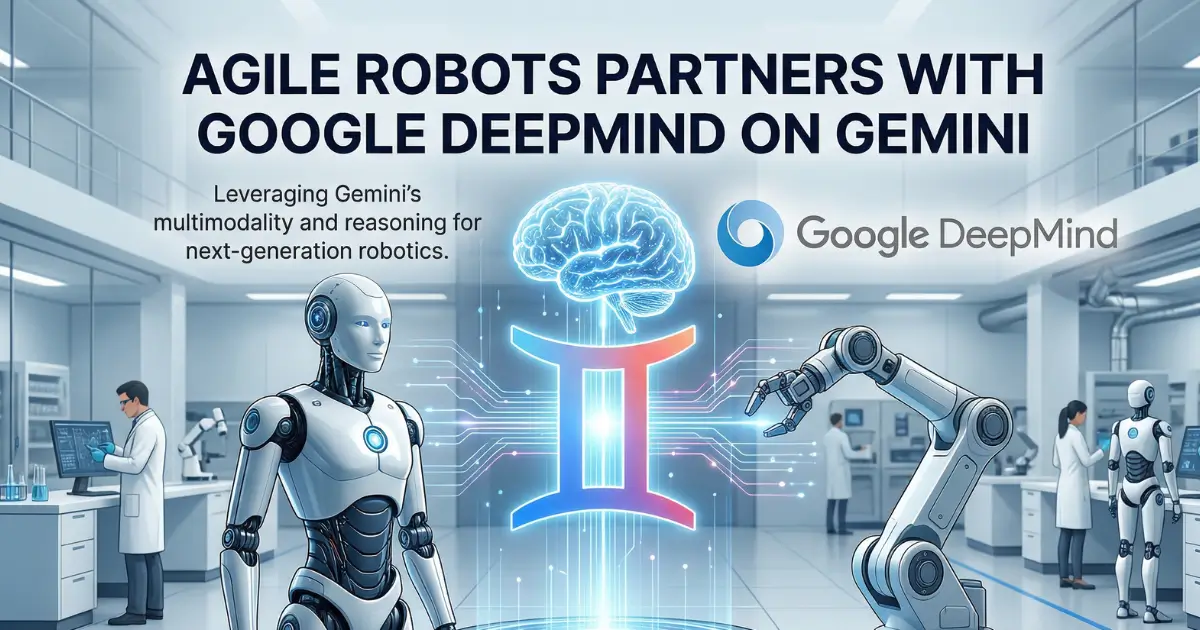
Munich-based robotics firm Agile Robots has announced a strategic research partnership with Google DeepMind, joining a rapidly growing list of hardware companies teaming up with the AI research lab to build smarter, more autonomous machines.
The deal will see Agile Robots integrate Google DeepMind's Gemini Robotics foundation models into its robotic systems. In return, data collected by those robots in real-world environments will be fed back to improve the underlying Gemini AI models — creating a loop where both the hardware and software get better over time.
The two companies plan to jointly test, fine-tune, and deploy AI-powered robots across a range of industrial sectors, including electronics manufacturing, automotive production, data centres, and logistics.
A Company With Scale Already in Place
Agile Robots is not a newcomer to the robotics space. Founded in 2018, the company has raised more than $270 million in venture capital from major investors including SoftBank Vision Fund, Chinese hardware giant Xiaomi, and Midas Group.
Crucially, it already has real-world traction. The company says it has deployed over 20,000 robotics solutions globally — a scale that makes it an attractive partner for DeepMind, which needs diverse, high-volume data to train and refine its AI models for physical-world applications.
Agile Robots CEO and co-founder Zhaopeng Chen framed the partnership as a step toward fully autonomous production systems. He said the company's existing global footprint proves intelligent automation can work at scale, and that integrating DeepMind's Gemini models positions the firm at the forefront of a rapidly expanding market.
A company spokesperson confirmed the partnership is long-term but declined to share details about its duration or financial terms.
Part of a Bigger Trend
The Agile Robots deal is the latest in a wave of robotics-AI partnerships that have accelerated sharply in 2026. The underlying logic is straightforward: building robots that can operate autonomously requires expertise in both hardware and software, and very few companies excel at both.
Earlier this year, Hyundai-owned Boston Dynamics — best known for its dog-like Spot robot — announced its own partnership with Google DeepMind. That deal focuses on using DeepMind's AI foundation models to help develop the next generation of Boston Dynamics' humanoid robot, Atlas. It is worth noting that Google previously owned Boston Dynamics from 2013 to 2017 before selling it to SoftBank, which later passed it to Hyundai.
Beyond DeepMind's orbit, other partnerships are forming across the industry. In early March, German robotics startup Neura Robotics entered a deal with Qualcomm involving the chipmaker's newly announced IQ10 processor series, which was specifically designed for mobile robots and humanoid platforms. Neura will use the processors as a reference design for its future robots.
Why Partnerships Are the Play
The rise of these collaborations reflects a maturing industry that is moving past the era of individual companies trying to build everything in-house. Robots are extraordinarily complex on both the mechanical and computational sides. A company that excels at dexterous hardware may lack the AI models needed for real-time decision-making. A software lab with cutting-edge machine learning may have no experience manufacturing reliable physical systems.
Partnerships allow each side to focus on its strengths while accelerating the path to commercially viable products. For Google DeepMind, deals like this one provide something money alone cannot buy: access to massive volumes of real-world operational data from robots working in factories, warehouses, and assembly lines. That data is essential for training AI models that can eventually generalise across different physical environments and tasks.
Physical AI as the Next Frontier
Industry leaders have increasingly pointed to physical AI — artificial intelligence that operates in and interacts with the real world — as the next major growth area for the technology sector. Nvidia CEO Jensen Huang has described it as a frontier opportunity, and the company has invested heavily in simulation tools and platforms designed to bridge the gap between digital AI and physical robotics.
As these partnerships continue to multiply, the robotics industry appears to be entering a new phase — one defined less by individual breakthroughs and more by strategic alliances between hardware specialists and AI powerhouses. The Agile Robots–DeepMind deal is unlikely to be the last of its kind. If anything, the pace is only picking up.