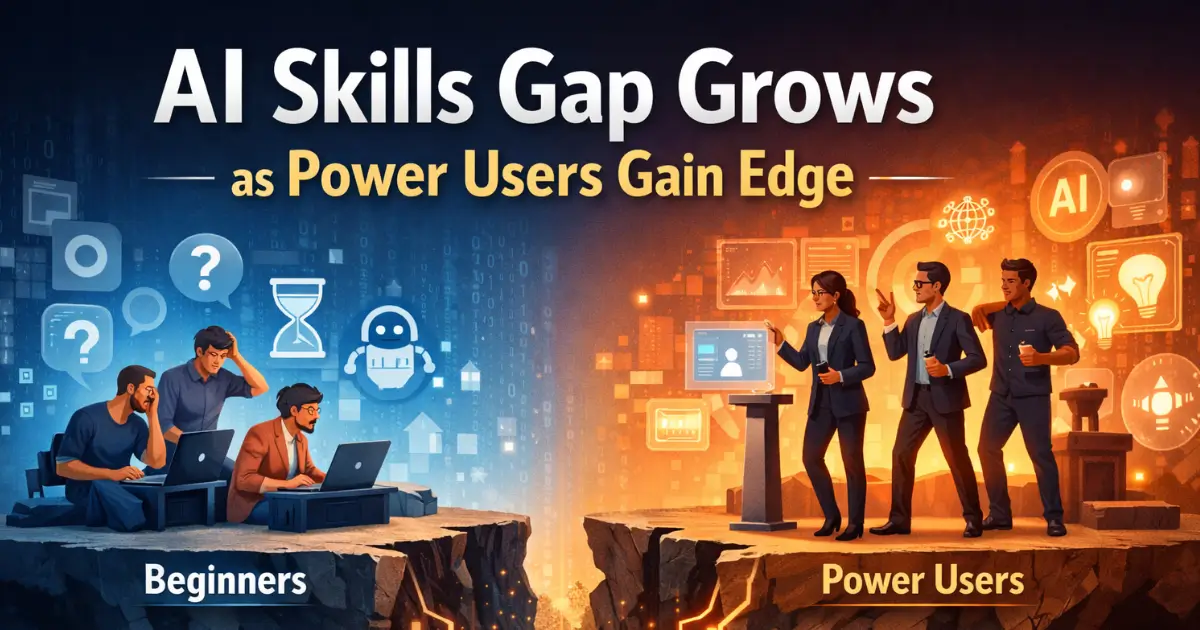
A new industry report has revealed a growing divide in the workforce driven by the rapid adoption of artificial intelligence. While AI tools are becoming more accessible across industries, not all workers are benefiting equally. Instead of replacing jobs outright, AI is creating a noticeable gap between those who know how to use it effectively and those who do not.
AI Transforming Tasks, Not Jobs
The findings suggest that artificial intelligence is currently reshaping tasks rather than eliminating entire roles. Professionals in fields such as writing, software development, and marketing are increasingly relying on AI to improve efficiency and speed. Routine processes are being automated, allowing workers to shift their focus toward more strategic and creative responsibilities, while overall employment levels remain relatively stable.
Power Users Building a Strong Advantage
Workers who have adopted AI early are gaining a clear edge. These power users are not limited to basic usage; they integrate AI into their daily workflows for brainstorming, automation, and decision-making. Their deeper engagement allows them to produce better results in less time, giving them a measurable productivity advantage over others in similar roles.
Limited Users Falling Behind
In contrast, many workers are still using AI at a surface level. Basic interactions, such as simple queries or one-time tasks, do not deliver the same value as advanced usage. This gap in understanding and application is preventing a large portion of the workforce from fully benefiting from AI, widening the divide between experienced and inexperienced users.
Unequal Access Driving Inequality
The report also highlights that AI adoption is uneven across different regions and industries. Workers in digitally advanced environments and knowledge-based sectors are more likely to adopt and benefit from AI tools. Meanwhile, those in less developed regions or traditional roles may lack access, training, or exposure, further increasing economic and professional inequality.
Challenges for Early-Career Professionals
The shift toward AI-powered workflows is also affecting new entrants to the workforce. Entry-level roles, which traditionally provide hands-on learning opportunities, are evolving as AI begins to handle repetitive tasks. This change may limit practical learning experiences for younger professionals, making it harder for them to build foundational skills.
Practical AI Skills Becoming Essential
Experts emphasize that the key issue is not access to AI, but the ability to use it effectively. Practical skills—such as evaluating outputs, asking precise questions, and integrating AI into real-world workflows—are becoming essential. Workers who develop these capabilities are more likely to succeed, while those who do not may struggle to remain competitive.
A Growing Divide in the Future of Work
As artificial intelligence continues to evolve, the gap between advanced users and the broader workforce is expected to widen further. The current trend shows that individuals who actively build AI skills are moving ahead quickly, while others risk falling behind in an increasingly AI-driven professional environment.