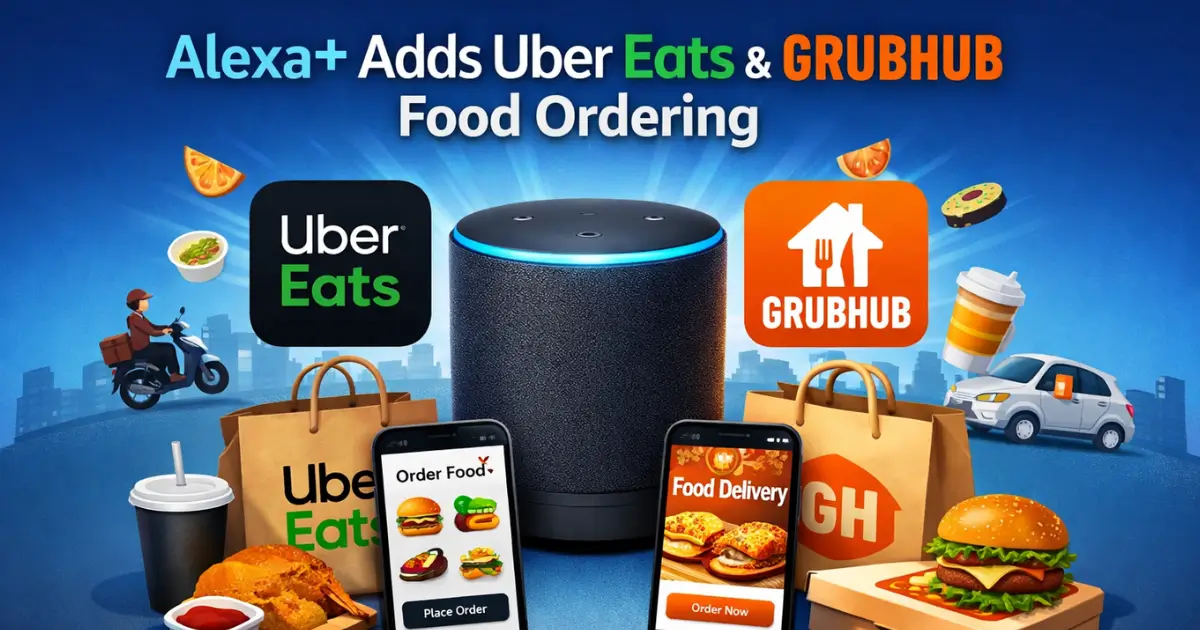
Amazon is making its AI-powered voice assistant feel a lot more like a personal concierge. The company has rolled out a new Alexa+ feature that lets users order food from Uber Eats and Grubhub through natural, conversational interactions — think chatting with a waiter rather than tapping through an app.
The update, which began rolling out on March 31, marks a notable step forward in Amazon's push to make Alexa+ a genuinely useful AI assistant for everyday tasks, starting with one of the most common: deciding what to eat.
Ordering Food Like You're Talking to a Person
The core promise of the new feature is simplicity. Instead of navigating menus and screens, users can kick off an order with a simple voice command like, "I want to order Italian for delivery." From there, Alexa+ takes over as a conversational guide — suggesting restaurants, walking through menu options, answering questions, and letting users customize their meal in real time.
Changed your mind about the appetizer? Want to throw in a dessert? Need to adjust quantities? All of that can be handled mid-conversation without starting over. Once the order is finalized, Alexa+ provides a full summary of everything in the cart, including item quantities and pricing, before checkout.
To get started, users need to link their Uber Eats or Grubhub account through the Alexa app. Once connected, previous orders sync automatically, making it easy to reorder go-to meals or branch out and try something new. The feature is currently available to Alexa+ subscribers with Echo Show 8 devices and larger screens.
A Stepping Stone for Broader AI Commerce
Amazon isn't treating this as a standalone update. The company has described the food ordering experience as a foundational step toward what it calls "adaptive interaction models" — AI-driven experiences that adjust to user preferences and behavior over time.
The long-term roadmap, according to Amazon, includes expanding similar conversational commerce features into grocery shopping and travel planning. The idea is that once users get comfortable ordering pad thai by voice, they'll eventually be booking flights and filling grocery carts the same way.
It's a vision that positions Alexa+ not just as a smart speaker assistant, but as an AI-powered commerce layer embedded into daily life. And food delivery — a high-frequency, relatively low-stakes transaction — is a smart proving ground.
The AI Ordering Problem No One Has Fully Solved
Of course, the broader track record of AI-powered food ordering is mixed at best. Fast food chains have been experimenting with AI assistants at drive-thrus for years, and the results have been uneven.
McDonald's famously paused its AI drive-thru initiative in 2024 after a series of widely reported errors, including an AI cashier that inexplicably added nine sweet teas to a customer's order. Taco Bell had its own viral moments, with videos circulating of its AI making similarly baffling mistakes. These incidents highlighted how difficult it is to get voice-based ordering right — especially in noisy, real-world environments.
Amazon's approach sidesteps some of those challenges by operating in the controlled environment of a home, with screen-based confirmation on Echo Show devices. That visual feedback loop — seeing your cart summarized on screen before you confirm — adds a layer of accuracy that pure voice ordering at a drive-thru window simply doesn't have.
Alexa+ Keeps Growing
The food ordering rollout is the latest in a string of updates since Alexa+ launched broadly across the U.S. in early February and expanded to the U.K. in March. Amazon has been steadily layering on new capabilities and personality options, including a "Sassy" mode designed for adults that isn't afraid to drop the occasional curse word, alongside milder options like Brief, Chill, and Sweet.
Together, these updates paint a picture of Amazon's broader strategy: make Alexa+ feel less like a utility and more like a personalized assistant with range — one that can be playful in one moment and handle a dinner order in the next.
Whether users will actually prefer talking to Alexa over tapping through the Uber Eats app remains to be seen. But with conversational AI improving rapidly and Amazon clearly committed to the long game, the gap between voice assistants and traditional app experiences is getting smaller with every update.
For now, at least, ordering dinner just got a little more hands-free.