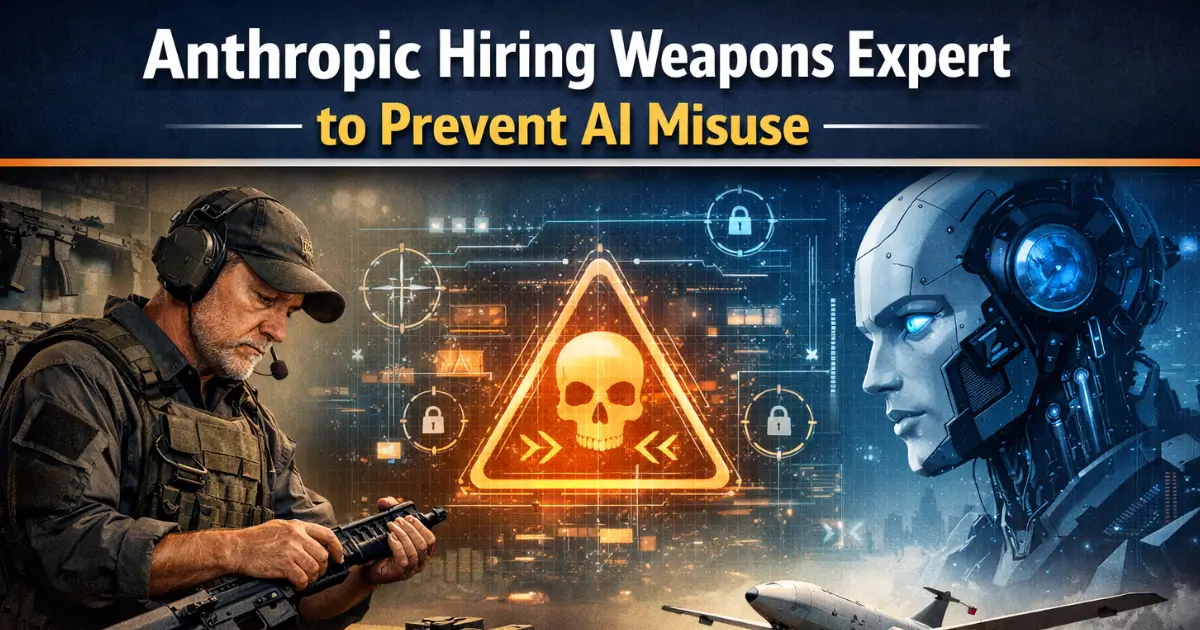
American artificial intelligence company Anthropic has posted an unusual job listing that is raising eyebrows across the tech world. The firm is looking to hire a chemical weapons and high-yield explosives expert to try to prevent what it calls "catastrophic misuse" of its software. In simple terms, Anthropic is worried that its AI tools could potentially be used to help someone access dangerous information about creating chemical or radiological weapons, and it wants a specialist to ensure its safety guardrails are strong enough to prevent that.
What the Job Listing Says
The LinkedIn recruitment post specifies that applicants should have at least five years of experience in chemical weapons and/or explosives defense, along with knowledge of radiological dispersal devices — commonly known as dirty bombs. The role would be based in San Francisco and Washington, D.C., though remote work is also an option. The position offers a salary ranging from $245,000 to $285,000.
Anthropic told the BBC that this role is similar to positions it has already created in other sensitive areas. The hire would join the company's policy team, working to identify potential misuse scenarios before they happen and to strengthen the AI model's ability to refuse harmful requests.
Anthropic Is Not Alone
Anthropic is not the only AI firm adopting this strategy. ChatGPT developer OpenAI has advertised a similar position — a researcher in biological and chemical risks — with a salary of up to $455,000, nearly double Anthropic's offer. The fact that two of the world's leading AI labs are simultaneously recruiting weapons safety experts signals just how seriously the industry is taking the threat of misuse as models become more powerful.
Searches for similar roles at other major AI startups turned up no comparable listings, suggesting that Anthropic and OpenAI are ahead of the curve on this particular type of safety investment.
Expert Concerns
Not everyone is comfortable with this approach. Dr. Stephanie Hare, a tech researcher and co-presenter of the BBC's AI Decoded programme, raised a pointed question about whether it is ever truly safe to use AI systems to handle sensitive information about chemicals, explosives, and radiological weapons. She noted that there is currently no international treaty or regulation governing this type of work, and that all of it is happening without public oversight.
"There is no international framework governing how AI companies handle weapons-related knowledge internally. The hiring of such experts may be well-intentioned, but without external oversight and regulation, we are trusting private companies to police themselves on matters of national and global security,"
Why Now?
The timing of this hire is significant. The issue of AI misuse has gained urgency as the U.S. government has increasingly called on AI firms for defense-related applications. Anthropic itself has acknowledged that its latest models showed elevated susceptibility to harmful misuse in certain settings, including instances where models provided limited support for efforts related to chemical weapon development.
Anthropic CEO Dario Amodei has been vocal about the risks. In an early 2026 essay, he flagged what he called a serious risk of a major attack facilitated by AI capabilities. The company's own safety assessments have found that as models become more powerful and autonomous, the potential for misuse grows — even without deliberate prompting from bad actors.
The Bigger Picture
This hiring move comes at a turbulent time for Anthropic. The company was recently designated a supply chain risk by the U.S. Department of Defense after it refused to allow its AI to be used for mass surveillance of Americans or in fully autonomous weapons systems. The Pentagon had been using Anthropic's Claude models on its classified networks, and the sudden ban left the military without its preferred AI tools.
The dispute has drawn wide support for Anthropic. Microsoft, retired military leaders, and AI think tanks have filed legal briefs supporting the company's position. Engineers from OpenAI and Google's DeepMind also filed an amicus brief, arguing that the Pentagon's actions represented an improper use of power with serious implications for the industry.
Balancing Safety and Innovation
The challenge Anthropic faces is one that the entire AI industry must eventually confront: how to make AI systems powerful enough to be useful while ensuring they cannot be weaponized. Hiring domain experts in weapons and explosives is one approach, but as critics point out, it also means giving AI systems access to sensitive knowledge — even if the goal is purely defensive.
Anthropic has warned that future capability jumps, new reasoning mechanisms, or broader autonomous deployments could invalidate today's safety conclusions. The company acknowledges that this is a challenge requiring ongoing oversight and governance.
The Bottom Line
Anthropic's decision to hire a chemical weapons and explosives expert underscores a growing reality in the AI industry: as models become more capable, the risks of misuse become more concrete. Whether this approach — bringing weapons knowledge inside the company to build better defenses — is the right one remains an open debate. What is clear is that the era of treating AI safety as an afterthought is over. The question now is whether industry self-regulation will be enough, or whether governments need to step in with binding international frameworks before it is too late.