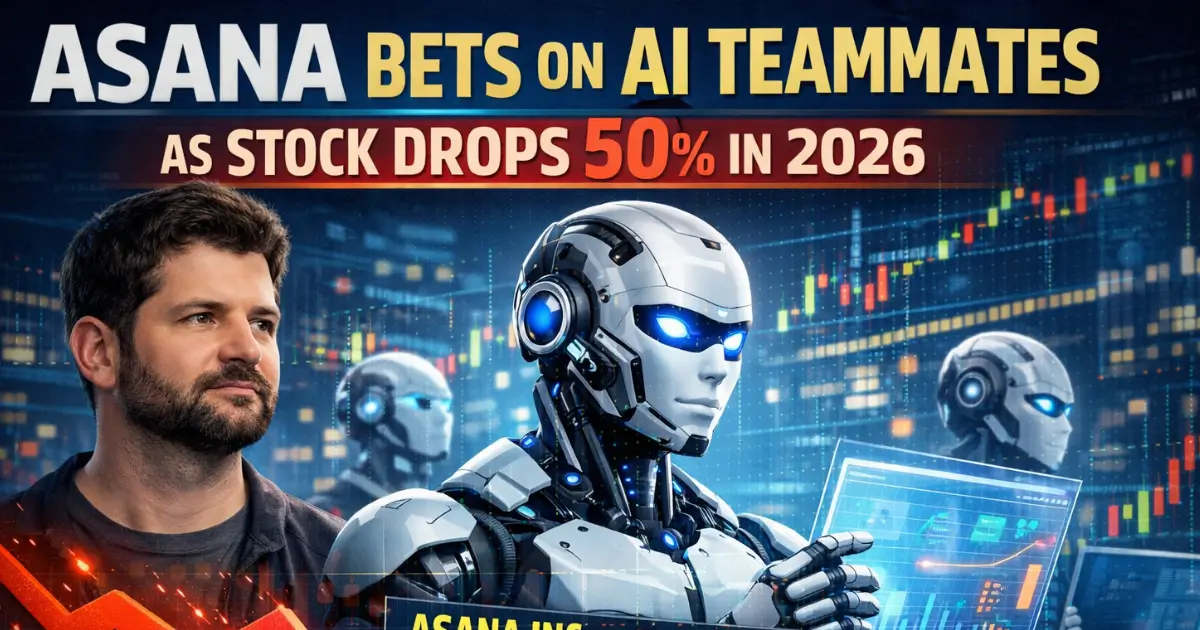
SAN FRANCISCO — The AI agent revolution was supposed to make work smoother, faster, and more efficient. Instead, for many enterprises, it has created a new layer of chaos. Companies are spinning up hundreds of agents per employee, most of which sit idle or fail at basic tasks, creating what industry observers are calling "agent sprawl." Asana, the work management platform whose stock has fallen roughly 50 percent from recent highs, believes it has the answer — and CEO Dan Rogers told Business Insider exactly how the company plans to prove it.
The pitch is simple but ambitious: while everyone else is building autonomous AI agents, Asana is betting that collaboration, not autonomy, is the key to making agents actually useful in the workplace.
Why Most AI Agents Are Failing in the Workplace
The problem is well documented. Research from Carnegie Mellon University found that 70 percent of AI agents in the wild today fail at basic tasks. Salesforce's own Slack CMO Ryan Gavin has predicted that 2026 would be the year of the "lonely agent" — companies deploying hundreds of bots that end up sitting idle like unused software licenses.
The root cause, according to Rogers, is that most AI agents are built for individuals rather than teams. They lack the context, checkpoints, and controls needed to operate effectively within complex enterprise workflows. An agent that can draft an email is not the same as one that understands who owns a project, what the dependencies are, and when a deadline is at risk.
This is the gap Asana is targeting with its AI Teammates — collaborative agents that live inside the company's work management platform rather than operating in isolated chat windows or standalone tools.
Asana Launches AI Teammates to Fix the Problem
Launched in beta last year and now reaching general availability, AI Teammates are pre-built agents that plug directly into Asana's Work Graph, the company's proprietary data model that maps relationships, goals, workflows, and organizational structure across an enterprise.
Unlike standalone AI assistants, these agents have persistent memory. They remember previous instructions, learn from team feedback, and build institutional knowledge over time. They can be assigned work just like a human colleague — drafting campaign briefs, triaging IT tickets, investigating bugs, or correlating data across projects.
Early results from the beta program have been encouraging. Asana says teams using AI Teammates finished work twice as fast, with tasks being 3.2 times more likely to have a clear owner and 2.6 times more likely to have a defined deadline. Morningstar, one of the early adopters, reported that an AI Teammate completed weeks of complex research in just hours.
Rogers has been vocal about what sets Asana's approach apart. He argues that agents can only collaborate effectively with humans if they have access to a company's operational blueprint — who is doing what, by when, how, and why. Most AI tools, he says, try to obtain this context by trawling through vast amounts of company data each time they are assigned a task. Asana's Work Graph provides that context natively.
Stock Down 50%, But Financials Tell a Different Story
Despite the AI momentum, Asana's stock tells a different story. Shares are down roughly 50 percent in 2026, and the company trades more than 90 percent below its all-time high of around $145 reached in 2021. The decline reflects broader market skepticism about mid-cap SaaS companies, a CEO transition after co-founder Dustin Moskovitz stepped down last year, and concerns about slowing revenue growth.
Rogers, who took over as CEO in mid-2025 after serving as the company's president, acknowledged the stock performance but pointed to improving fundamentals. Asana posted fiscal year 2026 revenue of $790.8 million, up 9 percent year over year, and achieved non-GAAP operating profitability for the first time. Free cash flow surged from $2.6 million to $84.5 million. AI Studio, the company's no-code workflow builder, grew ARR by more than 50 percent quarter over quarter in the final quarter of the fiscal year.
The company has guided for $850 million to $858 million in revenue for fiscal year 2027, with AI products expected to contribute 15 percent of net new annual recurring revenue.
Rogers: 'Autonomy Is the Wrong Goal' for AI Agents
Rogers frames the opportunity in direct opposition to the industry's current obsession with autonomous agents. His argument is that enterprise work is inherently multiplayer — it involves handoffs, approvals, dependencies, and cross-functional coordination that no single-player AI tool can manage effectively.
Two of the world's five most valuable public companies expanded their Asana deployments in fiscal year 2026, a signal that large enterprises see value in the platform's approach. Anthropic, the AI safety company, is also among Asana's customers, running compliance, finance, product, and engineering coordination through the platform.
The company now offers 21 pre-built AI Teammates across marketing, IT, and operations, with a no-code builder for creating custom agents. It has also launched integrations with Anthropic's Claude Code and supports Model Context Protocol connections for interoperability with other enterprise tools.
Can Asana Survive the Enterprise AI Battle?
For Asana, the stakes are clear. The work management market is being reshaped by AI at every level, with Microsoft, Salesforce, and a wave of AI-native startups all competing for the same enterprise dollars. Asana's bet is that the companies that win will not be the ones with the most autonomous agents but the ones that best orchestrate human and AI collaboration.
Rogers summed it up plainly: AI does not reduce coordination. It multiplies it. If he is right, Asana's current stock price may look like a bargain in hindsight. If he is wrong, the company risks being squeezed between larger platform players and nimbler AI-native competitors in a market that is moving faster than ever.