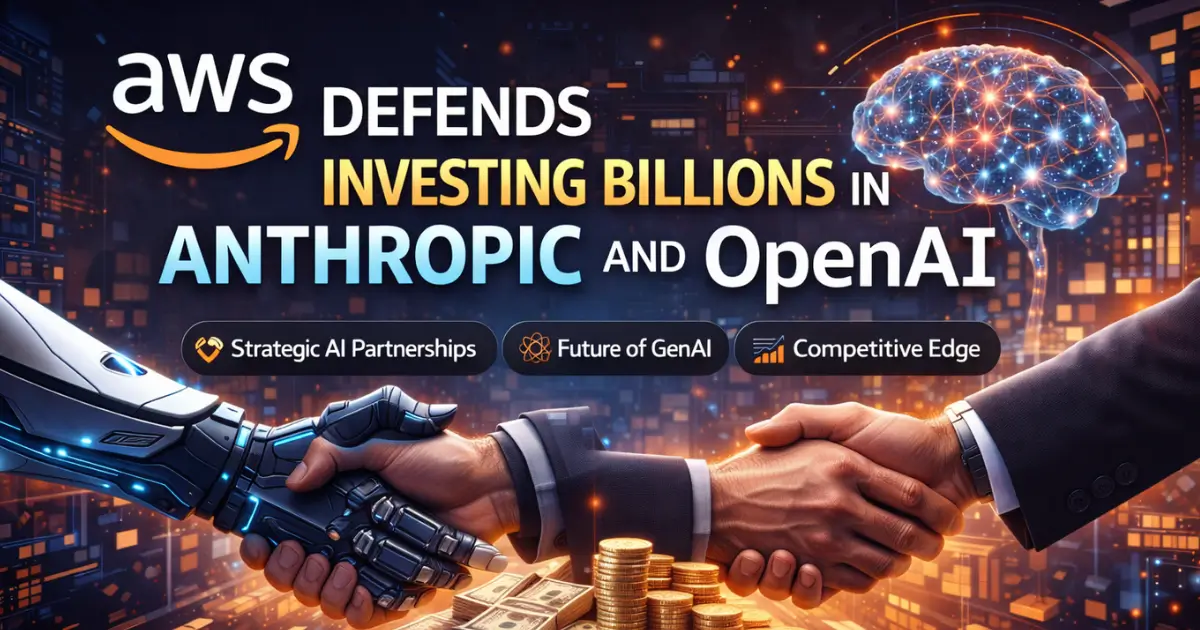
AWS CEO Matt Garman doesn't see a problem with Amazon pouring $8 billion into Anthropic and then turning around and dropping $50 billion on OpenAI. In fact, he thinks it's exactly what the moment demands.
Speaking at the HumanX conference in San Francisco this week, Garman tackled the question head-on: how does Amazon justify deep partnerships with two AI companies that are openly — and sometimes pettily — at war with each other?
His take? AWS has been doing this for nearly two decades.
Competing With Partners Is in Amazon's DNA
Garman has been at Amazon since 2005, back when AWS was still a year away from launching. He explained that the cloud unit realized early that it couldn't build every product on its own. Partnerships were non-negotiable. But so was the fact that Amazon would eventually ship its own products that directly overlapped with what those partners offered.
Over time, AWS turned that tension into an operational discipline — going to market alongside partners while also running competing first-party services. The deal, according to Garman, is simple: Amazon promises not to give itself an unfair competitive advantage.
It sounded radical in 2006. Today, even Oracle — one of AWS's biggest competitors — sells its database on the AWS platform. The industry has moved on.
A Defensive Move Disguised as Offense
The OpenAI investment wasn't just about portfolio diversification. It was survival math. Both Anthropic and OpenAI models were already available on Microsoft Azure, which remains AWS's largest cloud rival. Letting Microsoft monopolize access to the two most sought-after AI model families was a risk Amazon couldn't afford.
By securing OpenAI for its own platform alongside its existing Anthropic relationship, AWS now offers enterprises what they increasingly want: choice. One cloud, multiple frontier models, no lock-in.
The Real Play: Model Routing
Garman outlined a future that goes beyond simply hosting models. He described AI model-routing services — tools that automatically assign tasks to whichever model performs best for the job. A planning task might go to one model. Complex reasoning might go to another. A cheaper, lighter model handles routine work like code completion.
This is where Amazon's dual investment pays off strategically. Routing services keep customers inside the AWS ecosystem and create a natural opening for Amazon's own homegrown AI models to earn usage based on merit. If the router picks Amazon's model for a task, that's market share gained without a single sales call.
It's competing with your partners — just quietly and algorithmically.
Everyone's Hedging
Amazon isn't an outlier here. When Anthropic announced its $30 billion funding round in February, at least a dozen investors on the cap table were also backing OpenAI. Microsoft — OpenAI's primary cloud partner and largest backer — was among them.
The old venture capital rule of picking one horse in a category is effectively dead in AI. The technology is moving too fast, the capital requirements are too massive, and the outcome is too uncertain for anyone to go all-in on a single bet. Hedging has become the default strategy across the board.
What This Signals for the Industry
For enterprise buyers, the takeaway is straightforward: plan for a multi-model world. No single AI provider will dominate every use case, and the companies building model-agnostic architectures now will have the most flexibility later.
For AI startups, the picture is more complicated. Capital is flowing freely, but the same investors funding your growth are also funding your competition. Loyalty has been replaced by optionality.
And for the cloud giants? They're positioning themselves as the infrastructure layer underneath all of it. Whether Anthropic or OpenAI ultimately leads the model race matters less to AWS than making sure the race is run on its servers.
Garman's framing at HumanX made the subtext explicit: in the AI era, conflict of interest is just another name for strategic positioning. The companies that get comfortable with that ambiguity fastest will be the ones that win.