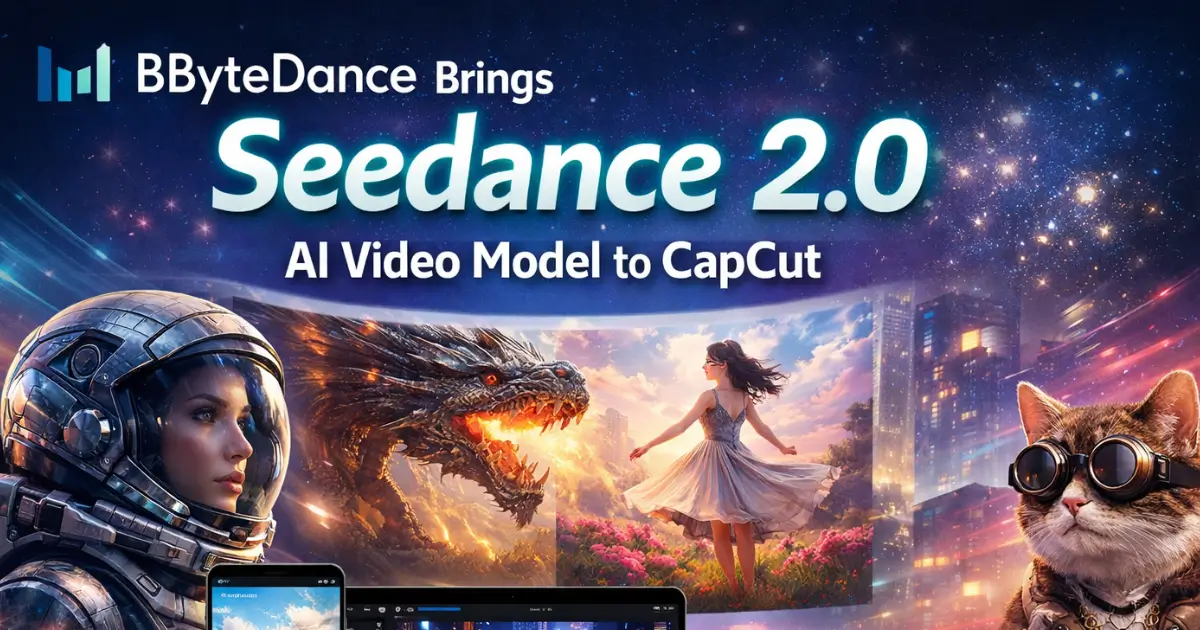
Just as OpenAI dials back its video generation efforts with the shutdown of its Sora app, ByteDance on Thursday confirmed that its new audio and video model, Dreamina Seedance 2.0, is now rolling out inside its popular editing platform CapCut.
The model allows creators to draft, edit, and sync video and audio content using prompts, images, or reference videos. This positions ByteDance as a major player in the AI video generation space at a time when one of its biggest competitors is stepping back.
The phased rollout will begin with CapCut users in Brazil, Indonesia, Malaysia, Mexico, the Philippines, Thailand, and Vietnam, with more markets to be added over time.
What Seedance 2.0 Can Do
The model's capabilities are broad and designed to appeal to a wide range of content creators. ByteDance says the video generation model works even without reference images — a creator can simply use a few words to describe a scene and the model will generate it. CapCut also handles realistic textures, movement, and lighting across different visual perspectives and angles, which could be used to edit, enhance, or correct creators' existing footage.
Another use case is allowing creators to test potential ideas based on early concepts or sketches before filming the actual video. This makes the tool particularly useful during the pre-production phase, helping creators visualize ideas before investing time and money into a full shoot.
The model supports a wide range of content types including cooking recipes, fitness tutorials, business or product overviews, and videos with motion or action-focused content — an area where AI video models have historically struggled.
At launch, the model supports clips of up to 15 seconds long across six aspect ratios.
Rolling Out Across ByteDance's Ecosystem
Within CapCut, the model will appear across different areas including editing features like AI Video and generation tools like Video Studio. It will also come to ByteDance's AI generation platform Dreamina and its marketing platform Pippit.
In China, the model is already available to users of ByteDance's Jianying app, the domestic version of CapCut. This multi-platform strategy ensures ByteDance can reach creators, marketers, and businesses across its entire product ecosystem.
Copyright Controversy and Limited Launch
The limited number of launch markets is no coincidence. The rollout follows a recent report that the model's global launch had been paused while ByteDance worked to address intellectual property issues that drew criticism from Hollywood over alleged copyright infringement. The entertainment industry raised concerns that the model could be used to generate content that infringes on copyrighted material, prompting ByteDance to take a more cautious approach.
That likely explains why the model is not yet available in the United States or other major Western markets where copyright enforcement is particularly strict.
Safety Measures and Watermarking
ByteDance is clearly trying to get ahead of potential misuse concerns. The company says it has added safety restrictions so the model cannot create videos from images or videos containing real faces. CapCut will also block the unauthorized generation of intellectual property.
All content produced by Dreamina Seedance 2.0 will include an invisible watermark to help identify AI-generated content when it is shared off-platform. This watermarking system could assist rights holders in filing takedown requests if copyrighted content slips through the model's filters.
However, the fact that the model still is not available in the US suggests that ByteDance acknowledges these protections may need further refinement before facing the scrutiny of Hollywood studios and major content owners.
The Bigger Picture
ByteDance's move comes at an interesting moment in the AI video generation landscape. With OpenAI retreating from Sora and other competitors still in early stages, ByteDance has an opportunity to establish Seedance 2.0 as the go-to AI video tool for millions of CapCut users worldwide.
The company says it will partner with experts and creative communities as the model rolls out to iterate and improve its capabilities. If ByteDance can successfully navigate the copyright minefield and deliver on the model's creative promise, Dreamina Seedance 2.0 could become one of the most widely used AI video generation tools in the world — simply by being built into an app that creators are already using every day.