
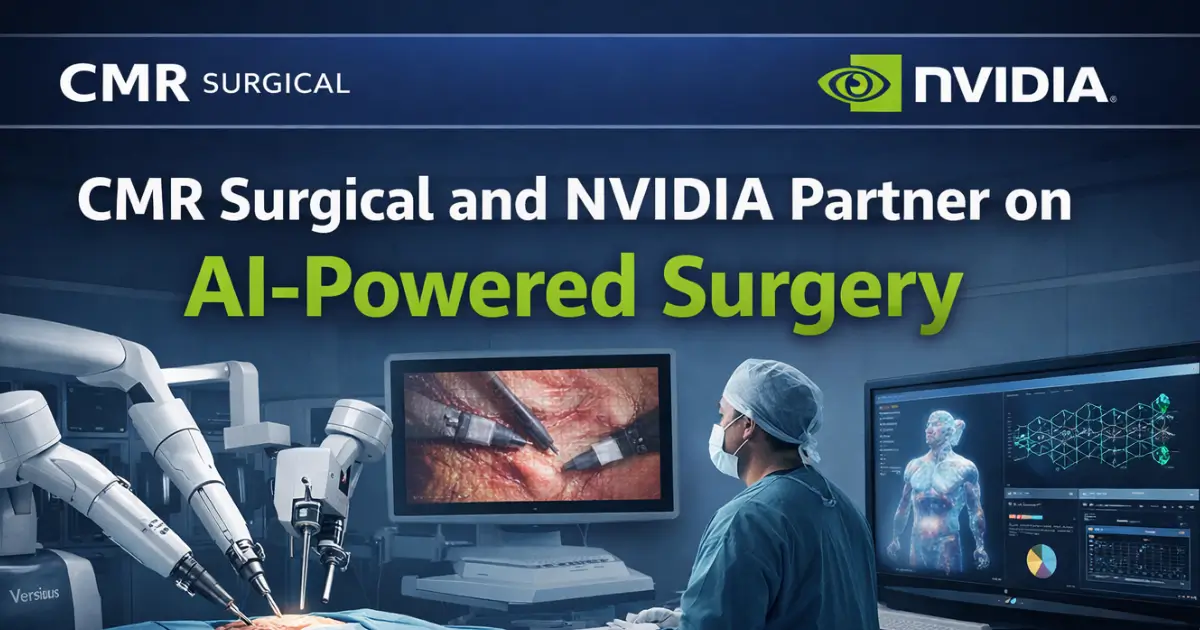
The future of surgery may look radically different thanks to a new partnership between two powerhouses in their respective fields. CMR Surgical, the global surgical robotics company headquartered in Cambridge, UK, has announced its participation in NVIDIA's Physical AI healthcare robotics initiative, unveiled at NVIDIA GTC. The collaboration aims to train the next generation of intelligent surgical systems using real-world data combined with cutting-edge AI simulation technology.
Building the World's Largest Surgical Dataset
At the heart of the announcement is Open-H — the world's largest open dataset for healthcare robotics, designed to train the next generation of intelligent surgical systems. The dataset combines real-world surgical video, robotic telemetry, and multimodal data from leading healthcare and robotics organizations.
CMR contributed close to 500 hours of anonymized surgical data from its Versius Surgical Robotic System, representing the largest share of surgical data in the initiative. This is not just a symbolic contribution — it forms the backbone of a dataset that could reshape how surgical robots are developed and deployed around the world.
Why Physical AI Matters in Surgery
Robotic surgery has already enabled millions of minimally invasive procedures worldwide, helping surgeons perform complex operations with greater precision and control. However, advancing surgical robotics further requires new approaches to how robotic systems learn from clinical experience.
This is where NVIDIA's Physical AI infrastructure enters the picture. The platform allows robotic systems to be trained and evaluated in simulated environments before deployment, helping accelerate development while maintaining high safety standards. CMR is also using NVIDIA Cosmos-H to generate physically accurate synthetic surgical data and evaluate new robotic policies for the future development of the Versius platform.
In practical terms, this means surgical robots could one day better understand the flow of an operation, anticipate a surgeon's next move, assist with complex tasks in real time, and serve as advanced training tools for medical professionals — all without compromising patient safety during the development phase.
Expert Voices
CMR Surgical's Chief Technology Officer, Chris Fryer, emphasized the untapped potential of surgical data. He noted that surgical robotics generates a rich and underutilized source of real-world clinical data, and that by contributing anonymized data to initiatives like Open-H, CMR aims to support broader innovation across the entire healthcare robotics community.
David Niewolny, Head of Business Development for Healthcare and Medical Technology at NVIDIA, said: "The next generation of surgical robotics will be powered by data, simulation and AI working together. Medical technology leaders like CMR Surgical are accelerating a new generation of intelligent robotic systems that can assist surgeons, scale surgical expertise and ultimately expand access to high-quality care."
The Versius Robotic System
The Versius Surgical Robotic System is designed to support surgeons in performing minimally invasive procedures across a range of specialties. It features a modular, portable design that integrates into existing operating room environments and surgical workflows. The system has performed approximately 40,000 surgical cases to date and is being used across specialties including urology, general surgery, gynecology, and thoracic surgery in leading hospitals around the world.
Versius became the first multi-port, soft tissue general robotic-assisted surgical device to gain clearance through the FDA's de novo process just over a year ago, marking a significant regulatory milestone. The system features collaborative arms and bedside units for direct patient access, and its design biomimics the human arm to give surgeons optimized dexterity during procedures.
A Growing Trend in Surgical AI
CMR is far from the only company investing in AI-powered surgery. NVIDIA has existing surgical robotics partnerships with companies like Johnson & Johnson MedTech, Karl Storz's Asensus, Moon Surgical, Virtual Incision, Neptune Surgical, and Stereotaxis. Johnson & Johnson MedTech also announced advances in its Monarch Platform for Urology using NVIDIA's physical AI capabilities, including virtual operating room environments and simulated patient anatomy for procedure planning.
The global market for robotic surgical procedures has reached approximately €14.3 billion in 2026 and is projected to grow to €49.1 billion by 2034. Around 60% of large hospitals worldwide have now adopted robotic surgical systems, signaling that what was once a niche technology is rapidly becoming the standard of care.
The Bigger Vision: Surgery for Five Billion
Perhaps the most compelling aspect of CMR's mission is its scale of ambition. Physical AI technologies could help democratize access to minimally invasive surgery and ultimately close the gap of five billion people globally who lack access to safe and affordable surgery.
As healthcare systems worldwide face increasing surgical demand and workforce constraints, innovations that enhance surgeon capabilities may also help expand access to minimally invasive procedures for more patients. AI-powered surgical systems could allow less experienced surgeons to perform complex procedures with guidance, and could bring robotic surgery to hospitals and regions that currently lack access.
The Bottom Line
The partnership between CMR Surgical and NVIDIA represents more than a technology announcement — it is a signal of where healthcare is heading. By combining real-world surgical data with NVIDIA's AI simulation platform, the two companies are laying the groundwork for surgical robots that are smarter, safer, and more accessible. The goal is not to replace surgeons, but to empower them with tools that make every operation better. If successful, this initiative could help bring the benefits of robotic surgery to billions of people who currently go without.