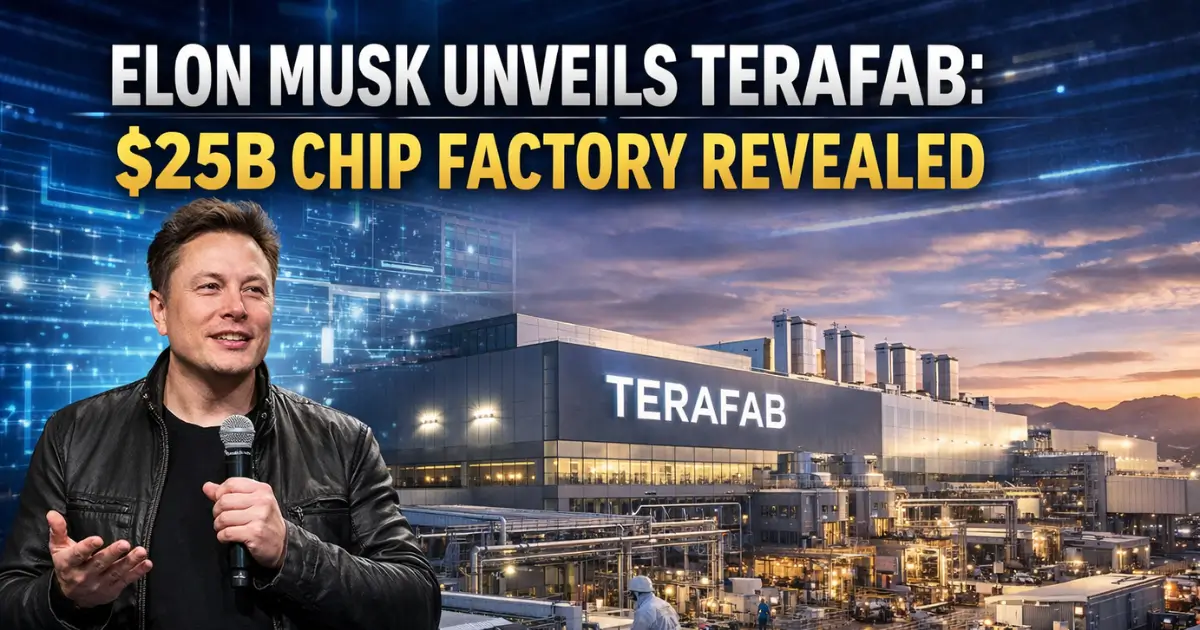
In what could be one of the most ambitious industrial announcements of the decade, Elon Musk has officially unveiled "Terafab" a massive semiconductor fabrication project jointly developed by Tesla, SpaceX, and xAI. The announcement was made on March 21, 2026, during a special event held at the historic Seaholm Power Plant in Austin, Texas, and was simultaneously broadcast live on X (formerly Twitter) via SpaceX's official channel.
Terafab is envisioned as a vertically integrated chip manufacturing facility that would consolidate every stage of semiconductor production from chip design and lithography to fabrication, memory production, advanced packaging, and testing all under a single roof. The project carries an estimated price tag of $20 to $25 billion, making it one of the largest private industrial investments in recent memory.
The Scale of Ambition
Musk described Terafab as nothing less than "the most epic chip-building exercise in history by far." The facility is designed to eventually produce over one terawatt that is, one trillion watts of artificial intelligence compute capacity per year. To put that figure in perspective, Musk claimed that all existing chip manufacturers on Earth combined currently produce only about two percent of the computing power that Tesla and SpaceX will need in the coming years.
The initial prototype fab will be located on the North Campus of Giga Texas in Austin, while the full-scale Terafab's final location has yet to be determined. The project is targeting 2-nanometer process technology, the most advanced chipmaking node currently entering commercial production worldwide. Tesla's fifth-generation AI chip, known as AI5, is among the first products the pilot facility will produce, with small-batch manufacturing expected to begin later in 2026 and volume production projected for 2027.
Why Build Terafab?
According to Musk, the driving force behind Terafab is simple: his companies need far more chips than the global semiconductor industry can currently supply. Tesla's expanding ecosystem including Full Self-Driving (FSD) technology, the Cybercab robotaxi program, and the Optimus humanoid robot demands an enormous and growing volume of custom AI processors. Musk has projected that Tesla could eventually manufacture tens of billions of Optimus robots, each requiring dedicated silicon.
Meanwhile, SpaceX has its own chip requirements for orbital AI satellites, space-based data centers, and radiation-hardened processors designed to operate in the extreme conditions of space. Musk revealed that roughly 80 percent of Terafab's compute output would be directed toward space-based applications, with only 20 percent allocated for terrestrial use.
"We either build the Terafab, or we don't have the chips, and we need the chips, so we build the Terafab," Musk stated bluntly during the presentation.
Skepticism and Challenges
Despite the grand vision, industry analysts and experts have raised significant questions about the project's feasibility. The semiconductor fabrication industry is notoriously difficult to enter, with barriers including massive capital requirements, decades of accumulated expertise, and extraordinarily complex supply chains.
For context, Taiwan's TSMC the world's leading chipmaker has invested approximately $165 billion over several years to build six fabs in Arizona, and those facilities are not expected to achieve 2-nanometer production until 2029. Tesla and SpaceX, by contrast, have zero prior experience in semiconductor manufacturing.
Morgan Stanley analysts have estimated that building meaningful chipmaking capacity for Terafab could require total capital investment in the range of $35 to $45 billion well above Musk's initial projections. Tesla's CFO acknowledged at the event that Terafab's costs are not yet factored into Tesla's already record-breaking 2026 capital expenditure plan, which independently exceeds $20 billion.
Some observers have drawn comparisons to Tesla's Battery Day in 2020, when Musk promised a revolution in battery technology with the 4680 cell. That program took years longer than initially promised and fell far short of its original targets.
A Galactic Vision
Musk, however, leaned into the skepticism, challenging doubters by pointing to Tesla and SpaceX's track record of defying critics. He framed Terafab not merely as a chip factory but as a stepping stone toward making humanity a multi-planetary civilization complete with AI-powered orbital satellites, lunar electromagnetic launch systems operated by Optimus robots, and eventually interstellar expansion.
Whether Terafab will become a revolutionary achievement or another case of over-promising remains to be seen. But one thing is certain: in the rapidly evolving landscape of AI and semiconductor technology, Elon Musk has once again placed the boldest possible bet.