
You just snapped the perfect photo of a hidden rooftop cafe, but now comes the hard part: writing a caption that actually helps the next person who finds it on Google Maps. What if you did not have to? Google just solved that problem, and the implications go far beyond saving you a few seconds of typing.
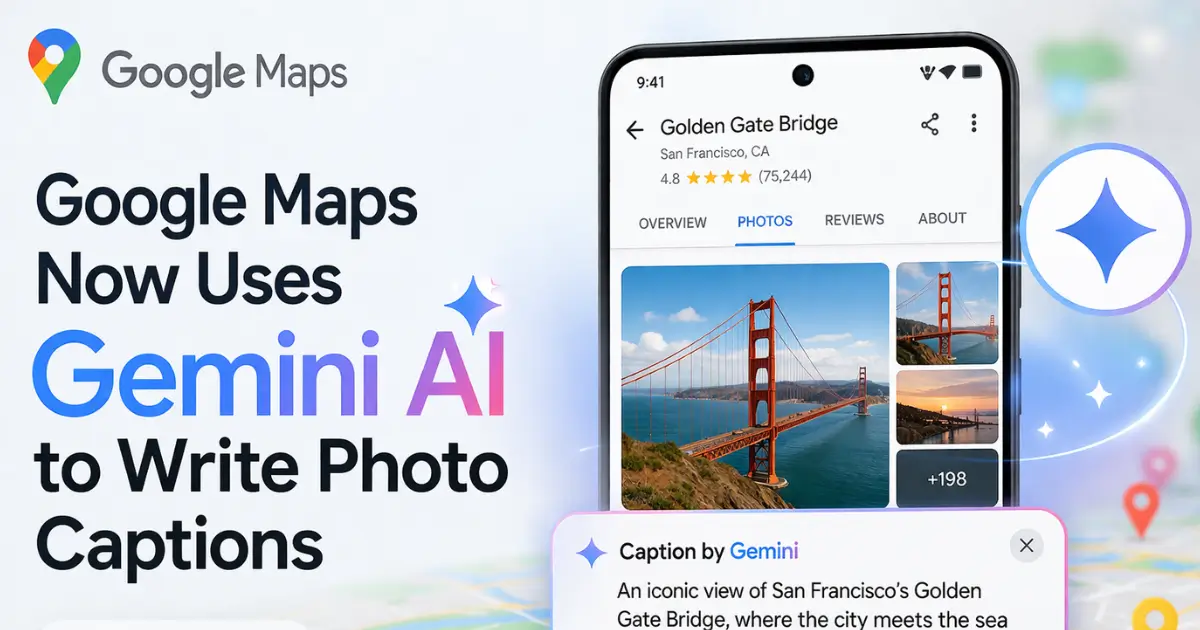
Google announced Tuesday that it is rolling out new features to make it easier for users to contribute local knowledge to Maps. The headline addition is that Gemini, Google's AI, can now automatically create captions when users share a photo or video about a place.
The feature works exactly as you would expect. Once users select photos they want to share, Gemini analyzes the images and generates captions. Users can then choose to edit or remove the caption. It is a simple workflow designed to eliminate the friction that stops many people from contributing helpful context along with their photos.
Caption suggestions are available now in English on iOS in the United States and will expand globally and to Android in the coming months.
Why This Matters More Than It Sounds
Google Maps is not just a navigation app. It has become one of the world's largest platforms for crowdsourced local information, and that information is only as good as the people who contribute it. Google says it has a community of over 500 million contributors who share photos, reviews, and videos to help others decide what to do and where to go.
But here is the problem: most people take photos but never bother to add context. A photo of a restaurant's interior tells you something, but a photo with a caption saying "the outdoor terrace has great sunset views and gets crowded after 7pm" tells you much more. By having AI handle the caption writing, Google is betting that it can dramatically increase the quality and usefulness of the millions of photos uploaded to Maps every day.
As Google explained in its blog post, photos and videos help people better understand a place, like the overall vibe or the newest menu items. The AI caption feature is designed to give users a head start so they are more likely to share that context rather than uploading a photo with no description at all.
Making It Easier to Find the Right Photo
Google is not stopping at captions. The company also wants to make it easier for users to find photos worth sharing in the first place.
If users turn on media access for Google Maps in their phone's settings, they will see photos and videos from their recent experiences directly in the "Contribute" tab. From there, they can tap on a photo and post it.
This is a clever move. Instead of asking users to actively remember to open Maps and upload something, Google is surfacing relevant photos automatically essentially reminding you that you have content worth sharing and making the upload process as close to a single tap as possible.
Photo and video recommendations are now available globally on iOS and Android.
Rewarding Contributors
Google also knows that contributions need motivation. To that end, the company is improving how it recognizes and rewards its most active contributors.
Users will now see total points earned displayed in the "Contribute" tab, and Local Guide levels will be highlighted on profile pages. For those unfamiliar with the system, Local Guides earn points by adding photos, writing reviews, answering questions, and checking facts to improve Google Maps.
Google has updated its achievement badges to make it easier to see if someone is an expert fact-finder, a master photographer, or a rising novice. The company is also making it easier to spot high-level contributors with new gold-colored profiles.
These gamification features may seem minor, but for a platform that depends on volunteer contributions to keep its data fresh, making contributors feel recognized is essential.
The Bigger Picture
This update is a textbook example of how Google is weaving AI into its most popular products not with flashy standalone features, but with small, practical tools that make existing workflows better. You do not need to open a separate AI app or write a prompt. You just take a photo and Gemini handles the rest.
Given that Maps largely relies on contributors to keep information fresh and updated, it makes sense for the company to streamline the process of these contributions. The easier Google makes it to share useful local knowledge, the more valuable Maps becomes for everyone and the harder it gets for any competitor to catch up with Google's crowdsourced data advantage.
For the 500 million people who already contribute to Maps, this update removes one more barrier. For Google, it is another quiet step toward making AI invisible not a product you use, but something that simply makes every product around it work better.