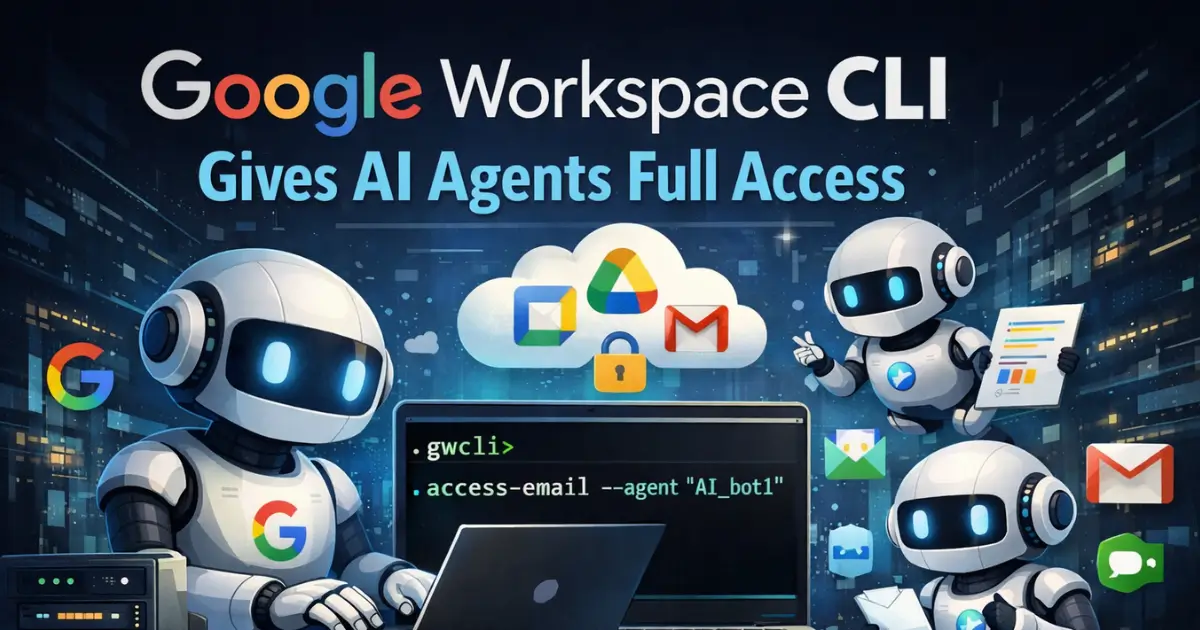
Google has open-sourced a new command-line interface tool called "gws" that unifies access to its entire Workspace ecosystem — including Gmail, Google Drive, Calendar, Docs, Sheets, Slides, Chat, and more — through a single command. What makes this release particularly significant is that the tool was designed from the ground up with AI agents as its primary users, not just human developers. The project, hosted under Google's official GitHub organization, has already attracted thousands of stars within days of its launch in early March 2026, signaling strong developer interest in agent-friendly infrastructure.
What Is Google Workspace CLI?
The tool, officially named Google Workspace CLI and invoked via the "gws" command, is written in Rust and distributed through the npm package registry. It eliminates the need for developers and AI agents to juggle multiple Google APIs, each with their own authentication flows and endpoint structures. Instead, gws provides a unified interface where a single installation command gives access to over 50 Workspace APIs. Every response is returned in structured JSON format, making it straightforward for large language models and autonomous agents to parse and act on the data.
Dynamic Command Surface: Always Up to Date
One of the most distinctive technical features of gws is its dynamic command surface. Unlike traditional CLIs that ship with a fixed set of commands, gws reads from Google's Discovery Service at runtime and builds its entire command structure on the fly. This means that whenever Google adds a new API endpoint or method, gws picks it up automatically without requiring a software update. Schema documents are cached for 24 hours to keep performance predictable in high-frequency agent pipelines, but the core principle remains: the tool is always in sync with the latest state of Google's APIs.
Built-In MCP Server for AI Integration
The release also includes a built-in Model Context Protocol (MCP) server, which has generated considerable excitement in the developer community. MCP is an open standard, originally developed by Anthropic, that allows AI systems to interact with external tools through a standardized interface. By running a simple command, developers can start an MCP server that exposes selected Workspace APIs as structured tools. Any MCP-compatible client — such as Claude Desktop, VS Code extensions, or custom agent frameworks — can then query Google Workspace directly. This effectively turns an organization's entire Workspace environment into an agent-accessible toolkit without the need for custom integration code.
Pre-Built Agent Skills and Recipes
Beyond the raw API access, the repository ships with over 100 pre-built "agent skills" and more than 50 curated recipes that package common multi-step Workspace workflows into reusable templates. These cover tasks ranging from summarizing email threads and drafting replies to searching Drive for recently modified files and scheduling calendar events. AI engineers can install these skills directly into their agent environments, accelerating the development of Workspace-powered automation. The tool also integrates as a Gemini CLI extension, allowing Google's own AI agent to inherit gws credentials and manage Workspace resources natively.
Security and Authentication
Security has not been overlooked. The CLI supports Google Cloud's Model Armor for response sanitization — a feature specifically designed for agentic contexts. By adding a sanitization flag, API responses are scanned for potential prompt injection payloads before they reach an AI agent. This addresses a real threat: a malicious actor who controls content in a user's Drive or inbox could craft documents designed to hijack agent behavior when read. Authentication is handled through multiple methods including OAuth with encrypted credentials stored in the OS keyring, service account key files, and environment variable tokens for headless or CI/CD environments.
Tech Giants Race to Power the AI Agent Economy
The broader context of this release reflects an intensifying competition among tech giants to build infrastructure for the emerging AI agent economy. Microsoft has been embedding Copilot functionality across its productivity suite, while OpenAI has been developing personal agent systems and recently hired Peter Steinberger, the creator of the popular open-source agent platform OpenClaw. Google, meanwhile, is pursuing a dual strategy: building its own agent ecosystem around Gemini while simultaneously creating tools like gws that are compatible with external agent frameworks regardless of the underlying model.
Not Yet an Official Product
It is worth noting that Google presents gws as a developer example rather than an officially supported product. The repository's README explicitly states that there are no guarantees regarding stability or long-term support, and breaking changes are expected as the project progresses toward version 1.0. For experimental use and small teams, this is unlikely to be a barrier. However, enterprises considering giving AI agents programmatic access to email, documents, and calendars will need to weigh the benefits of early adoption against the risks of building on pre-release tooling.
The Year of Skills and CLIs
Vercel CEO Guillermo Rauch captured the sentiment around the launch by declaring that 2026 is shaping up to be the year of skills and CLIs, with the command line becoming the primary interface for both human operators and AI agents interacting with cloud services. Whether gws evolves into a formally supported Google product or remains a community-driven project, its rapid adoption suggests that the developer community has been waiting for exactly this kind of unified, agent-first interface to enterprise productivity tools. The race to make business software accessible to autonomous AI systems is now well and truly underway.