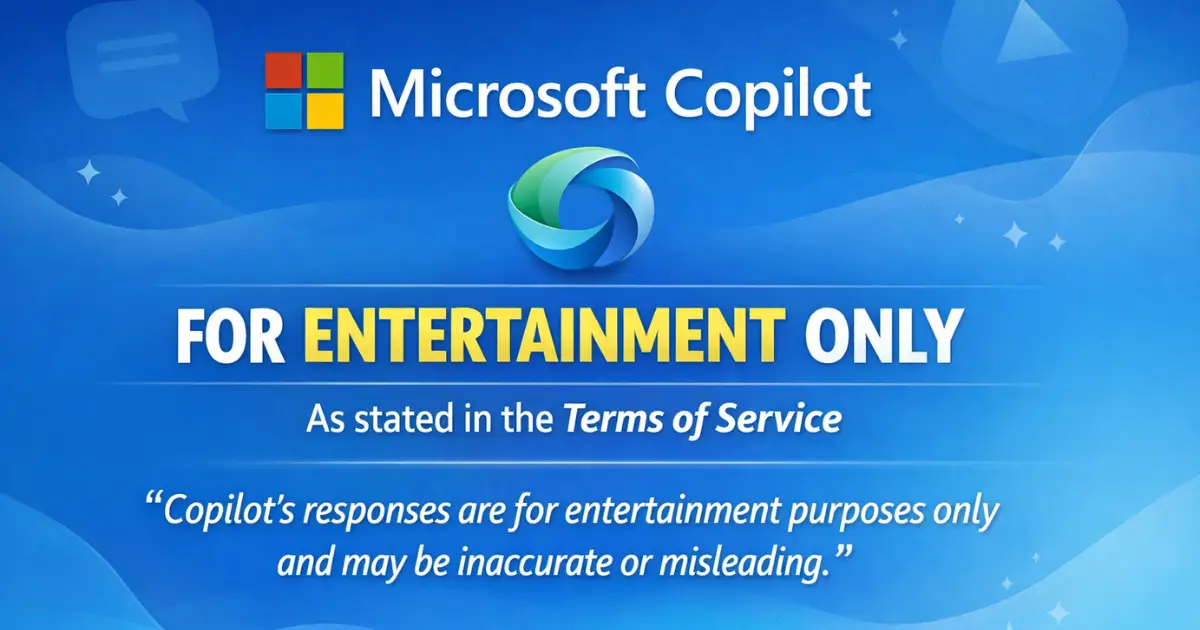
The tech giant is aggressively pushing its AI tool to enterprise customers — but its legal fine print tells a very different story. In what has quickly become one of the most talked-about revelations in the AI industry this week, Microsoft's popular AI assistant Copilot is described as being "for entertainment purposes only" in the company's own terms of use. The discovery, which gained rapid traction on social media, has sparked a lively debate about the gap between how AI companies market their products and how they legally define them.
What the Terms Actually Say
The terms of use for Copilot, which appear to have been last updated on October 24, 2025, contain a remarkably blunt warning: the tool is for entertainment purposes only, it can make mistakes, it may not work as intended, and users should not rely on it for important advice. The language essentially tells users that they are on their own if something goes wrong.
This is particularly striking given the context. Microsoft is currently focused on getting corporate customers to pay for Copilot, positioning it as an indispensable productivity tool for businesses worldwide. The company has invested billions in AI infrastructure, embedded Copilot across its Office suite, Windows, and enterprise platforms, and made it central to its growth strategy. Yet buried in the legal language is an admission that the tool is, officially speaking, not meant to be taken seriously.
Microsoft's Response
Once the terms went viral on social media, a Microsoft spokesperson told PCMag that the company plans to update what they described as "legacy language." The spokesperson explained that as the product has evolved, the wording no longer reflects how Copilot is actually used today and will be changed in the next update.
The response suggests that the terms were likely drafted during an earlier phase of the product's development — perhaps when Copilot was more of an experimental chatbot than the enterprise-grade tool Microsoft now claims it to be. Still, the fact that such language remained in place for months while the company aggressively marketed Copilot to Fortune 500 companies raises questions about oversight.
An Industry-Wide Problem
Microsoft is far from alone in this practice. As Tom's Hardware pointed out, other major AI companies use similar disclaimers. OpenAI's terms of use caution users not to treat its outputs as a "sole service of truth or factual information," while Elon Musk's xAI warns users against relying on its AI outputs as "the truth."
This pattern reveals a fundamental tension at the heart of the AI industry. These companies spend enormous sums marketing their tools as revolutionary, productivity-boosting, and even life-changing technologies. Simultaneously, their legal teams are carefully crafting terms that absolve the companies of responsibility when those same tools produce inaccurate, misleading, or outright fabricated information.
The Trust Paradox
This situation creates what might be called the AI trust paradox. On one hand, companies need users — especially paying enterprise clients — to trust their AI tools enough to integrate them into critical workflows. On the other hand, the technology is still fundamentally unreliable in ways that make blanket trust dangerous, and the companies know it.
AI models, including Copilot, still suffer from well-documented problems such as hallucinations, where the system generates plausible-sounding but entirely false information. They can confidently present incorrect data, fabricate sources, and provide advice that could be harmful if followed without verification. The legal disclaimers, however embarrassing they may be from a marketing perspective, exist because these risks are real.
What This Means for Users
The takeaway for everyday users and businesses alike is straightforward: AI tools are genuinely useful for many tasks, but they should never be treated as authoritative sources of truth. Whether it is Microsoft Copilot, ChatGPT, or any other AI assistant, the outputs require human verification — especially when the stakes involve medical, legal, financial, or safety-related decisions.
Microsoft has promised to update the wording of its terms, but changing the language does not change the underlying reality. AI is still a technology in progress, impressive yet imperfect. The irony is that the most honest thing these companies have said about their products may be hiding in the fine print that almost nobody reads.