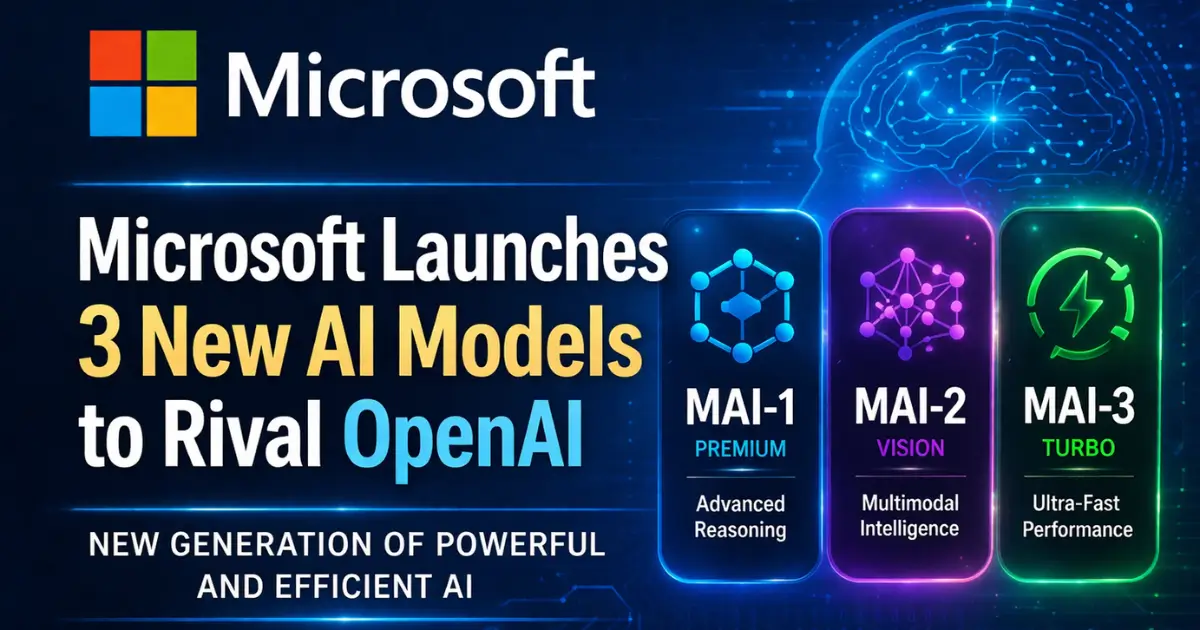
Microsoft is making it clear that it has no intention of sitting on the sidelines of the AI race. The tech giant's research division, Microsoft AI, has unveiled three brand-new foundational models capable of generating text, voice, and images — a bold move that puts the company in direct competition with rival labs like OpenAI and Google, even as it continues to pour billions into its partnership with OpenAI.
What Are the Three New Models?
The three models — MAI-Transcribe-1, MAI-Voice-1, and MAI-Image-2 — each target a different modality of AI-powered content generation.
MAI-Transcribe-1 is a speech-to-text model that supports 25 languages and is reportedly 2.5 times faster than Microsoft's existing Azure Fast transcription service. For businesses and developers relying on real-time transcription across multilingual environments, this could be a game-changer.
MAI-Voice-1 is an audio generation model that allows users to produce 60 seconds of audio in just one second. It also includes the ability to create custom voices, opening up significant possibilities for media, accessibility, and customer-facing applications.
MAI-Image-2, a video and image generation model, was initially released on MAI Playground — Microsoft's new testing platform for large language models — on March 19. All three models are now available through Microsoft Foundry, and the transcription and voice models are also accessible via MAI Playground.
Who Built Them?
The models were developed by Microsoft's MAI Superintelligence team, an advanced AI research group led by Mustafa Suleyman, the CEO of Microsoft AI. The team was officially formed in November 2025, and these releases represent its first major public output.
Suleyman framed the launch around what he calls "Humanist AI" — models designed with humans at the center, optimized for natural communication, and trained for practical, real-world use. He promised that more models would follow soon, both on the Foundry platform and embedded directly into Microsoft's suite of products and experiences.
How Do They Compare on Price?
In an increasingly competitive and crowded AI market, Microsoft is betting that affordability will be a key differentiator. The company claims its models are cheaper than comparable offerings from both Google and OpenAI.
MAI-Transcribe-1 starts at $0.36 per hour. MAI-Voice-1 is priced from $22 per million characters. MAI-Image-2 starts at $5 per million tokens for text input and $33 per million tokens for image output. For enterprise customers running high-volume AI workloads, these pricing tiers could offer meaningful savings compared to the competition.
What About the OpenAI Partnership?
The launch inevitably raises questions about Microsoft's complex and evolving relationship with OpenAI, the company it has invested over $13 billion in. Microsoft hosts OpenAI's models across its products through a long-standing multi-year partnership, yet is now openly building rival capabilities under the same roof.
Suleyman addressed this tension head-on, reaffirming Microsoft's commitment to OpenAI in recent interviews. He noted that a recent renegotiation of the partnership gave Microsoft the freedom to pursue its own superintelligence research more aggressively. In essence, Microsoft is taking a dual-track approach — building its own models while continuing to leverage and support OpenAI's technology.
This strategy mirrors what Microsoft has done with hardware, particularly AI chips. The company both manufactures its own custom chips and continues purchasing from outside suppliers like Nvidia and AMD.
The Bigger Picture
Microsoft's move signals a clear message to the industry: it intends to be a full-stack AI player, not just a distributor of someone else's technology. By developing proprietary models that are fast, multilingual, and competitively priced, Microsoft is building an independent AI identity that could reshape its position in the market.
As the AI arms race intensifies, the question is no longer who can build the best model — but who can build the most useful, affordable, and widely accessible one. With these three new releases, Microsoft has thrown its hat firmly into that ring, setting the stage for an even fiercer battle among the world's biggest tech companies in the months ahead.